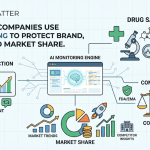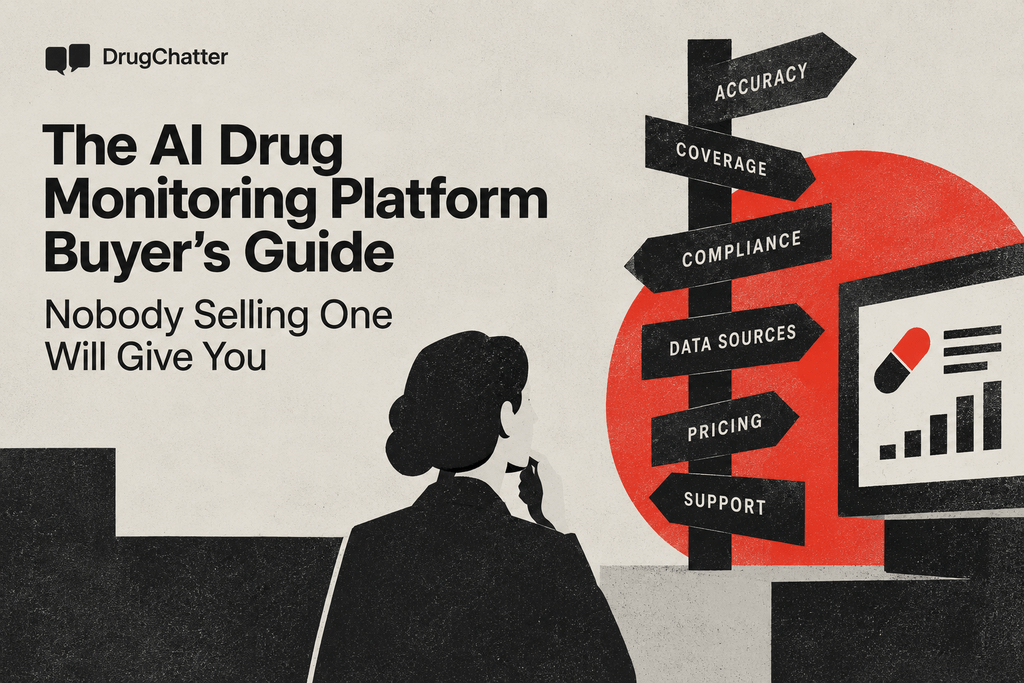
ChatGPT, Claude, and Gemini now field millions of medication questions a day. Here’s how pharma teams build a defensible, ongoing process for watching what these models actually say — and what that process can’t do for you.
Executive summary
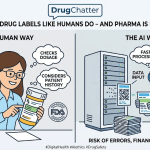
General-purpose AI models don’t read from your approved label — they synthesize answers from clinical literature, forums, patient discussions, and their own training data, often without signaling how confident or current that mix is. That creates real exposure: unapproved indications suggested as first-line options, dosing guidance without renal or weight adjustment, or safety warnings quietly dropped from an answer.
Monitoring this isn’t a one-time audit. It’s an operating discipline built on five parts: a structured prompt library, regular sampling across models, disciplined response capture, claim review against the label, and escalation to the right team. Done well, it gives Medical Affairs, Regulatory, PV, and Brand a shared, evidenced view of a drug’s AI narrative — not a way to control or approve what any model says.
Why this needs its own workflow
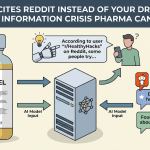
An analysis published in BMJ Quality & Safety reviewing chatbot answers to medication questions found that a large majority carried some potential for harm, with a meaningful share risking severe outcomes if a patient acted on the advice as given. The models weren’t malfunctioning — they were doing what general-purpose LLMs do: blending regulated label data with prescriber forums, pre-print abstracts, and anecdotal patient reports, and presenting the result in the same confident voice regardless of source quality.
That means an off-label suggestion, an omitted contraindication, or a hallucinated efficacy comparison can sit in front of a patient or clinician without anyone at the company knowing it happened — until it shows up in a complaint, an inspection finding, or a competitor’s win.
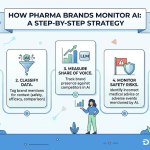
The five-part monitoring workflow
1) Prompt libraries
A versioned, reusable set of questions per drug — patient-phrased and clinician-phrased — covering indication, dosing, interactions, off-label use, and safety. Built once, expanded as real user questions and new labeling surface, so sampling isn’t reinvented every cycle.
2) Model sampling
Running the same prompt set across ChatGPT, Claude, Gemini, and other models patients actually use, on a fixed cadence. Models diverge from each other and update on their own independent schedules, so a single-model check tells you almost nothing about the others.
3) Response capture
Logging the exact response text, model and version, and timestamp for every sampled answer. This is the evidentiary record — the thing that lets a team show, months later, what a model actually said and when, rather than relying on memory of a screenshot.
4) Claim review
Comparing captured responses against the approved label, SPL data, and prescribing information to flag unsupported claims, missing safety language, incorrect dosing, or misstated competitor comparisons. Automated classification narrows the field; anything flagged still needs a medical or regulatory reviewer’s eyes before action is taken.
4) Escalation
Routing each flagged item to the team that owns it — with a documented trail of what was found, who reviewed it, and what was done — rather than letting findings sit in a shared inbox. Escalation paths should exist before the first finding arrives, not get improvised after one.
What this workflow does not do
- It does not remove, correct, or suppress content inside a third-party model — you’re documenting and managing exposure, not editing someone else’s system.
- A flagged error can resurface after it’s fixed once; models retrain and update on their own timeline, outside your control.
- It is not a regulatory submission activity and does not constitute, imply, or expedite regulatory approval or agency endorsement of any claim.
- It does not replace formal adverse-event intake. Anything surfaced during monitoring that looks like a genuine safety report still has to go through your normal pharmacovigilance case-processing channel.
What each team is watching for
Medical Affairs
Scientific accuracy of AI answers, evidence gaps against current literature, and the questions patients and HCPs are actually asking that go unanswered or answered poorly.
Regulatory Affairs
AI-generated claims that conflict with approved labeling, and where a model’s phrasing edges into promotional or off-label territory the company didn’t create but is still exposed to.
Pharmacovigilance
Emerging safety themes and adverse-event language in AI answers that may warrant formal signal review, separate from — and feeding into, not replacing — standard case intake.
Brand / Commercial
How the drug is positioned against competitors inside AI answers, share-of-voice shifts, and narrative drift as new trial data or forum chatter enters the model ecosystem.
Where DrugChatter fits in
Because model outputs drift as the underlying systems update, this can’t run as an annual audit — it has to run continuously to mean anything. DrugChatter operates the sampling, capture, and label-comparison layers described above as an ongoing service: simulating patient and physician queries across ChatGPT, Claude, Gemini, and other major models, classifying responses against structured label and SPL data, and routing findings into dashboards and briefings built for Medical Affairs, Regulatory, PV, and Brand teams specifically.
It’s built to give teams continuous visibility into their drug’s AI narrative and a documented trail of what was monitored and found — not to guarantee any particular model’s output, and not a substitute for a team’s own regulatory, medical, or safety judgment on what to do with a finding.See DrugChatter’s AI monitoring platform →
FAQ
Does monitoring stop a model from repeating an error?
No. You don’t control a third-party model’s weights or training data. Monitoring documents an issue and lets you manage exposure or respond with your own content and outreach — but a flagged answer can resurface until the model itself updates, on its own schedule.Is this the same as pharmacovigilance case reporting?
No. Treat anything surfaced during AI monitoring that resembles a genuine adverse-event report as a trigger for your standard AE intake process, not a replacement for it. The two should be connected, not merged.How often should sampling run?
It depends on the brand’s risk profile. Many teams run their core prompt set weekly and add ad hoc sampling around a label change, a new safety signal, or a competitive event.Does this help with regulatory approval or filings?
No. It’s an operational visibility and risk-management practice, not a regulatory submission activity, and it does not influence or expedite an approval decision.Which AI models actually need to be covered?
At minimum, the models patients and clinicians are most likely to be using — commonly ChatGPT, Claude, and Gemini — with coverage expanded as usage patterns shift toward other assistants.Who should own escalations once something is flagged?
Ownership is usually shared rather than centralized: Medical Affairs and Pharmacovigilance own accuracy and safety findings, Regulatory and Legal own label-conflict and promotional findings, and Brand owns competitive or narrative findings — tracked in one shared log so nothing falls through the gaps between teams.This guide is an operational overview and does not constitute regulatory, legal, or medical advice. AI monitoring supports internal decision-making and does not guarantee, imply, or expedite regulatory approval, and does not replace a company’s formal pharmacovigilance, regulatory, or medical review processes.