About two-thirds of practicing US physicians, roughly 650,000 people, now use a chatbot called OpenEvidence to help decide how to treat patients. In April 2026 alone, the service was queried during nearly 27 million clinical encounters. The product is free to physicians and funded by ads from drug and device companies.[1] A field rep calling on one of those physicians is no longer the only voice in the room, and in a growing number of cases is not even the first one.
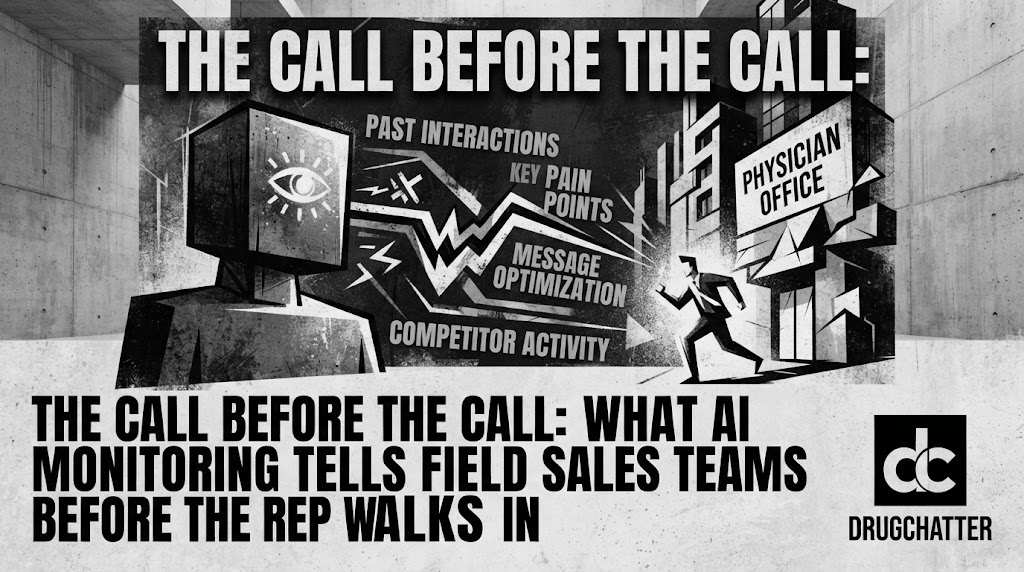
This changes what a field sales team needs to know before a call. It is no longer enough to know the label, the formulary status, and the competitor’s latest claim. Reps, their managers, and the medical affairs and compliance functions that support them now need to know what an AI system already told that physician, or that physician’s patient, about the drug being detailed.
The Short Answer
AI monitoring for field sales means systematically checking what ChatGPT, Gemini, Claude, Perplexity, and clinician-facing tools like OpenEvidence say about a company’s drugs and its competitors’ drugs, then routing anything that contradicts the approved label, omits a required safety statement, or shapes an HCP’s or patient’s expectations, to the people who plan calls, write call notes, and review promotional content. It is a new input to territory planning and objection handling, not a replacement for the label, the package insert, or a rep’s own product training.
Why Physician Access Was Already the Field Force’s Core Problem
AI did not create the access problem. It is landing on top of one that has been building for more than a decade. ZS Associates’ AccessMonitor found that the share of physicians considered broadly accessible to reps fell from 55% in 2013 to 51% in 2014, continuing a decline that had already cut the US rep headcount from a 2005 peak of roughly 101,800 to about 63,000.[7]
The pandemic accelerated the trend sharply. McKinsey’s 2020 analysis of HCP and pharma-rep interaction data found that reported contact frequency between physicians and pharma reps, including remote contact, fell by an average of 65% during the acute phase of COVID-19, a steeper drop than the corresponding decline in patient visit volume.[6] Access partly recovered afterward, but Veeva’s Pulse data, cited by the company’s VP of global business consulting in a 2026 interview, shows HCP access to pharma companies reverting from a post-pandemic high of 60% in 2022 to about 45% today, which Veeva frames as a correction after an overcorrection rather than a new low.[8]
Every hour a physician does not spend with a rep is an hour that gets filled by something else: a colleague, a conference abstract, a clinical decision-support tool, or, increasingly, a chatbot.
What the Data Shows: How Often Physicians and Patients Are Actually Asking AI
Physician-side adoption
The American Medical Association’s 2026 Physician Survey on Augmented Intelligence, fielded January 15 to February 2, 2026 among 1,692 physicians, found that 81% of physicians report using AI in their practice, up from 38% in the 2023 wave of the same longitudinal survey.[2] Separately, OpenEvidence, the ad-funded clinical AI tool built on content licensed from journals including NEJM and JAMA, reports that about 60% of its queries are clinical decision questions, where a physician describes a patient case and asks what to do.[1]
Accuracy has not kept pace with adoption. An unpublished December 2025 study cited by NBC News found OpenEvidence answered fewer than 45 out of 100 tougher medical questions correctly, despite the same model scoring a perfect result on the US Medical Licensing Examination.[1] That gap, between exam performance and performance on harder, less standardized clinical questions, is the same pattern that shows up in the drug-information-specific studies below.
Patient-side adoption
The West Health-Gallup Center on Healthcare in America surveyed more than 5,500 US adults between October and December 2025 and found that one in four adults, more than 66 million people, report using AI tools or chatbots for physical or mental health advice. Fifty-nine percent of recent AI users said they researched a topic before seeing a doctor and 56% said they researched after a visit; 46% said AI made them feel more confident asking their provider questions.[3]
A February 2026 Tebra survey of 803 US adults and 211 healthcare providers found that 38% of providers report patients regularly bring ChatGPT-generated summaries to appointments, and 37% of providers say patients have made serious health decisions based on ChatGPT output before ever consulting them. Providers were split on the net effect: 64% said patient AI use increases misinformation risk and 44% said it adds confusion to appointments, while 60% said genAI helps explain medical terms and 52% said it has value as a pre-visit prep tool.[4]
A 2026 KFF poll found that roughly a third of US adults turn to AI chatbots for health advice, and 19% specifically use AI to interpret lab results or medical test results. OpenAI has said that more than 300 million people ask health-related questions on ChatGPT every week, a global figure that is not specific to prescription drug information but signals the scale of the channel.[5]
“I’ll give them a recommendation and they’ll say, ‘Let me go ask AI,’ and I’m like, ‘Then why are you here?'”[5]
Where AI and the Approved Label Diverge
Adoption numbers only matter to a field team if the answers are wrong often enough, and in specific enough ways, to change what a physician or patient believes walking into a call. Two independent studies, run a year apart with different question sets, both found the same failure pattern: general background questions score well, and specific dosing and interaction questions score poorly.
Drug information specialists from Long Island University’s College of Pharmacy collected 45 real questions fielded by LIU’s own drug information service between January 2022 and April 2023, then tested them against ChatGPT and had a second investigator verify the answers against professional literature. The chatbot answered only 10 of 39 answerable questions satisfactorily. The three most common question types were therapeutics, compounding or formulation, and dosage, and the chatbot supplied references for only 8 of the 28 questions it directly addressed.[9]
A separate study of 80 questions across four categories, drug-drug interactions, adverse drug effects, drug dosage, and alternative therapies, found ChatGPT’s accuracy varied sharply by category: 30% on drug-drug interactions, 35% on drug dosage, 65% on adverse drug effects, and 85% on alternative therapies.[10]
The pattern in both studies is the same: the categories where a field rep’s product knowledge is most likely to be tested against a competitor, dosing and interaction questions, are exactly the categories where general-purpose AI performs worst. A rep who assumes a physician’s AI-informed baseline understanding is accurate on those points is working from a bad assumption.
Original analysis: reading the two studies together
Both studies used different models, question sets, and time windows, so their scores are not directly comparable as a single trend line. What they do agree on, independently, is the rank order of difficulty: interaction and dosage questions score lowest, and general or background questions score highest. That agreement across two unrelated studies is a stronger signal than either study’s individual accuracy percentage, and it is the piece of evidence a field team can actually act on: build call prep and objection-handling material around interaction and dosing questions first, because that is where an HCP’s AI-formed assumption is statistically most likely to need correcting.
The Compliance Line: What a Rep Cannot Say That an AI Chatbot Already Said
A physician who has already read an AI-generated summary that omits or softens a boxed warning creates a specific kind of pressure on the rep sitting across the desk: the temptation to match the tone of the room rather than the label. FDA’s Office of Prescription Drug Promotion (OPDP) has punished exactly that failure before, in a case that predates generative AI but defines the standard AI monitoring now has to protect against.
In October 2018, OPDP sent an untitled letter to Eisai after a complaint that one of its sales representatives gave a lunch presentation on Fycompa (perampanel) containing statements about off-label use, and that the rep minimized the drug’s boxed warning for homicidal ideation and aggressive behavior, telling attending clinicians they should not worry about it. OPDP characterized the statements as false and misleading and ordered Eisai to submit a full accounting of related promotional materials.[11]
That letter is nearly a decade old, but OPDP’s enforcement pace has only accelerated. Of the more than 200 total enforcement letters FDA issued in 2025, 74 went to pharmaceutical and biologic manufacturers, 10 of them warning letters and 64 untitled letters; all but five were issued after HHS and FDA announced a DTC advertising crackdown on September 9, 2025.[12] By late July 2026, OPDP was issuing untitled letters at a pace of roughly two per month for the year, including one to Viatris on July 13, 2026 over a convenience claim in a video advertisement for TOBI Podhaler (tobramycin inhalation powder) that had reportedly been in use since 2022.[13]
The Eisai letter is a warning specific to a scenario AI monitoring is built to catch before it recurs: a rep, under pressure to reassure a skeptical physician, drifts from the label. AI monitoring does not review what a rep says out loud. What it can do is show compliance and training teams which safety statements, warnings, and off-label questions AI tools are already surfacing to physicians, so call scripts and objection-handling guidance are built around the actual questions reps are getting, worded to stay inside the label rather than match whatever reassurance the AI gave.
Brand Visibility Before the Detail: What AI Already Told the Physician
Before a rep enters an exam room, an AI-informed physician may already have a mental ranking of which drugs in a category get mentioned first. 5W AI Communications’ Pharma/Rx AI Visibility Index, published in May and June 2026, ranked the top 25 pharmaceutical companies by modeled AI citation share across more than 60 patient and consumer prompts run against ChatGPT, Claude, Perplexity, Gemini, and Google AI Overviews in Q2 2026. Eli Lilly led with an estimated 12.5% citation share and Novo Nordisk followed at 11.5%, both driven by GLP-1 drugs; Pfizer (8.5%), Johnson & Johnson (7.0%), and Merck (6.0%) rounded out the top five. The index’s central finding is that citation share tracks the drugs patients self-research rather than DTC ad spend or company revenue: the US pharmaceutical industry spent an estimated $8 billion on DTC advertising in 2024, the largest single ad category in the country, yet Merck, maker of the world’s top-selling drug, ranked fifth in AI citation share.[14]
5W states plainly that its citation-share figures are directional estimates modeled from public data and observed retrieval patterns across a defined prompt set, not a comprehensive census of every AI query, so the numbers should be read as a snapshot of relative visibility rather than an exact market count.
For a field team, that gap between revenue and citation share is a targeting signal, not a vanity metric. A rep detailing a drug in a therapeutic area where the company’s AI citation share badly trails a competitor’s is walking into more calls where the physician’s or patient’s starting frame of reference favors someone else. That is useful information for account planning even when it changes nothing about the clinical message itself.
AI Monitoring as an Input to Territory and Account Planning
Field force technology is already being rebuilt around AI, though mostly on the operations side rather than the AI-monitoring side. Veeva launched AI Agents for Vault CRM in December 2025. ZS folded its ZAIDYN intelligence layer into Salesforce Agentforce in January 2026. PharmaForceIQ acquired Aktana the same month to build what it calls an “optichannel-in-a-box” platform. IQVIA introduced a Field Force Agent product in 2026 aimed at helping commercial and medical field teams prioritize actions and access real-time insights inside their existing CRM.[15][16]
None of that tooling, as currently marketed, is built to answer a narrower question: what is an AI chatbot telling the physicians on this territory about this drug, right now, this month. That is a distinct data feed from call-activity analytics, prescription data, or next-best-action scoring, and it currently has to be layered on rather than assumed to already be inside a CRM’s AI features. A territory plan built only on call history and Rx trends is blind to a shift in AI-citation share or a new AI-surfaced misconception until it shows up in a declining trend line weeks later.
What Different Functions Need From AI Monitoring Data
| Function | What they need to see | What they do with it |
|---|---|---|
| Field sales leadership | Territory- or account-level shifts in AI citation share and recurring AI-surfaced misconceptions | Adjust call priorities and pre-call briefing material |
| Individual reps | A short, current list of what AI tools are telling physicians about this drug and the top competitor | Objection handling, without departing from approved messaging |
| Medical Science Liaisons | AI-surfaced clinical or mechanism-of-action claims that need scientific exchange to correct | KOL engagement, unbranded scientific response |
| Marketing / Brand | Category-level citation share versus competitors and versus ad spend | Channel investment decisions, content gap identification |
| Regulatory / Compliance / Legal | Label misalignment patterns that could tempt reps into matching an AI tool’s off-label framing | Call-script and training updates, OPDP-facing documentation |
| Pharmacovigilance | AI-generated adverse-event or interaction claims inconsistent with the current label | Signal triage, distinct from and not a substitute for FAERS reporting |
What This Means for Field Sales Leadership
The practical output of AI monitoring for a sales leader is not a dashboard of AI mentions for its own sake. It is a short, recurring answer to one question: has anything an AI tool is telling physicians or patients about this drug or its main competitor changed since the last briefing cycle. A citation-share shift, a new AI-surfaced dosing misconception, or a competitor’s AI-amplified new indication are all reasons to update call prep before the next territory cycle, not after a quarter of missed calls explains why.
What This Means for Compliance and Regulatory Affairs
The Eisai/Fycompa letter and the accelerating 2025-2026 OPDP enforcement pace point to the same risk for AI-informed calls: a rep who feels pressure to sound as reassuring as the AI-generated summary a physician already read. Compliance teams reviewing call scripts and objection-handling material have a new, concrete input for that review: the actual AI-surfaced claims reps are encountering in the field, sourced from monitoring rather than anecdote, so script language can be tested against real AI-formed physician expectations before a rep improvises an answer that drifts off-label.
What This Means for Medical Science Liaisons
MSLs operate in unbranded scientific exchange, which gives them more room than reps to directly address an AI tool’s mischaracterization of a mechanism of action or a trial result with a key opinion leader. AI monitoring data tells an MSL team which claims are actually circulating among AI-informed physicians, rather than which claims medical affairs assumes are circulating, which changes what gets prioritized in KOL conversations and advisory board agendas.
Where a Tool Like DrugChatter Fits
DrugChatter’s AI-monitoring product tracks how AI systems describe specific drugs against the current prescribing information over time, which is the underlying data layer a field organization would need to build any of the function-specific views described above. It is one input among several, alongside call-activity data, prescription trends, and the field force platforms already in use, not a replacement for label review, MLR-approved messaging, or a rep’s own clinical training.
Limitations: What AI Monitoring Cannot Do
AI monitoring data describes what a chatbot said in response to a sampled set of prompts at a point in time. It cannot confirm that a specific physician read or believed a specific AI-generated answer, and it is not a substitute for FAERS-based pharmacovigilance signal detection, for MLR review of a company’s own promotional materials, or for a rep’s direct read of the room. Citation-share figures like 5W’s index are explicitly modeled estimates from a defined prompt set rather than a census of all AI traffic, and accuracy studies like the LIU/ASHP and Middle East University research reflect the specific models, question sets, and time windows tested, not a permanent verdict on any AI system’s current performance. AI models are also updated frequently, so a monitoring finding from one month does not guarantee the same answer appears the next.
Key Takeaways
- Roughly two-thirds of US physicians now use the ad-funded clinical AI tool OpenEvidence, which logged nearly 27 million clinical encounters in April 2026 alone.[1]
- Physician AI adoption reached 81% in the AMA’s 2026 survey, more than double the 38% reported in 2023.[2]
- More than 66 million US adults report using AI chatbots for health advice, and a February 2026 survey found 37% of providers say patients have made serious health decisions based on ChatGPT before ever consulting them.[3][4]
- Two independent accuracy studies, run with different models and question sets, both found AI chatbots perform worst on drug-drug interaction and dosage questions and best on general background questions, the same rank order in both studies.[9][10]
- A 2018 OPDP untitled letter against Eisai, for a sales rep who minimized a boxed warning to match an audience’s expectations, defines the compliance risk AI monitoring is built to help prevent as AI-informed physician expectations become more common.[11]
- 5W’s 2026 index found AI citation share does not track DTC ad spend or company revenue: Merck, maker of the world’s top-selling drug, ranked fifth in pharma AI citation share behind Eli Lilly and Novo Nordisk.[14]
FAQ
Do pharma reps still matter if physicians are getting drug information from AI?
Yes. AI adoption is high among physicians, but the accuracy studies above show it is inconsistent on exactly the questions, dosing and interactions, where a rep’s product training adds the most value. The data points to a changed starting point for calls, not a redundant rep.
How is AI monitoring for field sales different from AI monitoring for brand marketing?
Brand marketing monitoring typically tracks category-level citation share and DTC-facing claims. Field sales monitoring is narrower and more operational: it is about surfacing the specific claims and misconceptions individual reps and MSLs are likely to encounter on calls, at the territory or account level.
Can a rep legally correct what a patient’s AI chatbot told them?
Reps can and should stay within FDA-approved labeling and company-approved messaging when responding to any question, whatever its source. OPDP’s 2018 Eisai letter shows the risk of improvising outside the label under social pressure; it does not change what a rep is permitted to say.[11]
What is OpenEvidence, and why does it matter to field sales teams specifically?
OpenEvidence is a clinician-facing AI tool used by an estimated two-thirds of US physicians, funded by advertising from drug and device companies, and used most often for clinical decision questions.[1] Because it is ad-funded, it is already a paid channel for many pharma companies, which makes monitoring what it actually tells physicians a natural extension of monitoring any other paid channel’s performance.
Are AI chatbots more accurate on some drug-information questions than others?
Yes. Two separate studies found chatbots scored far higher on general background questions than on drug-drug interaction or dosage questions, a consistent pattern across different models and question sets.[9][10]
Has FDA issued guidance specific to sales reps referencing AI-generated content?
Not specifically. FDA and EMA issued joint AI guiding principles in January 2026, and OPDP’s 2025-2026 enforcement wave has focused on DTC advertising rather than field-rep conduct, but the FD&C Act’s existing prohibition on false or misleading promotional statements, the standard applied in the 2018 Eisai letter, applies regardless of what a rep’s information source was.[11][12]
Does higher AI citation share mean a drug is more clinically effective?
No. 5W’s index found citation share tracks which drugs patients self-research online, not clinical superiority, sales rank, or DTC ad spend; Merck’s top-selling Keytruda ranked below Eli Lilly and Novo Nordisk’s GLP-1 franchises in AI citation share despite Keytruda’s revenue lead.[14]
Should MSLs and sales reps use the same AI monitoring data?
They can draw on the same underlying data, but MSLs typically need it framed around mechanism-of-action and trial-result claims for unbranded scientific exchange, while reps need it framed as objection-handling input that stays inside approved, branded messaging.
How often should AI-generated drug information be re-checked?
AI models update frequently, and the accuracy studies cited here reflect specific models tested at specific points in time, so a monitoring finding is a snapshot rather than a permanent result. Territory-level briefing cycles are a reasonable minimum re-check interval for an active field program.
Is patient use of AI chatbots actually changing what happens in the exam room?
Survey data suggests yes for a meaningful share of visits. A February 2026 Tebra survey found 38% of providers report patients regularly bring ChatGPT-generated summaries to appointments, and 37% say patients have made serious health decisions based on ChatGPT output before consulting them.[4]
References
- NBC News, reported via BoingBoing. “Two-thirds of US doctors now ask an AI chatbot for treatment advice.” May 18, 2026. https://boingboing.net/2026/05/18/two-thirds-of-us-doctors-now-ask-an-ai-chatbot-for-treatment-advice.html
- American Medical Association Center for Digital Health and AI. “2026 Physician Survey on Augmented Intelligence,” reported in The ASCO Post. March 2026. https://ascopost.com/news/march-2026/ama-survey-finds-rapid-growth-in-physician-ai-adoption/
- West Health-Gallup Center on Healthcare in America survey, reported via Epocrates. “Millions of Americans now turn to AI for health advice before seeing a doctor.” April 16, 2026. https://www.epocrates.com/online/article/millions-of-americans-now-turn-to-ai-for-health-advice-before-seeing-a-doctor
- Tebra. “How patients and providers use ChatGPT in care,” reported via eMarketer. “ChatGPT is showing up in patient appointments, healthcare providers report.” February 2026. https://www.emarketer.com/content/chatgpt-showing-up-patient-appointments–healthcare-providers-report
- KFF 2026 poll, reported via TO VIMA (Wall Street Journal syndication). “Doctors don’t want patients to read test results with AI. They’re doing it anyway.” 2026. https://www.tovima.com/wsj/doctors-dont-want-patients-to-read-test-results-with-ai-theyre-doing-it-anyway/
- McKinsey & Company. “COVID-19 and commercial pharma: Navigating an uneven recovery.” https://www.mckinsey.com/industries/life-sciences/our-insights/covid-19-and-commercial-pharma-navigating-an-uneven-recovery
- Pharmaceutical Commerce. “Pharma rep access: down, down, down,” citing ZS Associates AccessMonitor data. July 22, 2014. https://www.pharmaceuticalcommerce.com/view/pharma-rep-access-down-down-down
- Pharmaceutical Executive. “HCP access drops: connected field engagement,” interview with Dan Rizzo, Veeva Systems, citing Veeva Pulse data. 2026. https://pharmexec.com/view/hcp-access-drops-connected-field-engagement-dan-rizzo
- Drug Topics. “ChatGPT provides inaccurate responses to questions about drug information,” reporting on Long Island University College of Pharmacy research presented at ASHP 2023 Midyear. https://www.drugtopics.com/view/chatgpt-provides-inaccurate-responses-to-questions-about-drug-information
- Middle East University. “The promise and challenges of ChatGPT in community pharmacy: A comparative analysis of response accuracy.” Published January 30, 2024. https://zenodo.org/records/10604814
- Regulatory Affairs Professionals Society (RAPS). “OPDP Sends Untitled Letter to Eisai for Sales Rep’s Off-Label Comments.” October 17, 2018. https://www.raps.org/resource/opdp-sends-untitled-letter-to-eisai-for-sales-rep.html
- King & Spalding. “2025 Year in Review: FDA Drug and Device Advertising and Promotion Enforcement.” January 21, 2026. https://www.kslaw.com/insights/articles/2025-year-in-review-fda-drug-and-device-advertising-and-promotion-enforcement
- FDA Law Blog. “OPDP Issues Its 20th and 21st Untitled Letters for 2026 (yawn).” July 28, 2026. https://www.thefdalawblog.com/2026/07/opdp-issues-its-20th-and-21st-untitled-letters-for-2026-yawn/
- 5W AI Communications. “Pharma / Rx AI Visibility Index 2026.” May-June 2026. https://5wpr.com/ai-visibility-index/pharma-rx-ai-visibility-index-2026/
- Tellius. “Best AI Platforms for Pharma Field Force Effectiveness in 2026: 10 Platforms Compared.” February 19, 2026. https://www.tellius.com/resources/blog/best-ai-platforms-for-pharma-field-force-effectiveness-in-2026-10-platforms-compared
- IQVIA. “Embracing intelligence to meet new field engagement challenges.” June 16, 2026. https://www.iqvia.com/library/articles/embracing-intelligence-to-meet-new-field-engagement-challenges