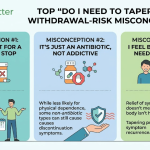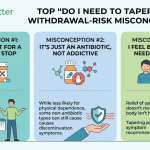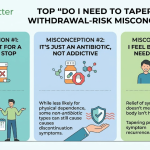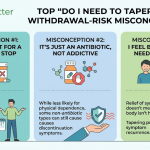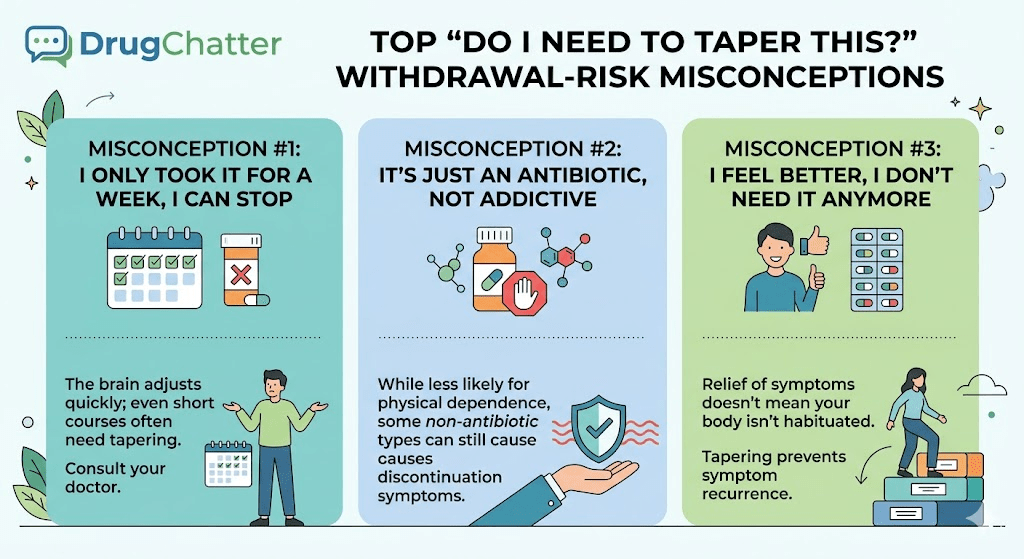
There’s a particular kind of anxious logic that shows up whenever someone misses a dose, runs out of a prescription, or decides to “stop for a while”: Do I need to taper this? Most clinicians would rather prevent a problem than chase it—so the question is reasonable. The trouble is that the internet is full of tidy rules that don’t quite match pharmacology, and they can lead people either to taper when they don’t need to, or to stop when they absolutely should not.
Below are the most common withdrawal-risk misconceptions—framed the way patients tend to experience them—along with the kind of practical, harm-reducing thinking that actually helps.
1) “If it’s a long-term medication, it always needs a taper.”
Long-term use can increase the chance that stopping abruptly will cause a rebound or withdrawal-like syndrome—but “long-term” is not the same thing as “taper-required.” Some drugs have effects that wear off smoothly; others can produce discontinuation symptoms due to neuroadaptation, receptor changes, or physiologic counter-regulation.
The more misleading version of this myth is the reflexive conclusion: duration automatically equals danger. The better approach is to identify whether the medication is known for discontinuation effects and what syndrome is expected.
2) “Side effects that happened early are the withdrawal symptoms.”
This one is sneaky. Patients who feel awful after missing doses sometimes assume the symptoms represent “withdrawal,” but the timing can be consistent with the medication simply not being there, worsening of the underlying condition, or overlapping adverse effects.
For example, with some commonly discussed therapies, the real question is what the medication was treating versus what the body is doing when the drug level falls. If you conflate the two, you can misjudge both urgency and the correct next step.
3) “Tapering fixes everything—so any taper plan is fine.”
Tapering is not a magic incantation. A taper can be too fast, too slow, or not tailored to the drug’s half-life and mechanism. Some regimens rely on smaller step-downs, others on timing adjustments, and some discontinuation syndromes don’t respond well to casual “cut the dose in half” strategies.
And even when tapering is appropriate, it doesn’t replace clinical monitoring—especially when the medication is for a condition where abrupt destabilization is itself risky.
4) “If I feel okay after stopping, I was safe to stop.”
Discontinuation symptoms aren’t always immediate. Some syndromes show up days later, or they start mildly and then intensify. A short “I stopped and nothing happened yet” window can create false reassurance.
The cautious way to think about this is: the absence of symptoms early does not prove the absence of risk. You want a plan for what to watch for and when to contact a clinician.
5) “The safest move is to stop and ‘see what happens’.”
This is the most expensive misconception, because “seeing what happens” can mean losing control of symptoms or triggering a physiologic rebound that would have been avoidable.
When in doubt, the safer path is to treat discontinuation as a medical decision: confirm the expected discontinuation profile, ask whether a taper is recommended, and use a schedule that matches the pharmacology.
6) “Withdrawal risk is the same as drug interactions and spacing rules.”
Another common confusion: discontinuation risk is about stopping, while interaction risk is about how drugs affect each other while both are present. People often bundle these topics into one vague fear—then make the wrong kind of adjustment.
For instance, many medication questions on the drugchatter site focus on spacing and effectiveness. A representative example: a recurring theme with lipitor-related timing concerns includes guidance like “what’s the recommended time gap between lipitor and lemon water?” https://www.drugchatter.com/chat/60456/what’s-the-recommended-time-gap-between-lipitor-and-lemon-water and whether timing or food/drink could reduce efficacy https://www.drugchatter.com/chat/50866/can-lipitor’s-effectiveness-be-reduced-by-lemon-water.
Those questions are valuable—but they’re not the same as asking whether you must taper a drug to avoid discontinuation symptoms.
7) “If a clinician doesn’t mention tapering, it’s probably unnecessary.”
Sometimes this reflects good practice: a drug truly may be safe to stop without a taper. But sometimes it reflects a time-pressured visit, incomplete medication history, or a lack of emphasis. The correct takeaway isn’t to assume “no taper needed”—it’s to ask.
Even a simple question can prevent the most common harm: stopping abruptly without knowing the drug’s discontinuation characteristics.
So what should you do when you ask: ‘Do I need to taper this?’
- Don’t rely on generalizations. Duration and personal intuition are not reliable indicators.
- Identify the medication and the indication. Mechanism matters, but the clinical context matters too.
- Ask explicitly about discontinuation. “What symptoms should I expect if I stop?” “Is tapering recommended?” “What schedule would you use?”
- Plan for monitoring. Know what changes are expected versus what should trigger urgent contact.
Stopping (or resuming) medication is one of those areas where common sense often loses to chemistry. The goal isn’t to live in fear of withdrawal—it’s to avoid the two extremes: quitting abruptly when tapering is appropriate, or tapering in a panic when it isn’t.
If you want to sanity-check medication-specific concerns, the DrugChatter archive is heavy on question-and-answer threads about medication behavior, timing, and risks (for example: azacitidine timing https://www.drugchatter.com/chat/59060/azacitidine-injected-at-12-37pm-yesterday-how-much-earlier-can-i-administer-today-s-dose, and lipitor-related timing/effectiveness https://www.drugchatter.com/chat/36535/can-bananas-interfere-with-lipitor’s-effectiveness), which can help separate “timing/effect” questions from “discontinuation/taper” questions.
Bottom line: the safest move is to treat “Do I need to taper this?” as a medication-specific question—not a generic one.