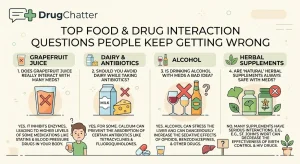
Top food and drug interaction questions people keep getting wrong
Every week, the same themes show up in patient questions: “Can I mix this with that?” “Does timing matter?” “Will my favorite food or supplement ruin the medication?” Sometimes the answer is reassuring. Sometimes it’s a clear “no.” And sometimes the real problem isn’t the interaction at all—it’s the misunderstanding behind the question.
Below are some of the most common interaction-related questions people keep getting wrong, with the original discussion links so you can see the details in context.
1) “Alcohol is just alcohol—does it really change how antibiotics work?”
People often treat alcohol as a separate issue from antibiotics, but absorption and tolerability can be affected. If you’re wondering about the impact of drinking on antibiotic absorption, start here: How does alcohol consumption impact antibiotic absorption?
2) “If I take a statin, food doesn’t matter that much.”
That’s a convenient belief, but it’s not always true—especially with high-fat meals. The questions that come up repeatedly are about whether fatty foods blunt or change statin performance:
4) “Supplements and ‘healthy’ add-ons can’t possibly interfere.”
People assume that because something is sold as wellness, it’s automatically interaction-free. But supplements can still change how a drug behaves—or how side effects show up. A few examples that come up:
11) “If I’m allergic or intolerant, it’s always obvious—so I don’t need to ask.”
Sometimes people don’t realize that symptoms can overlap with other issues. If you’re trying to identify what might be a medication allergy, this is a common starting point:
Most “interaction” problems aren’t solved by guessing. They’re solved by checking timing, food context (especially fat), OTC add-ons, and your own baseline health (liver function, age, recovery needs). If you’re unsure, the safest move is to ask—specifically about the combination you’re considering—before you take it.
And if you’re looking for the exact answers behind these recurring misunderstandings, the links above are the place to start.