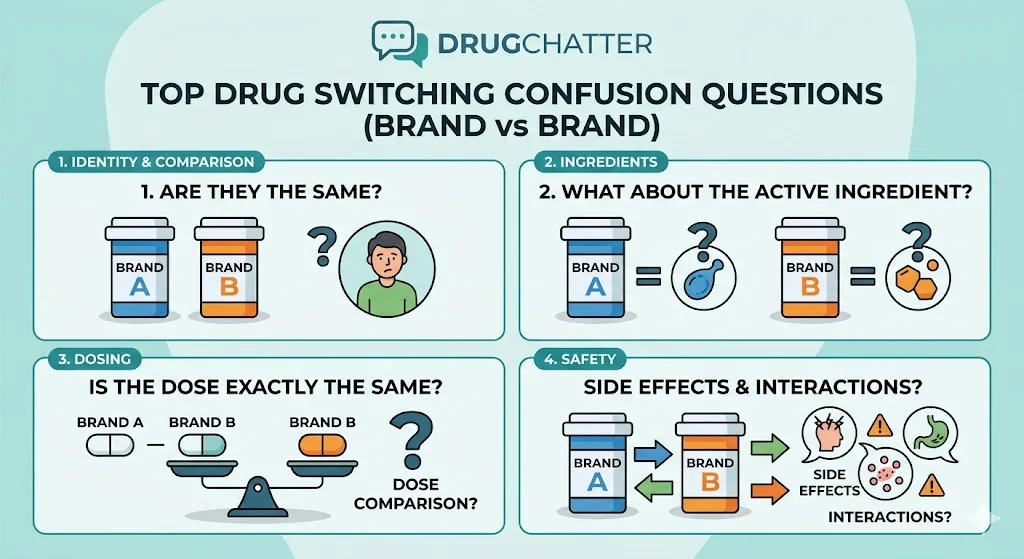
Drug switching is supposed to be boring: same active ingredient, same job, fewer headaches. But in the real world—formularies, insurance rules, pharmacy substitutions, and “equivalent” products that aren’t quite equivalent—people keep asking the same questions. Here are the ones that show up most often when the issue is brand vs brand, and the answers that help cut through the noise.
1) “Is this really the same drug?” (Wegovy vs Ozempic)
When people hear “semaglutide,” they assume the rest is interchangeable. It isn’t always that simple—especially when you’re comparing two branded products with different dosing/packaging and cost structures. If you’re trying to understand the practical difference, start here:
2) “What happens if I change the schedule?” (Switching to evening Ozempic injections)
Sometimes the “switch” isn’t to a different brand—it’s to a different routine. Patients worry that changing timing could change effects, tolerability, or how well the regimen fits their life. This question captures that anxiety directly:
3) “Is the generic the same as the brand?” (Ruxolitinib—Apotex’s version and timing)
Brand-vs-brand confusion often bleeds into brand-vs-generic confusion, especially when patients see a familiar drug name and then encounter a different manufacturer. For ruxolitinib, the questions tend to cluster around whether/when a competitor’s version became available and what that means for patients:
4) “If the active ingredient is the same, why do I feel different?” (The hidden role of formulation and excipients)
Even when the active ingredient is the same, people can react differently to the “inactive” parts—fillers, binders, delivery mechanics, and other formulation details. That’s why questions about inactive ingredients and formulation comparisons keep surfacing:
5) “Does switching change how well it works?” (When brand changes collide with lifestyle and absorption)
Sometimes the “brand switch” is blamed for what is really a diet/timing interaction. But patients don’t care about the taxonomy—they care about outcomes. If you’re trying to understand whether the surrounding conditions can change effectiveness, these questions show the pattern:
6) “Is it just cost?” (Because cost drives substitutions)
Cost isn’t a side issue—it’s often the reason the switch happens in the first place. If you want to understand how money can translate into pharmacy reality, this is the kind of question that matters:
7) “What if the switch is to a different product line?” (Xolair patent questions—availability and substitution pressure)
When patents expire or change hands, the market shifts. That can lead to more options, more substitutions, and more “is this the same thing?” questions. For xolair, the patent-related confusion shows up as:
Brand-vs-brand questions keep recurring because patients are trying to reconcile three things at once: (1) what the label says, (2) what the pharmacy hands them, and (3) what their body does afterward. The best way to reduce the chaos is to ask the specific question that matches your situation—cost, timing, formulation, or availability—and then verify with your clinician or pharmacist if anything changes.
If you want to go deeper, the links above are the most direct “start here” answers to the recurring confusion points.