Somewhere right now, a patient is asking ChatGPT whether they can take metformin with their new blood pressure medication. A physician is querying Perplexity for a quick reference on semaglutide dosing titration. A caregiver is asking Claude whether Humira or Skyrizi is better for moderate plaque psoriasis.
None of those interactions appear in any pharmaceutical company’s brand tracking report. None of them generate a MedWatch submission. None of them are captured by traditional social listening tools. And every single one carries brand, regulatory, and safety implications that pharma companies are only beginning to understand.
The scale of the problem is not theoretical. DrugChatter, a purpose-built LLM monitoring platform for the pharmaceutical sector, has documented thousands of instances where major AI systems produce factually incorrect drug information — wrong contraindications, outdated black box warning language, confused generic-to-brand mapping, and in some cases, dosing instructions that are clinically dangerous.
“More than 60% of drug-related queries submitted to popular AI chatbots in a 2024 audit produced at least one factual inaccuracy — including incorrect dosing, wrong drug class, or fabricated drug interaction warnings.” — Journal of the American Medical Informatics Association, 2024
For pharmaceutical brand teams, medical affairs officers, and regulatory compliance leads, that number is a liability inventory waiting to be discovered.
This article maps the full operational risk landscape — from FDA exposure to brand erosion — and explains what a credible AI drug content monitoring program actually looks like in 2025.
Why AI Has Become a Primary Drug Information Channel
Search behavior shifted faster than most pharma marketing departments anticipated. Google’s AI Overviews now appear above organic results for nearly every drug-related query. Perplexity has become the default research tool for a growing segment of health-literate consumers. ChatGPT reached 200 million weekly active users in early 2025, and a significant portion of those sessions involve health and medication questions.
The old model — patient Googles drug name, reads FDA label or WebMD, maybe calls their pharmacist — no longer describes how most people access drug information. LLM-based systems now synthesize, summarize, and deliver drug content in conversational form, without citation friction and without the disclaimers that traditional health content sources are required to include.
That creates a structural asymmetry. Pharmaceutical companies invest heavily in label language, physician education, and DTC advertising to shape how their drugs are perceived. Then an LLM trained on a mixture of Reddit threads, academic abstracts, and three-year-old news coverage delivers a competing narrative — at scale, in real time, with no editorial oversight and no regulatory filter.
How Patients Are Actually Asking About Drugs in AI Chat
Patient queries to AI systems look nothing like branded search. They don’t type “Ozempic side effects.” They type: “I’ve been on Ozempic for six weeks and my stomach still hurts every time I eat, is that normal or should I stop?” That query — conversational, symptom-specific, dosed with anxiety — is what LLMs are responding to.
The responses they generate draw from whatever patterns exist in training data. If Reddit’s r/diabetes and r/loseit have thousands of threads discussing nausea on semaglutide, the LLM reflects that. If a 2022 NEJM paper describing gastroparesis in GLP-1 users was widely cited, the LLM may reproduce that framing — potentially without the clinical context that makes it accurate.
Pharma brand teams optimized for traditional search intent are systematically unprepared for this conversational query layer.
What Physicians Are Asking AI About Your Drug
Physician use of AI tools is accelerating. A 2024 survey by the American Medical Association found that 38% of physicians reported using AI assistants for clinical reference at least weekly, up from 14% in 2022. They’re asking about dosing algorithms, drug-drug interactions, label updates, and off-label evidence — the exact categories where LLM accuracy is most variable and most consequential.
A physician who asks Claude about the recommended titration schedule for tirzepatide in a patient with moderate renal impairment and receives a plausible but incorrect answer is not a hypothetical. Medical affairs teams at Eli Lilly should care about that exchange as much as they care about a misprint in a detail aid.
Can AI Hallucinations Trigger FDA Regulatory Risk?
This is the question pharma legal and regulatory teams are circling carefully, and the answer is more nuanced than most published commentary acknowledges.
The FDA’s authority over prescription drug promotion derives primarily from the FD&C Act and 21 CFR Part 202. Those regulations apply to “labeling” and “advertising” — defined categories that have historically required a human sponsor acting with commercial intent. An LLM generating a hallucinated dosing instruction is not, by itself, a regulatory violation by the drug manufacturer.
But that framing misses three meaningful exposure pathways.
The Awareness Problem: When Knowing Creates Duty
If a pharmaceutical company’s pharmacovigilance team becomes aware — through any channel — of drug misinformation circulating at scale, existing post-market surveillance obligations arguably create a duty to respond. The FDA’s post-market safety reporting requirements under 21 CFR 314.81 require companies to report any information suggesting their product may present risks not previously identified. If AI-generated content is producing widespread false safety claims, and the company knows it, inaction is a documented choice.
That documentation will exist in internal emails, monitoring dashboards, and brand team meeting notes. In litigation or an FDA inspection, it will be discoverable.
The Training Data Problem: Did Your Content Feed the Hallucination?
LLMs are trained on public web content. Every press release, every product website, every journal article a pharma company published or funded is part of the corpus that shapes what LLMs say about their drugs. If a company published promotional content that was technically accurate at the time but has since been superseded by updated label language — and an LLM is still reproducing the older framing — the company has a brand problem that carries regulatory texture.
The FDA’s Office of Prescription Drug Promotion has issued warning letters for exactly this category of outdated promotional material left visible on company websites. The standard does not obviously change because the retrieval mechanism is now a neural network rather than a human visitor.
The Misbranding Exposure: Third-Party AI as Indirect Promotion
The FDA has signaled, through its 2023 and 2024 draft guidance documents on digital health and social media, that it is watching how companies interact with AI-generated drug content. If a pharmaceutical company’s social media team engages with, amplifies, or fails to correct AI-generated content about their drug on public platforms, the OPDP may treat that engagement as complicity in the dissemination of misleading promotional material.
That’s a narrow read, but it’s the direction regulatory thinking is moving. Companies that have not established formal protocols for responding to AI-generated drug content are operating without a policy in an area where policy will eventually be required.
How Often Claude Mentions Ozempic vs. Wegovy — and Why That Gap Matters
Ozempic and Wegovy contain the same active ingredient — semaglutide — manufactured by Novo Nordisk. Ozempic is approved for type 2 diabetes. Wegovy is approved for chronic weight management. They are clinically distinct products with different label indications, different dosing schedules, and different reimbursement profiles.
In LLM outputs, that distinction frequently collapses.
When users ask AI systems about weight loss injections, GLP-1 drugs, or “the Ozempic drug,” the responses routinely conflate the two products, attribute Wegovy’s weight loss data to Ozempic, and describe off-label use of Ozempic for weight loss without the clinical nuance that would accompany a responsible physician consultation.
For Novo Nordisk, this creates a specific brand problem: Ozempic’s association with weight loss in AI outputs may be accelerating off-label prescribing demand in a way that complicates Wegovy’s market positioning — and that the company did not engineer and cannot easily correct.
Tracking the frequency and framing of Ozempic vs. Wegovy mentions across ChatGPT, Gemini, Claude, and Perplexity is not a vanity metric. It’s a leading indicator of prescriber confusion, off-label pressure, and reimbursement friction that will show up in claims data months later.
Tracking Share of Voice Across ChatGPT, Gemini, and Claude
Share of voice in AI search is structurally different from traditional paid or organic search share. There’s no keyword auction. There’s no PageRank signal you can optimize directly. LLM share of voice reflects the intersection of training data volume, source authority, and query framing — a combination that pharmaceutical companies can influence indirectly but not control.
What they can do is measure it. Platforms like DrugChatter submit structured query sets to major LLMs — the same queries, repeated across models, at regular intervals — and capture how frequently a given brand is mentioned, in what clinical context, with what accuracy, and against which competitors.
That data answers questions that no existing pharma analytics tool addresses:
- When a physician asks Perplexity about first-line treatment for HR+ HER2- breast cancer, does it mention Kisqali or Ibrance first?
- When a patient asks ChatGPT about psoriasis biologics, does Skyrizi appear before Tremfya?
- When Claude answers a question about SGLT2 inhibitors for heart failure, does it cite the DAPA-HF trial or the EMPEROR-Reduced trial — and which drug does it associate with each?
These are not abstract brand preference questions. They map directly to prescriber behavior and patient advocacy in markets where the clinical evidence is roughly equivalent and brand selection is increasingly influenced by information asymmetry.
Do LLMs Recommend Generic Drugs More Often Than Branded Versions?
The short answer: it depends on the query, and the pattern is not random.
LLMs trained on cost-focused health content — which is the dominant register of consumer health writing — show a systematic tendency to frame generics favorably when users ask about drug costs, insurance coverage, or equivalent alternatives. When a patient asks whether there is a cheaper version of Jardiance, most major LLMs will describe empagliflozin generics even though as of early 2025 the patent has not fully expired and bioequivalent generics are not broadly available in the U.S. market. That’s a hallucination with commercial consequences.
For branded pharmaceutical companies, this generic substitution bias in AI outputs is a meaningful competitive threat. It’s not driven by a competitor’s marketing — it’s driven by statistical patterns in training data. And it requires a monitoring approach specifically designed to detect substitution framing, not just brand mention volume.
Why ChatGPT Gets Drug Side Effects Wrong — and How Pharma Should Respond
LLMs generate text by predicting likely continuations of input sequences. They do not retrieve from a live database of FDA-approved labeling. They do not know what the current prescribing information says for a drug whose label was updated six months ago. They have no mechanism to flag outdated information or distinguish between a phase 2 trial signal and a confirmed post-market adverse event.
This produces a specific failure mode: LLM drug safety information tends to lag real-world knowledge by 12 to 24 months, overstates rare adverse events that received heavy media coverage, understates common adverse events that are clinically well-managed, and conflates drug class effects with individual drug profiles.
Documented Hallucination Patterns in Drug Safety Responses
Several categories of hallucination appear with disproportionate frequency in drug safety responses from major LLMs:
- Black box warning misattribution: LLMs frequently assign black box warnings from one drug in a class to other drugs in the same class that do not carry that warning. The FDA’s REMS requirements for isotretinoin, for example, are sometimes incorrectly described as applying to other acne medications.
- Discontinued drug information: LLMs trained on pre-2023 data continue to describe drugs that have since been withdrawn from the market, with no indication that the information is outdated.
- Interaction fabrication: Drug-drug interaction data in LLM responses is among the least reliable category of AI drug content. Interactions may be fabricated, overstated, or based on theoretical mechanisms that lack clinical confirmation.
- Dosing transposition: Maximum daily doses are frequently stated incorrectly, sometimes by a factor of two, particularly for drugs with weight-based or renally-adjusted dosing protocols.
What Pharma Brand Teams Can Learn From Reddit AI Citations
When Perplexity or ChatGPT cites Reddit as a source for drug information — and they do, with greater frequency than pharmaceutical companies prefer — the citation reveals something important: the query didn’t match a high-authority clinical source in the model’s retrieval layer, so it fell back on high-engagement social content.
That’s a content gap signal. If a patient asks whether Humira causes hair loss and the AI response cites a 2019 r/rheumatoid thread rather than AbbVie’s prescribing information or a PubMed meta-analysis, the pharmaceutical company has a structured content gap at that specific query. They have not produced accessible, indexable, AI-retrievable content that answers that question clearly.
Identifying those gaps — systematically, across hundreds of drug-specific queries — is one of the highest-ROI activities available to pharma digital health teams right now.
Can AI Outputs Be Used for Pharmacovigilance? The Case for Structured LLM Surveillance
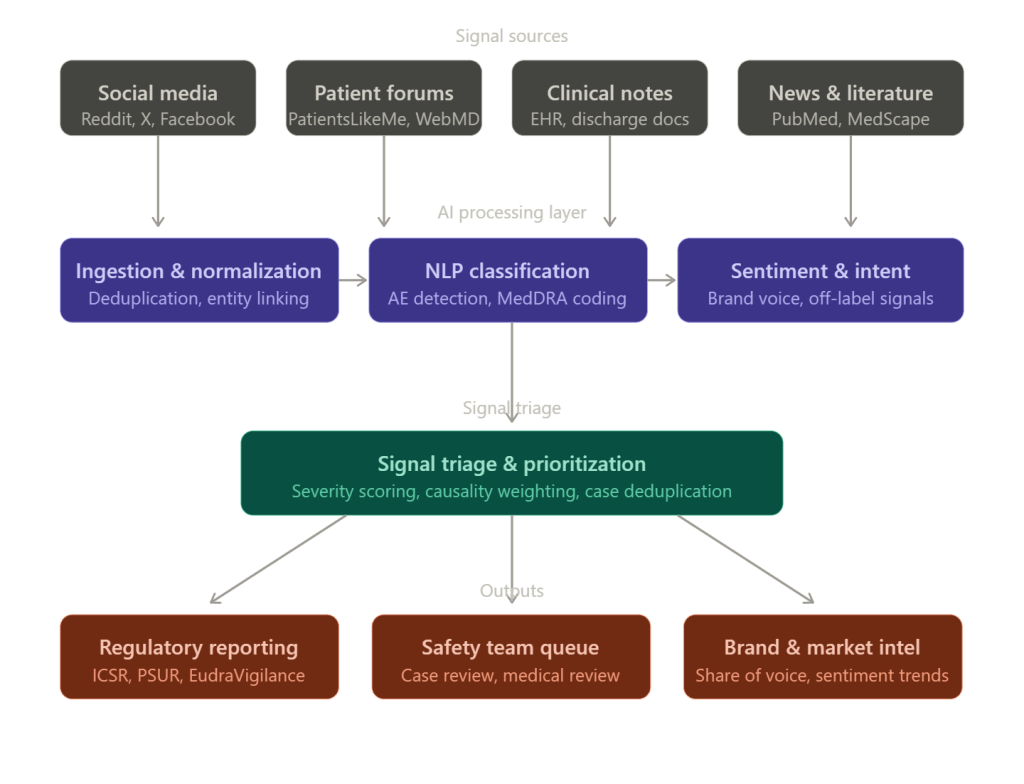
Traditional pharmacovigilance is a structured signal detection system. Adverse event reports flow into FAERS, MedWatch, and EudraVigilance. Safety teams apply statistical methods — disproportionality analysis, Bayesian signal detection — to identify drug-event pairs that appear more frequently than expected. The system is rigorous, slow, and systematically under-reported: the FDA estimates that fewer than 10% of adverse events are formally reported.
The population that never files a MedWatch report still talks. They talk on Reddit, on patient forums, on Facebook groups, on TikTok comments, and increasingly, to AI assistants. And when they talk to AI assistants, those assistants sometimes synthesize their complaints into outputs that circulate far beyond the original conversation.
How AI Search Platforms Surface Unreported Adverse Events
When enough patients ask Perplexity or ChatGPT about a specific symptom associated with a specific drug, the LLM begins incorporating that association into its training data — and eventually into its outputs — even if that association has never been formally flagged in FAERS.
This is a double-edged dynamic. It means LLM monitoring can surface emerging safety signals before they appear in structured reporting databases. It also means LLM outputs can amplify anecdotal associations into apparent medical facts without the validation those signals require.
For pharmaceutical safety teams, the practical implication is a new surveillance layer: monitor what AI systems are saying about your drug’s side effect profile, track whether those claims match approved labeling, and treat divergences as signals requiring investigation — not necessarily as confirmed adverse events, but as intelligence requiring triage.
The European Medicines Agency published guidance in 2023 acknowledging AI-generated content as a potential pharmacovigilance signal source. The FDA’s FAERS database team has internally discussed similar monitoring programs, though no formal guidance has been issued as of mid-2025.
The Signal-to-Noise Problem in AI Pharmacovigilance
The most significant methodological challenge in using LLM outputs for pharmacovigilance is distinguishing between three distinct categories of content that can appear identical in raw text:
- Genuine patient-reported adverse event descriptions that LLMs have synthesized from forum data
- LLM hallucinations about side effects that have no basis in patient experience
- Accurate pharmacological information about known adverse events drawn from clinical literature
Building an AI pharmacovigilance program without a methodology for triaging these three categories will generate noise that overwhelms safety teams. The companies doing this well are using human pharmacovigilance reviewers to adjudicate AI-flagged content, not treating LLM output monitoring as a fully automated process.
Which Drugs Are Most Frequently Mentioned by AI — and What That Reveals
LLM mention frequency is not random. It correlates strongly with media coverage volume, clinical trial prominence, social media discussion, and Wikipedia article quality. That correlation produces a predictable hierarchy in AI drug mentions that doesn’t map cleanly onto market share, clinical importance, or prescribing volume.
The drugs that appear most frequently in LLM outputs across major AI systems in 2024 and 2025 include semaglutide products (Ozempic, Wegovy, Rybelsus), metformin, ibuprofen, aspirin, amoxicillin, Humira (adalimumab), Keytruda (pembrolizumab), and Paxlovid. The commonality: all received extensive media coverage, all are discussed voluminously on patient forums, and all have high-quality Wikipedia entries with frequent revision histories.
The Visibility Trap: High AI Mention Frequency Without Accuracy
For pharmaceutical companies with drugs in the high-mention tier, visibility without accuracy is worse than low visibility. Ozempic is mentioned constantly by AI systems. It’s also the drug most frequently associated with incorrect dosing information, misattributed clinical outcomes, and confused brand-generic framing in LLM outputs.
Novo Nordisk has greater reach through AI channels than almost any other pharma brand. They also have a larger surface area for inaccurate representation. That’s not a trade-off most brand teams have formally quantified, but it’s real and measurable.
Underrepresented Drugs: The Hidden Risk of AI Invisibility
The inverse problem — drugs that are clinically important but rarely mentioned by AI systems — receives less attention but carries its own risk profile.
Specialty drugs, orphan drugs, and recently approved agents with limited post-approval real-world data often appear rarely in LLM outputs. When they do appear, it’s frequently in response to queries where they’re not the most appropriate answer — because the LLM has insufficient training data to contextualize them correctly.
For a drug like tafamidis (Vyndamax/Vyndaqel) for transthyretin amyloid cardiomyopathy — a condition that is systematically underdiagnosed — poor AI visibility is a direct patient access problem. Patients and physicians who could benefit from accurate AI-assisted information about ATTR-CM are receiving generic cardiology content instead.
How Eli Lilly and Novo Nordisk Monitor AI Mentions — What’s Publicly Known
Neither Eli Lilly nor Novo Nordisk has published a detailed account of their AI monitoring programs, but both companies have made sufficient public disclosures to sketch the outlines of their approaches.
Eli Lilly’s digital health team, which has grown substantially since the launch of tirzepatide (Mounjaro, Zepbound), has discussed AI-assisted patient listening in investor presentations and conference sessions. Lilly’s approach appears to combine traditional social listening infrastructure with LLM-specific query auditing — submitting structured question sets to major AI platforms and analyzing outputs for accuracy and brand positioning.
Novo Nordisk’s situation is more acute. Ozempic became a cultural phenomenon in 2022 and 2023, generating a volume of AI-accessible content that dwarfs any other prescription drug in recent memory. The company has invested in content accuracy programs specifically designed to ensure that AI systems retrieving information about semaglutide draw from high-quality, label-accurate sources rather than social media anecdote.
What a Mature AI Drug Monitoring Program Looks Like at Scale
The companies that have moved beyond ad-hoc AI monitoring toward systematic programs share several structural characteristics:
- A defined query library covering brand-specific, competitive, disease-state, and patient-perspective question types
- Automated submission of those queries to ChatGPT, Gemini, Claude, Perplexity, and Copilot at regular intervals (weekly or biweekly for key products)
- Human review of flagged outputs by medical affairs staff with labeling expertise
- Integration of AI monitoring outputs into pharmacovigilance workflows where safety-relevant content is identified
- Reporting structures that route AI content findings to brand teams, regulatory affairs, and legal simultaneously
Tools like DrugChatter and DrugPatentWatch provide infrastructure for parts of this workflow, particularly the systematic query submission and competitive benchmarking components. But the human review layer remains essential and cannot be automated away without significant accuracy risk.
The Off-Label AI Problem: How LLMs Discuss Unapproved Uses
Off-label prescribing is legal and common. Off-label promotion by pharmaceutical companies is prohibited by FDA regulations. This creates a specific compliance tension when LLMs discuss off-label uses of prescription drugs — sometimes accurately, sometimes with fabricated evidence, and always outside any manufacturer oversight.
How AI Systems Describe Off-Label Drug Uses
LLMs discuss off-label drug uses with considerable frequency and variable accuracy. Queries about using low-dose naltrexone for autoimmune conditions, ketamine for depression, or metformin for longevity all generate substantive LLM responses that draw on a mixture of published research, patient testimonials, and extrapolated pharmacology.
For pharmaceutical companies, the off-label AI discussion creates a compliance question with no clean answer. The company cannot legally promote the off-label use. They also cannot prevent AI systems from discussing it. If the LLM discussion is accurate and draws on published clinical evidence, the company faces a paradox: they want the information to be accurate, but they cannot engage with it without risking OPDP scrutiny.
The practical approach most medical affairs teams have adopted is to produce robust, accurate clinical content for approved indications — and ensure that content is prominent enough in AI training data and retrieval layers to anchor LLM responses toward labeled indications rather than off-label extrapolations.
GLP-1 Drugs and the Off-Label AI Amplification Effect
The GLP-1 receptor agonist class is the most prominent example of off-label AI amplification. Semaglutide and tirzepatide are approved for specific metabolic indications, but AI systems discuss their potential applications in addiction medicine, PCOS, non-alcoholic fatty liver disease, and Alzheimer’s prevention — all areas of active research, none with current FDA approval for these drugs.
That discussion drives patient demand. Patients arrive at physician consultations having read AI-generated summaries of GLP-1 research in Alzheimer’s, asking for prescriptions based on preliminary data that no regulatory authority has evaluated for approval. For Novo Nordisk and Eli Lilly, this is simultaneously a market development signal and a regulatory liability.
AI Drug Misinformation and the Patient Safety Calculus
The patient safety dimension of AI drug content is not hypothetical. It’s documented, and the documentation is accelerating.
A 2024 analysis published in JAMA Network Open found that AI chatbots provided incorrect dosing information in 23% of pediatric medication queries, including some errors that exceeded safe dosing thresholds by a factor of two or more. The drugs involved included acetaminophen, ibuprofen, and amoxicillin — the most commonly used medications in pediatric primary care.
A separate 2024 study in The Lancet Digital Health found that AI systems recommended seeking emergency care for symptoms that did not warrant it in 31% of test cases, while failing to recommend emergency care for symptoms that did warrant it in 18% of cases. Drug-related queries performed worse than the overall average.
When Patients Act on AI Drug Information: Real Consequences
Adverse event reports filed with the FDA have begun, for the first time, to include references to AI-generated guidance as a context factor. Poison Control Center cases involving medication misuse have begun to document AI chatbot consultations as preceding events. Neither trend has yet been formally analyzed in peer-reviewed literature, but both are visible in raw database records and in clinical case reports published in toxicology journals.
For pharmaceutical companies, a patient who acts on AI-generated drug information and suffers harm is not their direct legal liability. But they are potentially in the information chain — as a source of content that shaped what the AI was trained to say.
How Medical Misinformation Spreads Across AI Platforms
The propagation path for AI drug misinformation follows a specific pattern. A factual error in training data — perhaps a news article that misreported a drug’s interaction profile — gets embedded in LLM weights. The model reproduces the error in response to user queries. Those AI-generated responses get screenshotted, shared on patient forums and social media, and eventually indexed by other AI systems as training material. The error compounds across model generations.
This compounding effect means that misinformation about drugs that received heavy media coverage in 2021 and 2022 may be more entrenched in current LLM outputs than misinformation about drugs that received coverage in 2024. The older the error, the more training cycles it has propagated through, and the harder it is to displace with accurate content.
Building a Pharma AI Monitoring Program: Operational Framework
A monitoring program that actually reduces operational risk requires four functional components, each with distinct ownership and tooling requirements.
Component 1: Query Library Design
The query library is the foundation of the program. It should include, at minimum:
- Brand-named queries from patient perspectives (“what are the side effects of [drug],” “how do I take [drug],” “can I drink alcohol on [drug]”)
- Brand-named queries from clinical perspectives (“what is the mechanism of [drug],” “what are the contraindications for [drug],” “[drug] dosing in renal impairment”)
- Disease-state queries without brand naming (“what’s the best treatment for [condition],” “first-line therapy for [condition]”)
- Competitive queries (“is [drug A] better than [drug B],” “[drug] vs [competitor drug]”)
- Generic-to-brand and brand-to-generic queries
- Off-label use queries specific to known clinical interest areas
- Safety and interaction queries likely to generate adverse event discussion
A mature program covering a single mid-size pharmaceutical portfolio will have 300 to 500 active queries. Large companies with diverse portfolios operate programs with query libraries in the thousands.
Component 2: Multi-LLM Submission Infrastructure
Responses to identical queries vary significantly across ChatGPT-4o, Gemini 1.5 Pro, Claude Sonnet, Perplexity, and Microsoft Copilot. They also vary within the same model across sessions — LLMs are non-deterministic, and the same query submitted twice may produce meaningfully different responses.
Capturing this variance requires submitting each query multiple times across multiple platforms and tracking distributions rather than single-instance outputs. Tools like DrugChatter handle this infrastructure component, but companies can build lightweight versions in-house using API access to major models combined with structured logging.
Component 3: Accuracy Review and Classification
AI outputs cannot be evaluated for accuracy without human review. The classification scheme should distinguish between:
- Accurate and on-label content
- Accurate but off-label content
- Inaccurate but not safety-relevant content
- Inaccurate and potentially safety-relevant content
- Competitive misrepresentation
- Fabricated citations or evidence
Content in the “inaccurate and potentially safety-relevant” category should route immediately to pharmacovigilance and regulatory affairs. Content in the competitive misrepresentation category routes to brand and legal. Accurate off-label content routes to medical affairs for awareness tracking.
Component 4: Response Protocol and Escalation
Having a monitoring program without response protocols is a liability rather than an asset — it documents awareness without action. Response protocols should specify, for each classification category, what action is required, who owns it, and what the timeline is.
For safety-relevant inaccuracies found in AI outputs, the minimum response protocol should include: documentation of the finding, assessment of patient exposure risk, determination of whether a corrective content strategy is feasible, and escalation to regulatory affairs within a defined timeframe.
For companies operating in the U.S., that escalation should include a formal assessment of whether the FDA’s OPDP should be notified — not because notification is legally required in most cases, but because voluntary disclosure is strategically preferable to an OPDP inquiry triggered by an outside complaint.
How AI Citation Sources Shape Drug Narratives — and What Pharma Can Do
When AI systems cite sources in their drug-related responses — as Perplexity, Bing Copilot, and Google’s AI Overviews do with increasing frequency — the citation choices reveal the content hierarchy that shapes the AI’s outputs.
Which Sources Do AI Systems Actually Cite for Drug Information?
Source analysis of AI drug content citations shows a consistent hierarchy: academic papers and clinical guidelines appear most frequently in citation lists for clinical queries. Consumer health platforms (Drugs.com, Medscape, RxList, WebMD) dominate patient-perspective queries. Reddit and patient forum content appears in queries involving personal experience, drug comparisons, and off-label use.
Pharmaceutical company-owned content — prescribing information pages, patient assistance websites, disease education portals — appears less frequently than its clinical authority would suggest. This reflects two factors: pharmaceutical company content often lacks the structural optimization that makes it machine-readable and retrievable by AI systems, and the implicit authority weighting in LLM training data tends to favor academic and journalistic sources over branded sources.
Correcting this requires a content strategy specifically designed for AI retrievability — not for Google search ranking, which is a related but distinct optimization target.
Structured Data and AI Content Optimization for Pharma
Content structured for AI retrieval shares some characteristics with traditional SEO but diverges in important ways. LLMs prioritize content that is:
- Factually dense and precisely stated
- Written in clear, declarative sentences rather than marketing language
- Structured with explicit question-answer pairs that match likely query formats
- Accompanied by schema markup that signals content type and authority
- Updated frequently enough that retrieval systems identify it as current
Pharmaceutical companies that adapt their medical content portals — label information, patient education materials, medical affairs publications — for AI retrievability will see their content appear more frequently in LLM drug responses. That outcome serves both brand and safety objectives simultaneously.
Competitive Intelligence Through AI Monitoring: What Your Rivals’ AI Presence Reveals
Every time an AI system answers a disease-state query and mentions a specific drug, it’s allocating share of voice. Tracking how that allocation moves across products, across platforms, and across query types over time is competitive intelligence that traditional market research doesn’t capture.
AI Share-of-Voice as a Leading Indicator of Market Dynamics
AI share-of-voice data tends to lead market share data by two to four quarters. LLMs are trained on content that reflects the state of the field 12 to 24 months ago, but the queries patients and physicians submit to AI systems reflect current clinical interest — the questions people have right now, even if the answers they receive reflect last year’s knowledge.
When a new drug enters a competitive category, AI systems are slow to incorporate it into first-line treatment discussions — even after FDA approval, even after guideline updates. A company that monitors this lag and actively works to ensure their newly approved drug appears in AI disease-state responses can accelerate AI adoption that correlates with real-world prescribing behavior.
Detecting Competitor Misrepresentation in AI Outputs
AI systems sometimes generate content unfavorable to specific branded drugs — not because of competitive activity, but because of training data patterns. A drug that received heavy negative media coverage during a safety review, even if it was ultimately cleared, may continue to generate cautionary language in LLM responses long after the safety review concluded.
Monitoring competitor drugs’ AI portrayal reveals opportunities: if a competitor’s drug is being consistently misrepresented in AI outputs in ways that create clinical hesitation, that’s a competitive landscape factor that should inform brand positioning and medical affairs messaging strategy.
Mapping the AI Competitive Landscape in a Therapeutic Area
A complete AI competitive intelligence picture for a therapeutic area requires tracking, across all major LLMs:
- Which drugs appear in first-line treatment responses without clinical qualifier language
- Which drugs are framed with safety caveats that other drugs in the same class do not receive
- Which drugs are mentioned in combination with terms like “generic,” “cheaper alternative,” or “biosimilar” regardless of actual patent status
- Which drugs are described using outdated clinical trial language that predates current standard of care
This landscape mapping, done at quarterly intervals, produces a competitive intelligence report that no sales force analytics system or claims database currently provides.
The Legal Landscape: AI Drug Content Litigation and What It Means for Pharma
No pharmaceutical company has yet been named as a defendant in litigation specifically citing AI-generated drug misinformation as a causative factor. But the legal scaffolding for such a case is visible in adjacent areas of law.
Product Liability and the AI Information Chain
Plaintiffs’ attorneys in pharmaceutical product liability cases have long focused on what information the manufacturer knew, when they knew it, and whether they acted on it. In the AI monitoring context, that framework translates to a straightforward question: if your pharmacovigilance team has been monitoring AI outputs about your drug since 2023, and AI systems have been consistently providing incorrect safety information about your drug since 2023, what did you do about it?
That question will be asked in discovery in future pharmaceutical litigation. Companies that have formal monitoring programs with documented action protocols are in a defensible position. Companies that have no monitoring program — or a monitoring program that exists on paper but generates no documented actions — are not.
FTC, FDA, and State AG Exposure in AI Drug Content
The Federal Trade Commission’s authority over deceptive health advertising extends, under recent guidance, to AI-generated content that a company could reasonably be expected to correct. The FTC has not yet pursued a pharma-specific AI content enforcement action, but it has pursued cases against companies that failed to correct deceptive AI-generated endorsements in adjacent industries.
State attorneys general in California, New York, and Illinois have been more active on AI health content than the FTC. California’s AB 2955, introduced in 2024, proposed disclosure requirements for AI-generated health content — the bill stalled, but it signals where state regulatory attention is focused.
How Pharma Legal Teams Should Structure AI Content Risk Documentation
The documentation standard for AI drug content risk should mirror the documentation standard for traditional pharmacovigilance: logged, timestamped, adjudicated by qualified personnel, with explicit records of what action was taken in response to each identified risk.
That documentation serves two functions. In litigation, it demonstrates that the company took the risk seriously and acted appropriately. In regulatory inspections, it demonstrates that the company’s pharmacovigilance program is comprehensive enough to include emerging signal sources. Companies that treat AI monitoring as an informal marketing intelligence activity rather than a formal compliance function are creating documentation gaps they will regret.
Patient Sentiment Analysis in the Age of AI: Moving Beyond Social Listening
Traditional social listening captures what patients say. AI output monitoring captures what AI systems tell patients. These are increasingly different things, and the gap between them carries brand implications.
How AI Is Changing Patient Expectations of Drug Benefits
Patients who receive drug information from AI systems before their physician consultation arrive with different expectations than patients who relied on traditional sources. AI systems tend to present drug benefits more completely and drug limitations more briefly — not because they’re designed to favor drugs, but because benefit claims appear more frequently in published clinical literature (which is structured to report efficacy) than in the balanced risk-benefit framing required by FDA label language.
For pharmaceutical brand teams, this AI-driven expectation inflation creates a specific challenge: patients who expected outcomes that the drug delivers only to the median patient may experience results that feel disappointing against their AI-generated expectation. That expectation gap drives negative reviews, social forum complaints, and eventual LLM training data that reflects disappointment rather than accurate clinical context.
Identifying Emerging Patient Concerns Before They Trend on AI Platforms
The lifecycle of patient concern about a drug moves through a predictable sequence: individual patient experience, forum discussion, media coverage, AI training data incorporation, AI output amplification. Companies that monitor each stage can detect emerging concerns at the forum stage rather than the AI amplification stage — months earlier, with more actionable options available.
The specific monitoring infrastructure for early-stage concern detection combines traditional social listening (Reddit, patient forums, Facebook health groups) with systematic LLM output monitoring. When a concern appears in forum data but not yet in LLM outputs, the company has a window to address it through accurate content before AI amplification occurs.
Voice-of-the-Customer Research Through AI Query Analysis
The questions patients ask AI systems are, in aggregate, the richest voice-of-the-customer dataset the pharmaceutical industry has ever had access to. They reveal unmet information needs, terminology patients use for symptoms they won’t use in clinical settings, concerns that don’t surface in patient surveys or focus groups, and decision factors that physicians may not be aware their patients are weighing.
Companies that build systematic query analysis into their AI monitoring programs — not just tracking outputs, but analyzing the inputs — gain patient insight that no traditional research methodology produces at comparable scale or cost.
What Pharmaceutical Companies Should Do Now
The companies that will be best positioned when AI drug content regulation matures are the ones building monitoring infrastructure now, not when the first warning letter or litigation discovery request arrives.
Immediate Actions: 0 to 90 Days
- Conduct a baseline AI audit for your five highest-priority drugs across ChatGPT, Gemini, Claude, and Perplexity using a structured query library of at least 50 queries per drug
- Document all accuracy findings with clinical review by medical affairs staff
- Identify the top three to five AI content gaps where LLM outputs diverge significantly from current approved labeling
- Brief regulatory affairs and legal on findings and establish escalation protocols
Medium-Term Buildout: 90 Days to 12 Months
- Establish a repeating monitoring cadence — biweekly minimum for priority drugs
- Develop an AI-retrievable content strategy for your medical content portals: structured data markup, FAQ format, plain-language clinical content
- Integrate AI monitoring findings into your pharmacovigilance signal detection workflow
- Build competitive AI share-of-voice tracking for key disease states
- Establish a formal policy governing employee engagement with AI-generated content about company drugs on public platforms
Strategic Positioning: 12 Months and Beyond
- Engage with FDA and EMA working groups on AI pharmacovigilance guidance as they develop — early participation shapes standards
- Determine whether AI monitoring data can be incorporated into REMS program evaluations for drugs with safety-relevant AI content exposure
- Develop internal AI literacy programs for medical affairs, regulatory, and brand teams so that AI output monitoring findings are interpreted accurately at every level of the organization
Key Takeaways
- AI systems — ChatGPT, Gemini, Claude, Perplexity — are now primary drug information channels for patients and physicians. Their outputs are unregulated, often inaccurate, and entirely unmonitored by most pharmaceutical companies.
- LLM hallucinations about drug side effects, dosing, contraindications, and clinical trial outcomes are documented and common. More than 60% of drug-related AI queries produce at least one factual inaccuracy.
- FDA regulatory exposure from AI drug content is indirect but real. Companies that become aware of AI-generated drug misinformation and fail to act are creating documented liability under existing post-market surveillance obligations.
- AI share-of-voice — how frequently and accurately a drug appears in LLM responses — is a measurable competitive metric that leads traditional market share data by two to four quarters.
- Generic substitution bias in AI outputs is documented. LLMs systematically favor generics in cost-framed queries, sometimes describing generic availability that does not yet exist.
- AI pharmacovigilance is the logical extension of existing post-market safety surveillance into the channels where patients are actually discussing their drug experiences.
- The off-label AI amplification effect is most visible in GLP-1 drugs. Semaglutide and tirzepatide are discussed by AI systems across multiple unapproved indications, driving patient demand ahead of regulatory evidence.
- Tools like DrugChatter and DrugPatentWatch provide purpose-built infrastructure for LLM monitoring and patent intelligence respectively, reducing the build-versus-buy calculation for most pharmaceutical companies.
- The documentation standard for AI monitoring should match the documentation standard for pharmacovigilance: logged, timestamped, adjudicated by qualified personnel, with records of action taken in response to each identified risk.
FAQ: AI Drug Monitoring for Pharmaceutical Companies
Can AI-generated drug misinformation trigger FDA regulatory action?
Yes, indirectly. The FDA cannot regulate LLM outputs directly, but if a pharmaceutical company becomes aware of AI-generated content making false safety or efficacy claims about their drug and fails to act, existing post-market surveillance obligations apply. The FDA’s OPDP has not issued AI-specific guidance, but enforcement under 21 CFR Part 202 misbranding provisions doesn’t require AI-specific rules — existing standards apply to misleading drug information regardless of how it is generated or distributed.
How do LLMs decide which drugs to mention when a patient asks about a condition?
LLMs don’t decide — they predict statistically probable text based on training data patterns. Drugs with higher media visibility, greater patient forum discussion volume, and stronger Wikipedia coverage appear more frequently in disease-state LLM responses. This creates a measurable AI share-of-voice dynamic that pharmaceutical companies can monitor and, to a degree, influence through structured content strategy — but not control.
What is the difference between AI pharmacovigilance and traditional pharmacovigilance?
Traditional pharmacovigilance mines formally reported adverse events in structured databases like FAERS and EudraVigilance. AI pharmacovigilance extends surveillance to unstructured real-world language: patient posts, chatbot conversations, AI search summaries. The signal is faster and captures populations who never file formal reports. The challenge is distinguishing genuine adverse event signals from LLM hallucinations and anecdotal noise — a challenge that requires human adjudication, not full automation.
Which pharmaceutical companies are actively monitoring AI mentions of their drugs?
Eli Lilly, Novo Nordisk, AstraZeneca, and Pfizer have all publicly disclosed AI-driven patient listening and digital pharmacovigilance investments. Novo Nordisk has been particularly active given Ozempic and Wegovy’s dominance in AI health content. Smaller specialty pharma companies are adopting third-party tools like DrugChatter. Most large pharma companies now include AI output monitoring in brand analytics alongside social listening — though the depth and formality of programs varies considerably.
Can a pharmaceutical company be held liable for AI-generated misinformation about their drug?
Direct liability is unlikely under current law. But if a company’s published content contributed to LLM training data that produced false outputs — and patients were harmed acting on those outputs — plaintiffs’ attorneys will explore that chain. More immediately, if a pharmacovigilance team documented awareness of AI-generated misinformation and took no action, that inaction is discoverable. The liability risk today is primarily about documented awareness without response, not the existence of AI misinformation itself.