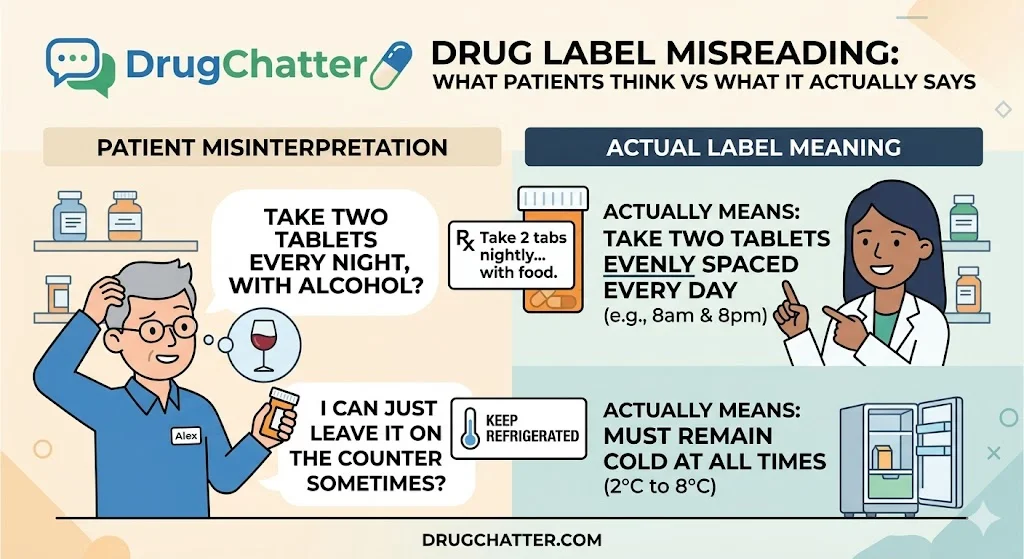
Somewhere between the pharmacy counter and the kitchen table, a drug label can turn into a Rorschach test. Patients don’t usually misread out of carelessness—they misread because the label is dense, the instructions are written for speed, and the stakes are high. The result is a familiar pattern: people think the bottle is telling them one thing, while the fine print (and the actual prescribing information) is telling them something else.
Below are a few of the most common “label misread” themes that show up in real questions—especially around dosing, timing, interactions, and what a medication is (or isn’t) meant to do. Click through to the original DrugChatter Q&A for the details.
1) “Is this the right dose… or the right schedule?”
One of the most dangerous misreads is confusing how much with how often. Patients may have the strength correct but the timing wrong—or vice versa—because the label format compresses everything into a small space.
2) “Can I take it with… anything?” (The label rarely says “yes”)
Labels often include interaction warnings, but patients frequently interpret those warnings as optional. The misread is subtle: “It doesn’t forbid it” becomes “It’s probably fine.” In practice, many interactions are dose- and timing-dependent, and some are about metabolism rather than “chemistry vibes.”
- Can lipitor interact with common painkillers?
- Will taking lipitor and st john’s wort affect my cholesterol levels?
- Can red wine interfere with lipitor’s cholesterol reduction?
- Can vascepa be safely taken with ginseng products?
- Can acyclovir be taken with other antivirals?
3) “It’s safe long-term” (until you read what “safe” actually means)
Another common misread is treating “approved” as “risk-free.” Labels don’t just say what you can do—they also imply what you must monitor. Long-term use can be perfectly appropriate, but the label’s job is to make sure you’re watching the right things.
- Is omeprazole safe to take long term?
- How often do lipitor’s liver side effects occur?
- Osteonecrosis prolia?
- Side effects of prolia on teeth?
4) “Generic means identical” (labels don’t always say what you think they say)
People often assume that “generic” means “same everything.” But labels can differ in excipients, formulation, and—most importantly—what the label emphasizes for administration and monitoring. Even when the active ingredient is the same, the patient experience can differ.
5) “The label tells me what it does” (but patients miss what it’s for)
Sometimes the misread isn’t about dosing—it’s about purpose. Patients may interpret a label as describing a symptom relief plan when it’s actually describing a disease-modifying or risk-reduction strategy. That mismatch can lead to disappointment, nonadherence, or “extra doses” to chase results.
- How effective is jencycla?
- What’s the typical ozempic effect duration on blood sugar?
- Can you provide the response rate of using ruxolitinib with azacitidine?
6) “Timing is optional” (it’s usually not)
Labels often include timing instructions that look like housekeeping but are actually pharmacology. Food effects, spacing from other meds, and “when to take” guidance can change absorption and effectiveness.
- What’s the recommended time gap between lipitor and oj?
- Cosentyx and food?
- Will lipitor and glucosamine affect each other’s effectiveness?
- Is there a way to mitigate lipitor’s sleep disruption?
7) “If it’s on the label, it’s what I should do” (but labels can be incomplete without context)
Some labels are written to cover a wide range of patients. That means the label can be technically correct while still being incomplete for your specific situation—especially with kidney/liver disease, vaccine timing, or special populations.
- Can i receive vaccines immediately after cosentyx?
- Is tigecycline contraindicated in certain liver conditions?
- Does tigecycline’s effect on liver differ in elderly?
- Methotrexate kidney disease?
What to do when you suspect a misread
If you’ve ever looked at a label and thought, “Wait—did I understand that right?”, you’re not alone. The safest move is to treat uncertainty as a reason to ask, not a reason to guess.
- Bring the exact bottle and label text to your pharmacist or prescriber.
- Ask about timing, spacing, and what to avoid—not just side effects.
- If you’re switching brands or generics, ask whether the instructions change (not just the active ingredient).
Because the label is only half the story. The other half is you: your other meds, your conditions, your schedule, and the small details that decide whether “taken correctly” is actually possible.