Spend enough time reading patient forums and one theme appears over and over again: confusion bordering on suspicion. A medication changes. A refill looks different. Insurance suddenly prefers another drug. A doctor swaps one biologic for another. And patients immediately wonder if something has gone wrong.
The question is rarely phrased directly as “Why did my doctor switch me from X to Y?” But the subtext is everywhere.
On DrugChatter, entire clusters of questions point to the same anxiety: efficacy, side effects, insurance pressure, drug interactions, and the uncomfortable reality that modern medicine is often an ongoing experiment in optimization rather than a straight-line cure.
Here are the biggest categories driving those switch-related questions — and what they reveal about how patients actually experience medicine.
“Is the newer drug actually better?”
This may be the dominant pharmaceutical question of the GLP-1 era.
Patients aren’t just asking whether a drug works. They’re asking whether another one works better.
Examples include:
Is mounjaro better than ozempic for weight loss?
Is gemtesa better than myrbetriq?
How does orfogliperon compare to oral semiglutide?
How does orfogliperon compare to wegovy pill?
Does meloxicam work better than ibuprofen for arthritis?
Is enbrel or humira better for psoriatic arthritis?
What’s striking is how often these questions emerge before hard comparative evidence exists. Patients are effectively running Bayesian updates in real time from Reddit anecdotes, commercials, TikTok transformations, and insurance formulary notices.
The industry calls this “therapeutic substitution.” Patients call it: Why am I suddenly taking something else?
Side effects are the hidden engine behind switching
Doctors rarely say, “This drug failed catastrophically.” More often the issue is attrition by tolerability.
Patients endure fatigue, nausea, constipation, dizziness, muscle pain, mood changes, or sleep disruption until either they or their physician decide the balance has shifted.
That dynamic shows up repeatedly:
Can ozempic cause hair loss?
Can Ozempic cause stomach pain?
Does ozempic cause vision changes?
Can mounjaro cause sulfur burps?
Does mounjaro cause tiredness?
Is muscle fatigue a common lipitor side effect?
Can liver damage from lipitor be reversed?
Does prednisone cause mood swings?
Can hydroxyzine cause daytime drowsiness?
There’s a lesson here the pharmaceutical industry understands well but patients often discover painfully: efficacy is only half the story. A drug that works brilliantly but makes daily life miserable tends not to survive long in the real world.
Insurance companies are often the invisible co-author of treatment plans
Another major source of switching anxiety has little to do with biology.
It’s economics.
Questions around savings programs, coupons, coverage restrictions, and biosimilars reveal how often therapy changes are driven by reimbursement rather than science:
Are there any restrictions on humira use in my plan?
What are the most common humira biosimilar names?
Are there any coupons for vascepa?
What factors affect vascepa insurance coverage?
How will the new vascepa program benefit me?
Is there a discount for vascepa renewals?
What percentage discount is offered for yervoy?
In many specialties, especially rheumatology, oncology, and diabetes, the practical question isn’t “What’s the best drug?” It’s “What can the patient realistically stay on?”
That’s a very different optimization problem.
Drug interactions are where confidence goes to die
Many switch-related conversations start after patients discover that ordinary life — grapefruit, turmeric, alcohol, supplements, antibiotics — suddenly became pharmacologically complicated.
Lipitor questions alone form an entire ecosystem:
What are the side effects of mixing grapefruit and lipitor?
Can garlic supplements reduce lipitor’s potency?
Which essential oils interact negatively with lipitor?
What are the risks of combining ibuprofen and lipitor?
Can i take acetaminophen with lipitor?
Can grapefruit oil reduce lipitor’s cholesterol benefits?
Once patients begin worrying about interactions, medication changes become psychologically easier to justify. Sometimes the switch is clinically necessary. Sometimes it’s precautionary. Sometimes it’s simply an attempt to reduce complexity.
Polypharmacy turns medicine into systems engineering.
Immunology drugs generate an entirely different category of fear
Biologics and immunotherapies produce some of the most intense “Should I stay on this?” discussions online.
Not because patients doubt efficacy — often these drugs work extraordinarily well — but because the immune system is not a subtle machine.
Questions cluster around infection risk, vaccines, allergic reactions, and long-term uncertainty:
Is cosentyx associated with reduced vaccine induced infection defenses?
How does cosentyx impact covid 19 vaccine immunity?
Can vaccination side effects worsen on cosentyx?
Are skin tests available for keytruda allergies?
Are there cases where yervoy’s side effects caused death?
Can immunotherapy increase lurbinectedin’s side effects?
These aren’t abstract concerns. Modern immunology therapies can produce dramatic benefits alongside equally dramatic toxicities. Patients know this. Which means every new rash, cough, infection, or lab abnormality becomes suspect.
The most revealing questions are often the simplest ones
Some of the most revealing DrugChatter posts are almost disarmingly basic:
Is repatha a statin?
Is simponi for arthritis?
Is levothyroxine for thyroid?
Is emgality for migraines?
Is aimovig for migraines?
It’s easy to underestimate these questions. But they reflect a central reality of modern healthcare: patients are frequently switched, escalated, tapered, combined, or substituted faster than they can fully understand the vocabulary.
Medicine has become specialized enough that many treatment journeys now resemble software update logs.
The real answer behind most medication switches
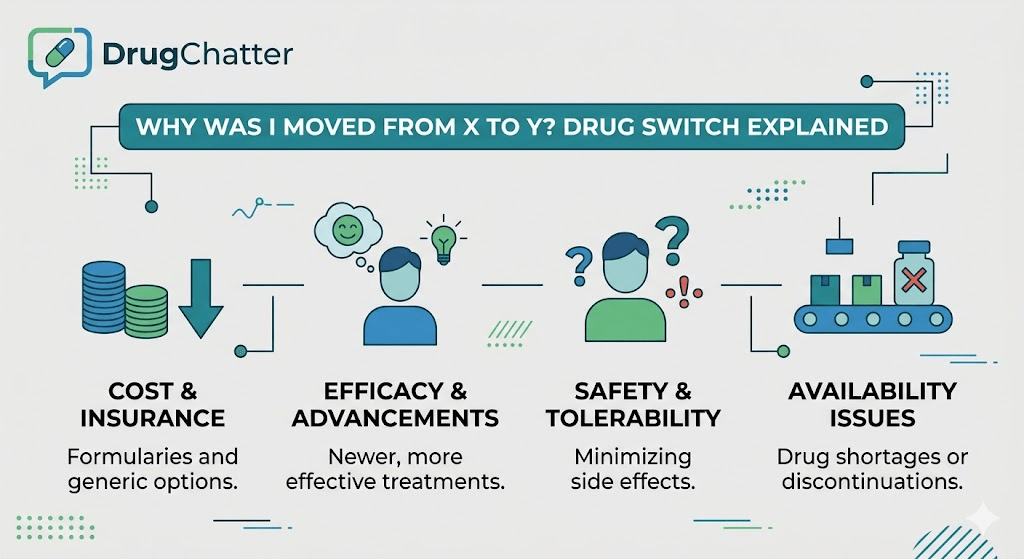
Most medication changes happen because of one of five things:
The original drug didn’t work well enough
The side effects became unacceptable
Another drug appeared safer or more convenient
Insurance changed coverage
The patient’s condition evolved
That sounds obvious. But what DrugChatter’s question patterns reveal is how rarely patients feel those transitions are fully explained.
And that gap creates the internet’s endless stream of:
“Why this instead of that?”
“Is the new one stronger?”
“Am I getting downgraded?”
“Is this because something is wrong?”
In reality, drug switching is often less about failure than iteration.
Medicine, especially chronic disease medicine, is rarely a single decisive intervention. It’s closer to ongoing calibration — equal parts biology, tolerability, economics, and probability management.
Which may be unsatisfying.
But it’s probably the most honest answer in pharmacology.