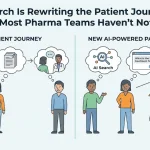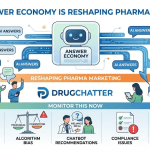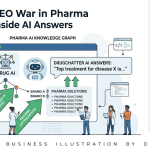
A patient types ‘Can I take Ozempic if I have pancreatitis?’ into ChatGPT. The model responds with an answer. That answer may be accurate, partially accurate, or dangerously wrong. The patient acts on it. No one at Novo Nordisk sees it happen.
This scenario repeats millions of times per day across ChatGPT, Gemini, Claude, Perplexity, and Microsoft Copilot. Each exchange is a data point that pharmaceutical brand teams, medical affairs departments, and pharmacovigilance units are almost entirely blind to.
That blindness is becoming a liability.
AI search has not replaced Google. It has added a new conversational layer between patients, physicians, and drug information — one that operates without editorial oversight, FDA review, or the labeling constraints that govern every other channel a drug company touches. The result is a live, perpetually updating corpus of drug claims that nobody in the industry is systematically tracking.
Some companies are starting to notice. A handful of vendors, including DrugChatter, have built purpose-built tools to query large language models at scale, extract drug mentions, classify sentiment, and flag safety-relevant outputs. But most pharma companies are still treating AI monitoring the way they treated social media in 2009: as someone else’s problem.
It is not someone else’s problem. Here is why — and what to do about it.
What ‘AI Monitoring’ Actually Means for Pharma Brand Teams
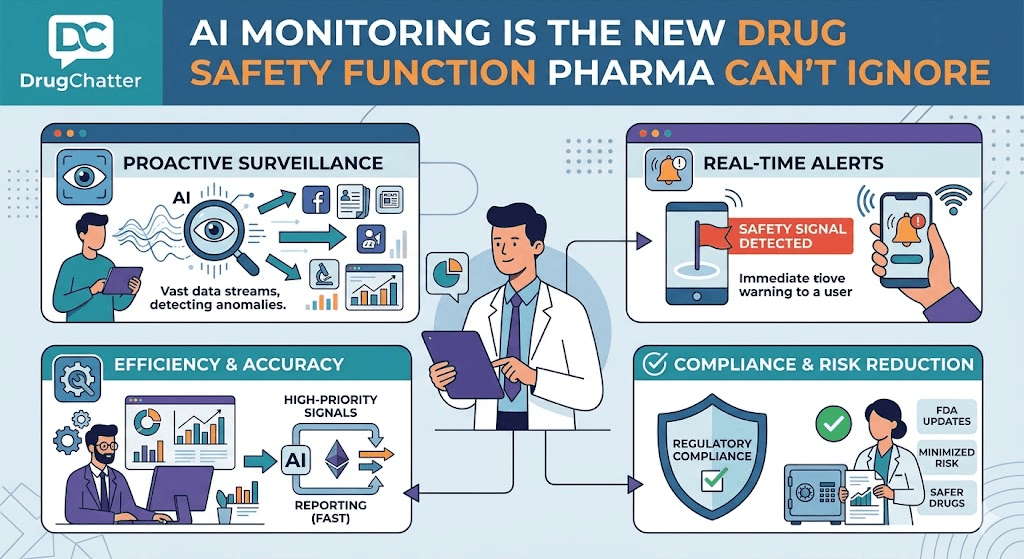
AI monitoring in a pharmaceutical context means systematically querying large language models with the same questions real patients and physicians ask, capturing the responses, and analyzing them for accuracy, sentiment, brand presence, safety claims, and competitive positioning.
It is not social listening. It is not traditional media monitoring. It is something new: a structured audit of what AI systems say about your drug, your competitors’ drugs, and the disease states your portfolio touches.
The practice sits at the boundary of several existing functions:
- Pharmacovigilance — because AI outputs can contain adverse event information, off-label recommendations, or contraindication claims that may constitute safety signals
- Medical affairs — because AI models are shaping physician and patient understanding of clinical data, sometimes inaccurately
- Brand management — because AI search is eroding the brand’s ability to control the first answer a patient receives about their drug
- Competitive intelligence — because AI models recommend, rank, and compare drugs in ways that directly affect prescribing consideration
No single team owns all of these. That is part of why AI monitoring has been slow to take root inside most pharma organizations.
How Is AI Drug Monitoring Different From Social Listening?
Social listening captures what people say about drugs. AI monitoring captures what AI systems tell people about drugs. The distinction matters.
A Reddit post about Wegovy causing hair loss is a consumer opinion. ChatGPT telling a user that ‘hair loss is not a known side effect of semaglutide’ — when it actually does appear in postmarketing data — is an AI system generating a factual claim that may be wrong.
Social listening has a well-established place in pharmacovigilance workflows. Regulatory agencies in Europe and the US have issued guidance on mining patient forums for adverse event signals. AI monitoring has no such regulatory framework yet. That gap is closing.
Which Teams Inside Pharma Should Own AI Monitoring?
The honest answer is that no team currently owns it cleanly, and that is the core organizational problem.
Medical affairs has the scientific fluency to evaluate whether an AI-generated drug claim is accurate. Brand teams have the commercial motivation to track share-of-voice. Pharmacovigilance teams understand adverse event reporting obligations. Digital and data teams have the technical capability to build or procure the tooling.
In practice, AI monitoring tends to get bootstrapped by whoever notices the problem first — often a brand manager who searched for their drug on Perplexity and didn’t like what they saw.
That is not a sustainable operating model. Companies that take this seriously are building cross-functional working groups that pull from all four functions and report into a senior enough stakeholder to act on what they find.
Why ChatGPT Gets Drug Side Effects Wrong — and Why That’s a Regulatory Problem
Large language models do not look up drug information in real time from authoritative sources. They generate responses based on statistical patterns learned from training data. That training data includes FDA labels, medical literature, and patient forums, weighted in ways that are opaque to anyone outside the model developer.
The result is a system that can confidently generate plausible-sounding drug information that is outdated, incomplete, or fabricated.
In a 2023 study published in JAMA Internal Medicine, researchers tested ChatGPT-3.5 on 284 questions about medications and found accuracy rates that varied significantly by question type. The model performed better on mechanism-of-action questions than on drug-interaction and dosing questions — precisely the categories where errors have the most clinical consequence.
A separate analysis by researchers at the University of California, San Francisco evaluated AI chatbot responses to questions about medication overdose. Several models provided information that was clinically inaccurate in ways that could increase harm risk.
From a regulatory standpoint, the question of who is responsible for these outputs is genuinely unsettled. The FDA’s existing adverse event reporting framework was not designed for AI-generated misinformation. The current MedWatch system captures adverse events that patients and providers report after drug exposure — not misinformation that precedes or shapes that exposure.
Can AI Hallucinations Trigger an FDA Warning Letter?
Not directly. The FDA issues warning letters to drug manufacturers for violations they control — promotional materials, labeling, manufacturing processes. An AI hallucination generated by OpenAI or Google is not something Eli Lilly controls or produces.
But the regulatory risk runs in a different direction: if patients act on AI-generated misinformation and experience harm, and if those events surface through adverse event reports or litigation, regulators and plaintiffs’ attorneys will want to know what the manufacturer knew about AI-generated drug claims and when.
That creates a duty-to-monitor argument that has not yet been tested in court but is structurally similar to arguments that have been made about social media drug misinformation. The manufacturer is not responsible for what an AI says. But the manufacturer that had no system to detect what AI systems were saying about their drug — and therefore had no mechanism to issue corrective information — is in a weaker position than one that did.
What Happens When an AI Recommends the Wrong Drug Dose?
The downstream effects are not theoretical. Poison control centers in the US have reported increases in calls related to medication misuse, and clinicians have documented cases where patients presented with unusual self-dosing patterns that they attributed to AI search guidance.
Semaglutide (Ozempic, Wegovy) is a useful case study. The drug has become a cultural phenomenon, driving an enormous volume of AI search queries about dosing, titration schedules, interactions, and off-label use. The FDA’s approved titration schedule for Wegovy is specific: patients start at 0.25 mg weekly and increase every four weeks. AI responses to dosing questions have varied widely from that schedule, sometimes recommending faster titration or different injection protocols.
A patient who adjusts their dose based on an AI response instead of their prescriber’s instructions creates a documented risk. If that adjustment leads to an adverse event, the adverse event is reportable. The connection to AI-generated guidance may or may not surface in the report, but it exists.
How Often Claude Mentions Ozempic vs. Wegovy — and Why the Gap Matters
Semaglutide is sold under two brand names in the US for different indications: Ozempic for type 2 diabetes and Wegovy for chronic weight management. The distinction matters clinically, commercially, and from a coverage and access standpoint.
It does not always matter to AI models.
When patients query LLMs with weight-loss questions, models frequently respond with Ozempic rather than Wegovy, reflecting the drug’s disproportionate cultural salience despite Wegovy being the FDA-approved indication for obesity. This has real-world effects: patients ask their physicians for Ozempic off-label for weight loss, creating prescribing dynamics and insurance issues that Novo Nordisk has had to actively manage.
From a brand monitoring standpoint, this is share-of-voice data with commercial consequences. If your drug is being undermentioned relative to a competitor — or if your brand name is being conflated with the wrong indication — that is actionable intelligence.
Tracking Share of Voice Across ChatGPT, Gemini, and Claude
AI share-of-voice measurement is still early-stage, but the methodology is straightforward in concept: send a standardized set of disease-state and treatment queries to multiple AI platforms, capture responses, extract drug mentions, and calculate mention frequency by brand and by platform.
The results are often surprising. Different models, trained on different data with different weighting, produce different drug rankings for the same query. A query like ‘What are the most effective GLP-1 medications for weight loss?’ may yield Wegovy as the top mention on Claude, Ozempic on ChatGPT, and Mounjaro (tirzepatide) on Gemini — all on the same day.
These differences are not random. They reflect differences in training data composition, recency weighting, and the specific RLHF (reinforcement learning from human feedback) choices made by each model developer. Understanding which model your target audience uses most, and what that model says about your drug, is commercially relevant.
Tools like DrugChatter are designed specifically for this use case: running structured query panels across multiple AI platforms and returning comparative brand mention data that pharma companies can act on.
Do LLMs Recommend Generic Drugs More Often Than Branded Drugs?
There is emerging evidence that they do, and the mechanism makes sense.
AI models are trained on text from the public internet, academic literature, and medical resources. That text skews toward generic names for two reasons: generic nomenclature is used in clinical literature, and cost-conscious patient forums actively discuss generic alternatives. Models trained on this data learn to associate ‘medication for X’ with generic names more often than brand names.
For branded drug companies, this creates a structural disadvantage in AI search that differs from traditional search. In Google, a brand can buy keyword visibility. In AI search, there is no equivalent mechanism — the model’s training data and retrieval architecture determine what it mentions, and neither is controllable through advertising spend.
The practical implication: if a patient asks ‘What medication should I take for rheumatoid arthritis?’, a model may recommend methotrexate (generic) as a first-line option without mentioning specific branded biologics, or may mention the biologic class without specifying which product. Brand teams need to know whether this is happening and how it compares to competitive products in the same class.
What Pharma Brand Teams Can Learn From Reddit AI Citations
Reddit is one of the most influential training and retrieval sources for AI models. OpenAI has a data licensing deal with Reddit. Google has integrated Reddit results more prominently into search and AI Overviews. When patients discuss drugs on Reddit — their experiences, concerns, and questions — that content shapes what AI models learn and, in retrieval-augmented systems, what they cite.
This creates a feedback loop. Patient concerns that are expressed on Reddit get encoded into AI training data. AI models then surface those concerns to future patients who search about the same drug. The patient forum conversation becomes the authoritative source for a generation of AI-generated drug information.
For pharma companies, Reddit is not just a social listening channel — it is effectively an upstream input to AI drug information. What gets discussed on r/diabetes, r/obesity, r/MultipleSclerosis, and similar communities shapes what AI systems will say about drugs in those disease states for months or years after the discussions occur.
How Patients Ask About Drug Interactions in AI Search
Patient query patterns in AI search differ meaningfully from traditional web search queries. AI search invites natural language questions, and patients use it that way.
Traditional search: ‘Ozempic alcohol interaction’
AI search: ‘I take Ozempic once a week and I’m going to a wedding — is it safe to drink a couple glasses of wine?’
The AI search query is richer in context, more specific to individual circumstances, and harder for a drug company to anticipate or optimize for. It is also more likely to elicit a detailed AI response that engages with the specific scenario rather than returning a list of links.
Understanding these query patterns matters for medical affairs teams. If patients are consistently asking AI systems about certain interactions, that is a signal about patient concerns that may not surface in physician-facing channels. It may also reveal misunderstandings about the drug that should inform patient education materials, label language, or field medical interactions.
How Physician Query Patterns in AI Differ From Patient Queries
Physicians are using AI search too, and their query patterns differ from patients in ways that matter.
Physicians ask more precise, clinical questions. ‘What is the REMS program for isotretinoin and when is it triggered?’ ‘What are the dosing considerations for vancomycin in a patient with CrCl below 30?’ These queries are designed to return clinical decision support — information that shapes prescribing decisions.
The accuracy of AI responses to physician queries carries higher stakes than patient queries because physicians are likely to weight the AI response more heavily relative to their own search behavior. A physician who receives an inaccurate response about a drug’s renal dosing adjustment may not catch the error the way a more skeptical patient might.
Medical affairs teams that monitor physician-style queries to AI platforms gain a window into potential clinical misinformation that could affect prescribing patterns for their drugs.
Can AI Outputs Be Used for Pharmacovigilance? The Regulatory Debate
The formal regulatory answer is: not yet, but the question is being actively examined.
The European Medicines Agency (EMA) has published several reflection papers on the use of digital sources for signal detection. Their 2022 guidance on social media and internet data for pharmacovigilance acknowledged the potential of automated text mining but emphasized the need for validation and quality control before such data could inform regulatory submissions.
The FDA’s position is similarly cautious. The agency has acknowledged that social media platforms contain adverse event signals but has not mandated that manufacturers mine them systematically. Guidance from 2014 and 2017 provided voluntary frameworks for social media monitoring without creating reporting obligations tied to specific platforms.
AI-generated content is a new category that neither framework fully addresses. An AI model that tells a patient they should not take a drug with certain foods — incorrectly — is not generating an adverse event report. But if a patient acts on that guidance and has a bad outcome, that adverse event may eventually reach a MedWatch report with no mention of the AI interaction that preceded it.
Which Adverse Events Are Most Likely to Surface in AI Outputs?
Based on the types of queries patients direct to AI systems, certain adverse event categories are more likely to appear in AI-generated drug information:
- Gastrointestinal effects (nausea, vomiting, diarrhea) — high patient salience, frequently discussed in patient forums that feed AI training data
- Weight changes — both as intended effects and as unintended consequences
- Drug interactions — patients frequently ask AI systems to evaluate their specific medication combinations
- Psychiatric effects — mood changes, suicidality, anxiety — particularly for drugs in the CNS space
- Injection site reactions — relevant for biologics and injectables with high patient internet activity
These are also the categories where AI models are most likely to generate inaccurate or incomplete information, because they are inherently patient-reported, subjective, and variable in their clinical significance.
What Does the EMA Say About AI-Generated Adverse Event Signals?
The EMA has not issued specific guidance on AI-generated content as an adverse event source as of mid-2025. However, the agency’s ongoing work on innovative pharmacovigilance methodologies includes a workstream on natural language processing and machine learning for signal detection.
The direction of regulatory travel is toward inclusion, not exclusion, of digital sources. Companies that build robust AI monitoring capabilities now are building infrastructure that will align with the regulatory environment likely to emerge over the next three to five years.
‘Approximately 40% of adults in the US now use AI chatbots for health information, and among younger adults the figure is closer to 60%. That is a patient education channel operating entirely outside the drug label.’ — Rock Health Digital Health Consumer Adoption Survey, 2024
How Eli Lilly and Novo Nordisk Think About AI Search Presence
Neither Eli Lilly nor Novo Nordisk has publicly disclosed a formal AI monitoring program. But the commercial pressure to understand AI search is directly tied to their GLP-1 portfolio.
Eli Lilly’s tirzepatide (Mounjaro for diabetes, Zepbound for obesity) and Novo Nordisk’s semaglutide products are the most searched and AI-queried drugs in the world right now. Every day, millions of patients, caregivers, and physicians ask AI systems about these drugs’ efficacy, side effects, dosing, cost, insurance coverage, and comparison to competitors.
The AI answers to those queries are shaping patient expectations before they ever walk into a physician’s office. A patient who asks Gemini ‘Is Zepbound better than Wegovy?’ and receives a response that emphasizes one drug’s superiority on weight loss outcomes arrives at their appointment with a preference already formed. The physician encounter is no longer the first touchpoint in the treatment decision.
For Lilly and Novo Nordisk, understanding what AI systems say about their drugs relative to each other is not a nice-to-have. It is a commercial intelligence priority.
How Competitive Intelligence Teams Are Using AI Query Audits
Competitive intelligence teams at pharma companies are beginning to structure AI query audits the same way they structure competitive call listening or market research panels.
The methodology: define a query panel of 50-200 questions that reflect realistic patient and physician search behavior. Run those queries across multiple AI platforms on a regular cadence — weekly or monthly. Extract and code the responses for drug mentions, brand vs. generic naming, clinical claims, safety language, and sentiment.
The output is a dataset that answers questions like:
- When a patient asks ChatGPT about GLP-1s, which brand gets mentioned first?
- Does Gemini mention our drug’s cardiovascular outcomes data?
- Is Claude recommending our drug for an off-label use we did not anticipate?
- Are any AI platforms citing package insert data that is outdated relative to our current label?
These are questions that no other monitoring system — not media monitoring, not social listening, not physician surveys — can answer directly.
What Smaller Pharma Companies Can Do With Fewer Resources
The GLP-1 giants have scale and resources. Smaller specialty pharma and rare disease companies face a different calculus: their drugs may be queried less frequently in AI systems, but when they are queried, the patient populations involved are smaller, more vulnerable, and more likely to be acting on limited information.
A patient with a rare disease asking an AI system about their treatment options is often dealing with a disease where the internet contains relatively little information, making AI models more likely to hallucinate or extrapolate. The stakes per query are higher even if the query volume is lower.
For these companies, targeted AI monitoring — running focused query panels around their specific drug, disease state, and patient population — is both feasible and high-value at a modest resource investment. Platforms like DrugChatter offer structured query capabilities that do not require a data science team to operate.
Drug Misinformation in AI: The Off-Label Use Problem
Off-label prescribing is legal. Off-label promotion by drug manufacturers is not. AI systems have no awareness of this distinction.
When a patient asks an AI system ‘Can I use Ozempic for weight loss?’, the model responds based on what it knows about semaglutide’s pharmacology, the clinical literature, and what is discussed on the internet — not on what Novo Nordisk is legally permitted to promote. If the model says yes and explains how, it is effectively providing off-label promotional information about a drug, without any of the fair balance, safety disclosures, or disclosure obligations that would apply to a manufacturer-produced communication.
This creates an asymmetric situation for pharma companies. If their drug is being discussed positively in off-label contexts by AI systems, the manufacturer benefits commercially but bears no direct regulatory responsibility for those claims. If the AI-generated off-label discussion is inaccurate or incomplete about safety, the manufacturer faces reputational risk and potential downstream adverse event exposure without having done anything to create the problem.
Which Drugs Are Most Frequently Mentioned by AI for Off-Label Uses?
Based on publicly available research and query testing, several drug categories generate disproportionate AI discussion of off-label uses:
- GLP-1 agonists — off-label weight loss queries for Ozempic, off-label use in non-diabetic patients
- Low-dose naltrexone (LDN) — AI systems frequently discuss LDN for autoimmune conditions, fibromyalgia, and long COVID based on patient forum activity, despite limited formal clinical evidence
- Modafinil — cognitive enhancement queries generate frequent AI discussion outside the drug’s approved narcolepsy and sleep disorder indications
- Metformin — longevity and anti-aging discussions in AI search vastly exceed the drug’s approved diabetes indication in volume
For manufacturers of these drugs, off-label AI discussions are both a commercial signal and a potential liability — and monitoring them is the only way to understand the full scope of how the drug is being perceived and discussed.
How AI Models Handle Drug-Drug Interaction Questions
Drug-drug interaction queries are among the most clinically significant category of AI drug questions, and AI models handle them inconsistently.
Current AI models draw on training data that includes drug interaction databases, prescribing information, and clinical literature — but that data is static relative to the model’s training cutoff. Drug interaction data gets updated regularly as new postmarketing data emerges. A model trained on data from 2023 may not reflect interaction data published in 2024.
The risk is not uniform across drug classes. For drugs with narrow therapeutic windows, complex CYP450 interaction profiles, or recently updated interaction data — warfarin, HIV antiretrovirals, certain psychiatric medications — AI interaction information is more likely to be outdated or incomplete.
Pharmacovigilance teams monitoring AI outputs for their drugs should prioritize interaction query panels for exactly these drug categories.
The Technical Architecture of an AI Drug Monitoring Program
Building an AI drug monitoring program requires solving three distinct technical problems: query generation, response capture, and analysis.
Query generation is the most underappreciated part. The queries you send to AI platforms determine the data you get back. A naive approach — asking generic questions about your drug — misses the long tail of patient and physician queries that generate clinically significant AI responses. A structured approach builds query panels from multiple sources: patient forum analysis, search term data, physician survey inputs, call center logs, and adverse event report narratives.
Response capture requires rate-limiting and compliance with each platform’s terms of service. Automated querying at scale is possible through API access for platforms that offer it (OpenAI, Anthropic, Google) and requires more careful handling for consumer-facing interfaces. Response capture also needs to handle multi-turn conversations, since patients often follow up their initial drug question with clarifying questions that generate the most clinically significant AI outputs.
Analysis is where the program generates actionable intelligence. Raw AI responses need to be coded for brand mentions, clinical claims, safety language, sentiment, citation sources, and accuracy relative to the approved label. Natural language processing can automate much of this coding at scale, but human medical review remains essential for flagging clinically significant outputs.
How to Build a Query Panel for AI Drug Monitoring
A well-constructed query panel for a single drug should cover at least four query categories:
- Efficacy queries: How effective is [drug]? Does [drug] work for [indication]? How does [drug] compare to [competitor]?
- Safety queries: What are the side effects of [drug]? Is [drug] safe to take with [other drug]? What are the risks of [drug] for [specific population]?
- Access and cost queries: How much does [drug] cost? Is [drug] covered by Medicare? How do I get [generic] instead of [branded drug]?
- Clinical and dosing queries: How do I take [drug]? What happens if I miss a dose of [drug]? Can I take [drug] if I have [comorbidity]?
Each category should include multiple query variants that reflect different patient literacy levels, different phrasings, and different contextual situations. A 50-query panel built this way gives you coverage of the most commercially and clinically significant AI response territory for your drug.
How Often Should Pharma Companies Run AI Monitoring Queries?
AI models update on different schedules. GPT-4o receives knowledge updates periodically. Gemini has more frequent retrieval-augmented grounding. Claude’s training data has a fixed cutoff that advances with new model releases. Perplexity uses real-time web retrieval.
This means AI drug information is not static — it evolves as models update, as new training data is incorporated, and as retrieval systems pull from newer web sources.
For stable, well-established drugs with no major recent clinical or regulatory developments, monthly monitoring may be sufficient. For drugs with active clinical development programs, recent label changes, ongoing litigation, or high media salience (like GLP-1s), weekly monitoring is more appropriate.
Event-triggered monitoring is also valuable: run a query panel immediately after an FDA advisory committee meeting, a significant clinical trial readout, a competitor label update, or a major media event involving your drug.
AI Search Optimization for Pharma: A Different Game Than SEO
Traditional pharmaceutical SEO focuses on getting authoritative, label-compliant drug information to rank on Google’s first page. The playbook is well-established: build high-authority content on owned domains, earn links from medical references, optimize for featured snippets.
AI search optimization works differently. AI models do not rank pages — they generate responses. What those responses say depends on what the model was trained on and, for retrieval-augmented systems, what sources the model decides are authoritative enough to cite.
This means pharma companies have less direct control over AI search outcomes than over traditional web search outcomes. You cannot buy your way to the top of a ChatGPT response. You can, however, influence it over time by ensuring that authoritative, accurate drug information is well-represented in the sources that AI systems draw from.
What Sources Do AI Models Cite When Discussing Drugs?
For retrieval-augmented AI systems like Perplexity, the citations are often explicit. Perplexity shows the sources it drew on when generating a drug response, and these typically include a mix of:
- DailyMed (the FDA’s official drug labeling database)
- Drugs.com and RxList
- Mayo Clinic, WebMD, and Healthline
- PubMed abstracts
- Reddit and patient forum content
- News coverage from health publications
For non-retrieval models like base GPT-4, citations are implicit in the training data. What the model ‘knows’ about a drug is a distillation of these same source categories, without the ability to attribute specific claims to specific sources.
For pharma companies, this source landscape suggests a content strategy: ensure that high-authority medical and patient-education resources contain accurate, complete, label-aligned information about your drug. The FDA’s DailyMed and your drug’s official website are already well-indexed by AI systems. Third-party health information sites that AI models regularly cite should also have accurate, current information — and monitoring those sites for accuracy is a legitimate element of an AI monitoring program.
Can Pharma Companies Correct AI Hallucinations About Their Drugs?
Not easily, and not directly. No pharma company can submit a correction to GPT-4 the way they can submit a takedown request to a website or a letter to a journal editor.
The practical options are indirect:
- Engage AI platform companies through their enterprise or safety feedback channels. OpenAI, Anthropic, and Google all have mechanisms for reporting factually incorrect model outputs, though response times and outcomes are unpredictable.
- Ensure that authoritative web sources containing correct information are well-indexed and highly authoritative so that retrieval systems prioritize them.
- Engage directly with high-authority third-party health information sites (WebMD, Mayo Clinic, Healthline) to ensure their drug information is accurate and current — since these sites feed AI retrieval systems.
- Monitor for hallucination patterns so you can respond proactively in patient-facing channels (patient education, call center scripts, HCP field medical talking points) to address the most common AI misconceptions.
This is not a fast playbook. But for drugs with high AI query volume, systematically addressing the upstream sources of AI misinformation is more sustainable than reactive damage control.
Patient Sentiment in AI Outputs: A New Measurement Problem
Traditional patient sentiment measurement relies on surveys, focus groups, patient reported outcomes, and social listening. These methods capture what patients think and feel directly.
AI outputs introduce a new measurement category: what AI systems reflect about patient sentiment, based on their training data. This is an indirect signal — AI responses are not patient opinions, they are AI-synthesized representations of aggregated patient information — but they are informative in a specific way.
If you ask five different AI platforms ‘What do patients say about taking Humira for rheumatoid arthritis?’, each platform will generate a response that reflects its synthesis of patient-reported information in its training data. Those responses, taken together, give you a snapshot of the patient sentiment landscape as it has been encoded into AI systems — which is itself a meaningful signal about what future AI systems will continue to reflect.
How AI Models Characterize Patient Experiences With Injectable Drugs
Injectable drugs — biologics, GLP-1s, insulin, subcutaneous treatments — generate specific patient experience content that AI models frequently incorporate. Injection site reactions, needle anxiety, administration errors, and adherence challenges all appear prominently in AI responses about these drug classes because they are heavily discussed in patient communities that feed AI training data.
For a brand team managing an injectable drug, understanding how AI characterizes the patient injection experience relative to a competitor’s device or formulation is part of understanding competitive positioning. If AI models consistently describe your drug’s injection as more painful or complex than a competitor’s — even if the clinical data says otherwise — that perception has real commercial weight.
What AI Systems Say About Drug Cost and Insurance Coverage
Drug cost and insurance coverage questions are among the most common categories of health queries that patients direct to AI systems. The answers AI generates are often outdated, incomplete, or inaccurate in ways that reflect the complexity of US drug pricing and coverage.
AI models are particularly bad at providing accurate information about:
- Current copay assistance program availability and eligibility
- Formulary placement, which varies by plan and changes annually
- Step therapy requirements
- Medicare Part D coverage specifics
For brand teams and patient services functions, AI-generated cost and access misinformation is a direct business problem. A patient who is told by ChatGPT that their insurance won’t cover a drug — incorrectly — may not call the manufacturer’s patient services line to check. They may simply switch to a competitor or abandon therapy.
Monitoring what AI systems say about your drug’s access and cost landscape, and ensuring that copay assistance information is prominently featured on sources that AI systems draw from, is a patient retention strategy.
Litigation Risk: When AI Drug Misinformation Meets Product Liability
No major pharmaceutical litigation case has yet centered on AI-generated drug misinformation as a causal factor. That will change.
The structure of a potential AI-drug litigation case looks like this: a patient relies on AI-generated drug information, experiences harm, and alleges that the drug manufacturer had a duty to monitor and correct AI misinformation about their product. The manufacturer disputes that duty. The court decides.
This is not far-fetched. Courts have evolved their understanding of pharmaceutical duty-to-warn obligations as communication channels have evolved. The failure-to-warn doctrine that applies to prescription drugs was developed in an era of package inserts and physician detailing. It has been extended to cover websites, direct-to-consumer advertising, and, in some jurisdictions, social media.
Whether AI-generated drug misinformation could support a negligence or failure-to-warn claim against a manufacturer depends on jurisdictional precedent, the specific facts of the harm, and how courts characterize the manufacturer’s relationship to AI-generated content about their drug.
The litigation risk is not the primary reason to build an AI monitoring program. The commercial and patient safety reasons are more immediate. But the litigation risk is real enough that general counsel and outside product liability counsel at major pharma companies should be aware of what AI systems say about their drugs.
What Pharmaceutical Legal Teams Should Know About AI Drug Searches
Legal teams should understand two specific risk categories from AI drug monitoring:
First, AI systems may be providing information about your drug that could be characterized as off-label or that omits required safety information. Even though the manufacturer did not generate this content, being aware of it and having no corrective response strategy is a weaker legal position than having documented awareness and systematic corrective action.
Second, AI monitoring data may itself become discoverable in litigation. If your company has been running AI monitoring queries and capturing responses, those records may be subject to document requests. This is an argument for building a program with proper legal oversight from the start, not an argument against building the program.
Emerging Vendors and Tools in the AI Pharma Monitoring Space
The vendor landscape for AI drug monitoring is still forming. Purpose-built tools are limited but growing.
DrugChatter has positioned itself as a specialized intelligence platform for pharmaceutical AI monitoring, offering structured query capabilities across multiple AI platforms with drug-specific analysis frameworks. The platform is designed for brand teams and medical affairs functions that need actionable intelligence without a data science buildout.
DrugPatentWatch provides patent and market exclusivity intelligence for pharmaceutical products — a complementary capability to AI monitoring, since patent status affects how AI systems discuss branded vs. generic alternatives and how long a brand will need to defend AI share-of-voice against generic encroachment.
General social listening platforms like Sprinklr, Brandwatch, and Talkwalker have AI-monitoring adjacent capabilities but were not designed for the specific requirements of pharmaceutical AI query monitoring — query panel management, multi-platform AI response capture, medical accuracy coding, and pharmacovigilance-adjacent workflow integration.
Traditional pharmacovigilance technology vendors (Veeva, ArisGlobal, IQVIA) have signaled interest in integrating AI output monitoring into their platforms, but these integrations are not yet mature in the market.
Build vs. Buy: How Pharma IT Teams Are Approaching AI Monitoring Infrastructure
The build-vs-buy decision for AI monitoring is currently skewing toward purpose-built vendor solutions for most pharma companies, for the same reasons that most pharma companies use commercial pharmacovigilance platforms rather than building their own: the regulatory and scientific complexity of getting it right outweighs the strategic value of proprietary technology.
The exception is the handful of large pharma companies with mature data science organizations and AI governance functions — primarily the top-ten global manufacturers — who are likely building internal AI monitoring capabilities as part of broader enterprise AI programs.
For everyone else, a combination of commercial platform tools and structured internal processes is the realistic near-term path.
Building the Internal Case: How to Get AI Monitoring Funded
Getting an AI monitoring program funded inside a pharma company requires making the business case in terms that resonate with whoever controls the budget.
For brand teams, the case is share-of-voice and competitive intelligence. AI search is becoming a significant patient touchpoint. Understanding what AI says about your drug relative to competitors is the same category of intelligence as tracking share-of-voice in physician detailing, patient advertising, or medical journal coverage.
For medical affairs, the case is scientific accuracy and physician confidence. If AI systems are misrepresenting your drug’s clinical profile to physicians who are using AI for clinical decision support, that affects prescribing. Medical affairs has both the motivation and the scientific credibility to drive corrective action.
For pharmacovigilance, the case is emerging regulatory alignment. The EMA and FDA are moving toward requiring digital source monitoring as part of pharmacovigilance. Building the capability before the mandate arrives is less disruptive and more defensible than scrambling to comply after the fact.
For legal and compliance, the case is risk documentation. Having a systematic record of AI monitoring activity, findings, and corrective actions creates a documented basis for defending the company’s reasonable care posture in any future dispute about AI drug information.
The budget ask for a pilot AI monitoring program is modest relative to other pharmaceutical intelligence investments. A structured 90-day pilot covering one drug, one disease state, and four AI platforms can be executed for less than a typical market research study — and generates intelligence that no other research methodology produces.
The Future: AI Monitoring as a Standard Pharmacovigilance Function
The trajectory is clear. AI search is not a passing trend. Patients and physicians are increasing their use of AI for health information, and the quality of that information is improving but remains imperfect. Regulatory agencies are developing frameworks for digital source pharmacovigilance that will eventually encompass AI-generated content. Litigation around AI misinformation in health contexts is inevitable.
AI monitoring will become a standard pharmaceutical function within three to five years. The question is whether your company treats it as an early-mover advantage or a late-compliance checkbox.
The companies that build AI monitoring capabilities now gain compounding intelligence advantages. They learn what AI says about their drugs today and can track how that changes as models update. They develop internal expertise in interpreting AI outputs through a clinical and commercial lens. They build relationships with AI platform companies through safety feedback channels. They establish regulatory records of systematic monitoring before it is required.
The companies that wait will be reactive — learning what AI said about their drug after a problem surfaces, not before.
The tools exist. The methodology is established. The commercial and regulatory case is documented. What most pharma companies are missing is the internal decision to treat AI monitoring as a core function rather than an experimental project.
That decision is not complicated. It is just overdue.
Key Takeaways
- AI models including ChatGPT, Gemini, Claude, and Perplexity generate drug information at scale every day, with no FDA oversight, no fair balance requirements, and no mechanism for manufacturer correction.
- AI monitoring — systematically querying AI platforms with patient and physician-style drug questions — is a distinct discipline that combines pharmacovigilance, brand intelligence, competitive monitoring, and medical affairs functions.
- AI models preferentially mention generic drug names over branded names, creating a structural share-of-voice disadvantage for branded drug companies that differs from traditional search and cannot be corrected through advertising spend.
- Drug interaction, dosing, and off-label use queries generate the highest risk AI responses — these are the query categories where AI accuracy is lowest and patient harm potential is highest.
- The litigation exposure from AI drug misinformation is real but not yet litigated. Companies that document systematic monitoring and corrective action are in a stronger position than those that do not.
- The vendor landscape is early-stage but functional. Purpose-built tools like DrugChatter offer immediate capability for pharma companies that do not want to build internal infrastructure.
- Reddit, patient forums, and health information sites are the primary upstream sources of AI drug information. Ensuring those sources contain accurate, current drug information is an indirect but effective AI monitoring strategy.
- Regulatory alignment is coming. The EMA and FDA are moving toward digital source pharmacovigilance frameworks. Building AI monitoring capability before the mandate arrives is more efficient than building it in response to a regulatory requirement.
FAQ: AI Monitoring and Pharmaceutical Drug Safety
What is AI monitoring in the pharmaceutical industry?
AI monitoring in pharma means systematically querying large language models — including ChatGPT, Gemini, Claude, and Perplexity — with the questions real patients and physicians ask about specific drugs, then analyzing those AI-generated responses for accuracy, brand presence, safety claims, competitive positioning, and sentiment. It gives drug companies intelligence about what AI systems say about their products, which no other monitoring methodology provides.
Can a pharmaceutical company be held liable for AI hallucinations about their drug?
No court has ruled on this directly. The manufacturer does not produce or control AI-generated drug information. However, the manufacturer’s documented awareness of AI misinformation and their response to it — or lack of response — is likely to factor into any future failure-to-warn or negligence analysis. Companies that can demonstrate systematic monitoring and corrective action are in a better legal position than those that cannot.
Do AI models recommend branded drugs or generic drugs more often?
Evidence suggests AI models favor generic drug names, reflecting their training on clinical literature and patient forums where generic nomenclature is standard. This creates a measurable share-of-voice gap for branded drugs in AI search that differs from traditional search and cannot be corrected through paid promotion. Monitoring this gap across platforms is a core AI brand intelligence function.
How often should a pharma company run AI monitoring queries?
Monthly monitoring is appropriate for stable, well-established drugs. Weekly monitoring is warranted for drugs with high AI query volume, active clinical development, recent label changes, or significant ongoing media attention. Event-triggered query panels — run after FDA advisory committee meetings, major trial readouts, or competitor label updates — provide additional intelligence at critical commercial moments.
Can AI outputs be used in pharmacovigilance submissions to the FDA or EMA?
Not currently as a formal, required data source. The FDA and EMA have issued guidance on digital sources for pharmacovigilance that acknowledges social media and internet data but does not yet specifically address AI-generated content. The regulatory direction is toward inclusion of digital sources in signal detection frameworks, and companies building AI monitoring capabilities now are aligning with the expected regulatory environment of the next three to five years.