There’s a quiet pattern in drug questions that shows up again and again: not “does it work?” but “what will it do to my body weight, my hunger, my sense of normal?”
If you strip away brand names and indications, a lot of modern pharmacology converges on one surprisingly emotional endpoint: the scale. And once a drug touches appetite, metabolism, or energy balance, the questions multiply fast.
Below is a tour through the most common DrugChatter questions about weight change—loss, gain, and everything patients notice in between.
1. The GLP-1 era: when weight loss became a primary endpoint
Let’s start with the obvious gravitational center: semaglutide and friends.
Questions about Ozempic tend to cluster less around “does it lower glucose?” and more around what it does to lived experience:
appetite suppression
food aversion
GI effects
fatigue
and the occasional “wait, why is my sleep different?”
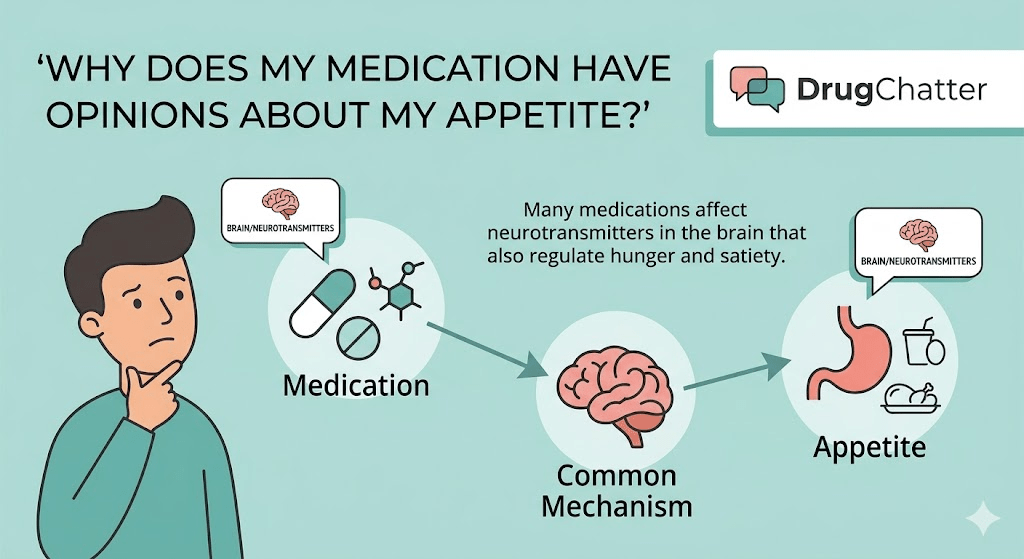
Mechanistically, this is expected—GLP-1 receptor agonism is doing several things at once: slowing gastric emptying, shifting satiety signaling, and altering reward pathways tied to food. But patients rarely describe it in mechanistic terms. They describe it as “food got quieter.”
Then come the side questions, which are really side-effect boundary tests:
Taken together, these aren’t random adverse-event hunting. They’re attempts to map a new pharmacological territory: a drug that meaningfully changes energy intake tends to ripple through multiple physiological systems, not just weight.
This is where endocrinology meets market dynamics. Tirzepatide and semaglutide aren’t just therapies; they’ve become comparative tools in a real-world experiment patients are running on themselves.
2. Appetite suppression isn’t always metabolic
Not all weight change drugs are designed for obesity.
Some of them just… accidentally interact with appetite.
Take Adderall, where weight-related effects are not the primary indication but show up in lived experience anyway:
This is pharmacology 101: stimulant effects, catecholamine signaling, and reduced appetite. But clinically, it creates a recurring tension—therapeutic benefit for ADHD on one axis, unintended weight change on another.
It’s a reminder that “side effects” are often just pharmacology doing what pharmacology does, but in a different context than intended.
3. Antidepressants and the slow creep problem
Weight change here is often less dramatic but more socially visible over time.
SSRIs like escitalopram sit in a complicated space: some patients experience weight neutrality, others gradual gain, others no change at all. The variability itself becomes the story.
Unlike GLP-1 drugs, where effects are often obvious and rapid, antidepressant-associated weight change tends to be slow enough that causality is hard to pin down—diet shifts, mood improvement, activity changes all entangle with pharmacology.
This is where patient forums become de facto pharmacovigilance databases, albeit messy ones.
4. The comparison economy: newer weight drugs vs everything else
Once a drug class starts producing visible weight loss, comparisons become inevitable:
GLP-1s vs each other
GLP-1s vs older agents
GLP-1s vs “natural appetite changes” (stress, lifestyle, other meds)
Even within the same class, patients are essentially running informal head-to-head trials in real time. The question “which is better?” is rarely just about efficacy—it’s about tolerability, sustainability, and identity (“can I live with this drug long-term?”).
5. The uncomfortable truth: weight is not a clean endpoint
What these questions reveal—more than anything—is that weight change is not a single pharmacological variable.
It is a composite output of:
appetite signaling
GI tolerability
fatigue and energy levels
reward circuitry changes
sleep disruption or improvement
behavioral compensation
So when someone asks whether a drug causes weight loss or gain, the honest answer is usually: it depends on which of those systems dominates in that individual.
That’s not a satisfying answer, but it is a pharmacologically honest one.
Closing thought
If there’s a unifying theme in these DrugChatter questions, it’s that patients are doing something pharmacologists often struggle to do cleanly: they are integrating subjective experience into mechanistic reality.
GLP-1 agonists make that especially visible, but the same pattern shows up across stimulants, antidepressants, and even drugs not remotely designed with weight in mind.
The scale, in other words, is not just reading biology. It’s reading pharmacology interacting with behavior in real time.
And that makes it one of the most sensitive readouts we have—just not always the easiest to interpret.