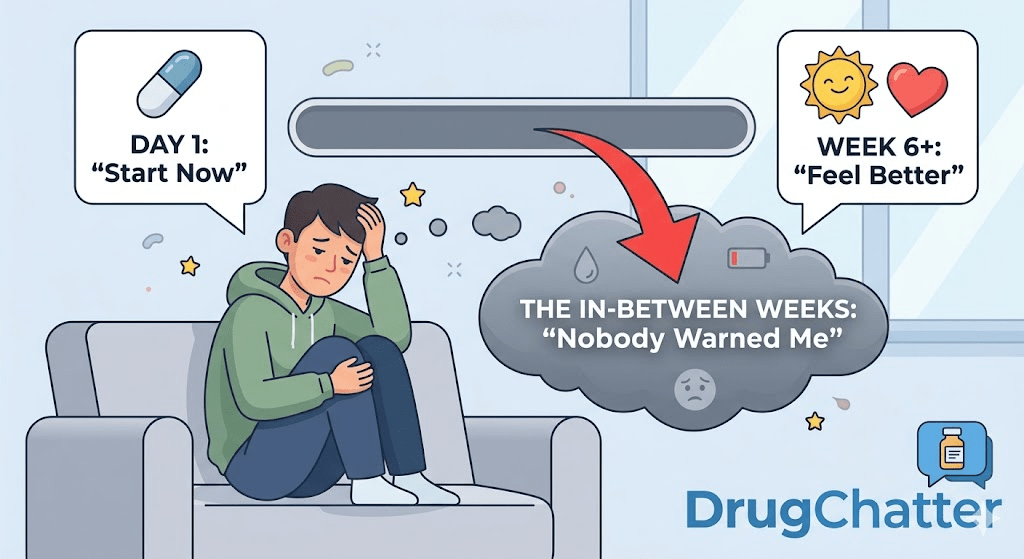
There’s a strange thing that happens in antidepressant discussions: everyone talks about the start (the “it finally kicked in” moment), and the stop (the “I feel like myself again” story), but almost nobody talks about the messy middle—dose changes, switching SSRIs, and the body’s reluctance to update its internal settings on schedule.
On DrugChatter, that middle shows up everywhere. Not as theory, but as accumulated lived confusion.
And if you zoom out—SSRIs, SNRIs, benzodiazepines, adjunct anxiolytics—you start to see a pattern that looks less like pharmacology and more like negotiation.
SSRIs: the expected effects, and the ones nobody agrees on
Take escitalopram. The clinical narrative is clean: improve mood, reduce anxiety, stabilize affect. The lived narrative is less tidy.
People don’t just ask “does it work?” They ask what it does to daily function.
Some notice fatigue lifting, or not lifting at all:
Others are tracking something more subtle—weight change during the start/stop cycle, which often becomes a proxy for “what is this doing to my body overall?”:
What stands out is not the variability (that’s expected), but the attempt to quantify it. People are not just asking for outcomes—they’re trying to map personal physiology onto a drug class that was never designed to be predictable at the individual level.
Emotional blunting: the trade nobody explicitly signs
One of the most recurring SSRI-adjacent concerns is emotional flattening. Not sedation. Not numbness in the neurological sense. Something more subjective: the sense that highs and lows have been sanded down.
This is where clinical language starts to strain. “Efficacy” improves, but “range of feeling” can narrow. Some patients accept that trade willingly. Others experience it as loss, not stabilization.
And that distinction matters more than the prescription.
Switching and stopping: where SSRIs become unpredictable
If SSRIs are often discussed as “maintenance drugs,” the reality is that maintenance depends on staying on them. The moment switching enters the picture, predictability drops sharply.
Even something as routine as starting and stopping escitalopram becomes a way to observe how slowly the system recalibrates:
This is where discontinuation effects, rebound symptoms, and timing mismatches tend to get bundled together in patient reports. The pharmacology is known. The experience is less linear.
Clinically, switching between SSRIs is usually described as straightforward (cross-taper, washout if needed). In practice, patients often describe a lagging nervous system—like hardware running new software but still caching old preferences.
Anxiety meds layered on top: benzodiazepines and beyond
SSRIs rarely exist in isolation in real-world treatment narratives. Anxiety spikes, sleep issues, and adjustment periods often introduce additional agents.
Take alprazolam (Xanax). Even the question of whether generic versions “feel” the same shows how subjective anxiolysis can be:
These aren’t SSRIs, but they show how treatment pathways often become layered systems rather than single-drug solutions. SSRIs set a baseline. Benzodiazepines often get used as a correction layer. That interaction is where dependence risk and escalation concerns tend to emerge clinically.
Side effects that blur categories: sedation, cognition, and “function”
Not all concerns are about efficacy. Some are about daytime functioning—the kind that determines whether a medication “fits” into a life.
Hydroxyzine is a good example. It’s not an SSRI, but it frequently appears in the same conversations about anxiety management:
Then there are drugs like pregabalin (Lyrica), used for neuropathic pain but often appearing in anxiety-adjacent contexts. The concern shifts toward long-term tolerability:
The common thread isn’t category—it’s sustainability. Can the drug be lived with, not just taken?
Adjunct antidepressants and off-label reality
Not all mental health pharmacology routes through SSRIs. Tricyclics and atypical agents still occupy important niches, especially where pain, sleep, and mood overlap.
Amitriptyline, for example, often shows up in chronic pain contexts:
Buspirone (Buspar), meanwhile, sits in the “not quite SSRI, not quite benzodiazepine” category and is often evaluated in terms of functional anxiety relief:
These are not edge cases—they’re reminders that “mental health medication” is not a single mechanism class, but a toolkit assembled under constraint.
The underlying pattern: stabilization is not instant
If there’s a unifying theme across SSRIs, switching, and withdrawal concerns, it’s this:
These drugs are often biologically gradual but experientially abrupt.
Effects build slowly.
Changes feel fast.
Transitions feel noisier than starts.
That mismatch is where most of the questions live—not in whether the drugs “work,” but in how long it takes for the nervous system to agree with the prescription.
Or, more bluntly: the brain doesn’t read the label.