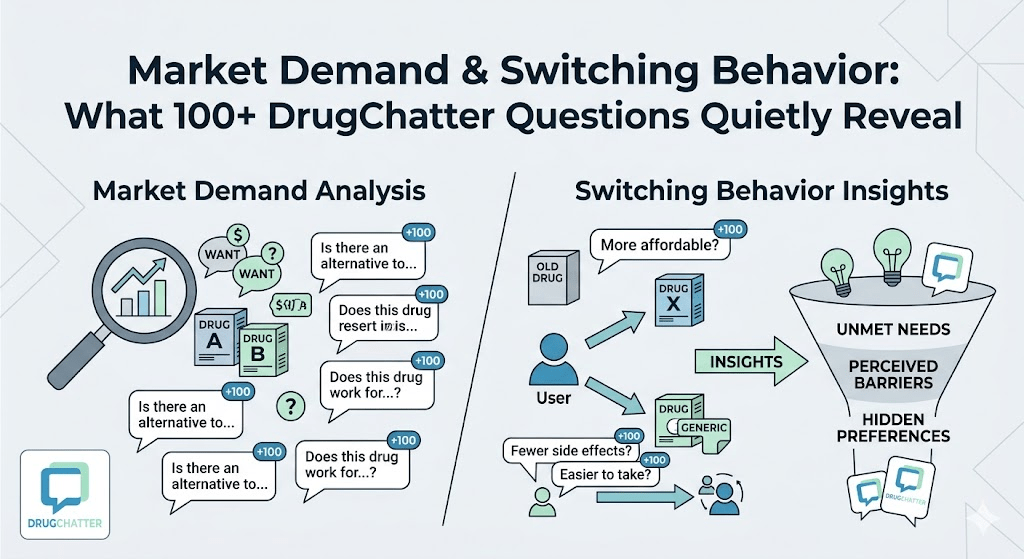
Nobody switches drugs because they want to. They switch because something stops working.
If you strip away the clinical jargon and look only at the questions people actually ask, a pattern starts to emerge.
Not “what does this drug do?” But: “Is this still the right drug for me?” And more importantly: “What else can I take instead?”
That’s the real market signal.
Across immunotherapies, statins, antivirals, weight-loss drugs, and even OTC painkillers, demand isn’t driven by novelty alone. It’s driven by friction: side effects, incomplete efficacy, cost, interactions, and fear.
Or in Derek Lowe terms: biology meets inconvenience, and inconvenience often wins.
1. When efficacy meets tolerability: the immunotherapy problem
Take checkpoint inhibitors like Yervoy.
The clinical story is powerful, but the lived experience is more complicated. Questions cluster around toxicity, prior chemo effects, and combination regimens:
This is switching pressure at its most biologically grounded: patients don’t “prefer” another therapy — they are sometimes pushed away from one by immune-related toxicity profiles.
Even combination oncology regimens amplify this. When toxicity stacks, demand shifts toward “better tolerated” alternatives, even if efficacy is comparable on paper.
2. The antibiotic illusion: short course, long uncertainty
This is where switching behavior becomes dietary, behavioral, and psychological. The drug doesn’t change — the user’s life around it does.
Even mild uncertainty (“Does this interact with my breakfast?”) can push people toward perceived “cleaner” alternatives like non-statin lipid-lowering agents (e.g., PCSK9 inhibitors such as Repatha).
4. The Ozempic effect: demand shaped by outcomes, not molecules
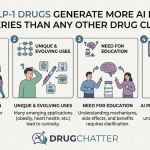
Few classes show switching pressure more clearly than GLP-1 therapies.
This is textbook switching behavior: once a therapeutic class proves demand, the competition shifts from “does it work?” to “which version works best for me specifically?”
Convenience (oral vs injection), side effects, and insurance coverage all become equally powerful drivers.
5. Side effects as the real switching engine
Across categories, adverse events quietly dominate decision-making.
This is subtle but important: patients don’t abandon therapy outright — they renegotiate it around real life. When that negotiation becomes too complex, switching becomes attractive.
The pattern underneath everything
Across all these categories, the same structure repeats:
A drug works
Side effects, interactions, or cost create friction
Patients reinterpret risk
Alternatives appear more “livable”
Demand shifts
Not because the science changed — but because the experience of the drug did.
That’s the real market signal hiding in these questions.
Not efficacy curves. Not receptor affinity charts.