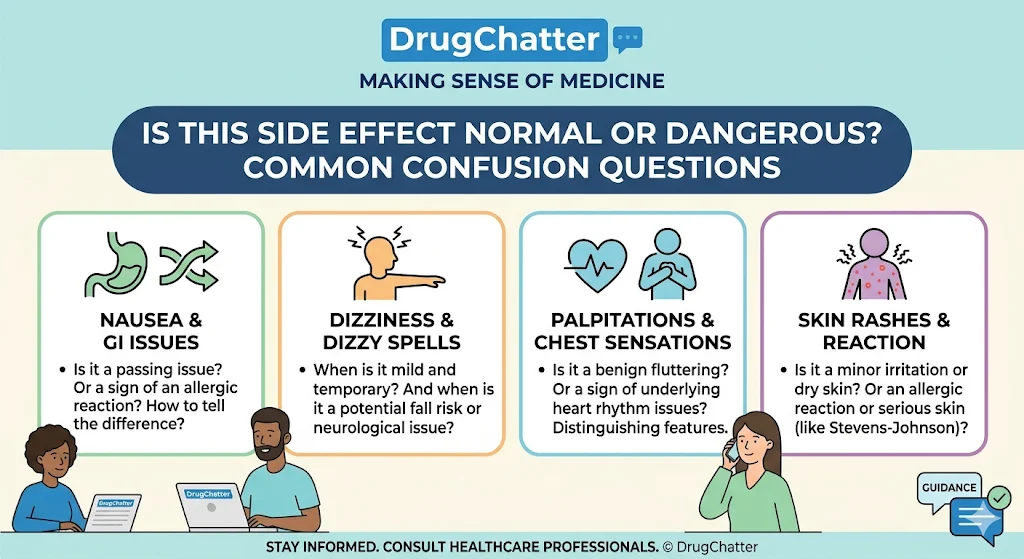
There’s a particular kind of message that shows up again and again in medicine: the one that starts with a symptom, then immediately asks whether it’s “normal” or “dangerous.” It’s understandable. Most people don’t wake up thinking about adverse events; they wake up thinking about their day. Then a new sensation appears—nausea, dizziness, a rash, a weird lab result, a price shock, a “wait, is this supposed to happen?” moment—and suddenly the internet becomes a triage nurse.
But here’s the problem with the phrase “normal or dangerous?” It compresses two very different tasks into one question. Sometimes the answer is about expected side effects and time course. Sometimes it’s about red flags that should trigger urgent medical evaluation. And sometimes—often, actually—it’s about confusion created by the way drugs are marketed, prescribed, and explained.
Below are some of the most common “confusion questions” people bring to DrugChatter—the kinds of queries that reflect that exact moment of uncertainty. Use them as a map for what to ask your clinician, what to watch for, and what not to ignore.
1) The “Is this side effect normal?” question that really means “Should I stop?”
When people ask about side effects, they’re often trying to decide whether the medication is still safe to take. That’s not just a comfort question—it’s a safety question.
2) The “I’m on a common drug—does that change what’s dangerous?” question
People take aspirin, statins, and other everyday meds for years. Then a new symptom appears, and suddenly the question becomes: does the background medication make this more or less concerning?
3) The “My body feels different—could the drug be doing that?” question
Sometimes the symptom is subtle: mood changes, blood pressure changes, timing questions. These can be benign—or they can be early warning signs. Either way, the uncertainty is the point.
4) The “I’m supposed to report this—right?” question
Many people don’t know whether they should call their prescriber for side effects, especially when the symptom is uncomfortable but not obviously an emergency. The safest approach is usually to report anything new, persistent, or worsening—particularly if it could signal a serious reaction.
5) The “Dose/timing” confusion that can masquerade as a side-effect problem
Sometimes the “danger” feeling comes from timing: taking the wrong dose at the wrong time, or expecting an effect on a schedule the drug doesn’t follow. That’s not the same as a true adverse reaction, but it can still be risky.
People worry that a switch—from brand to generic, or between formulations—might change side effects. That concern is common, and it’s not irrational. While generics are designed to be equivalent, individual tolerance can vary, and the practical details (dose form, excipients, and patient factors) can matter.
Sometimes the confusion isn’t about the symptom at all—it’s about the medication itself. If you don’t know what the drug is, what it’s for, or what it can do, then every new sensation becomes a mystery.
Food, alcohol, and other lifestyle factors can change how a drug behaves. When people feel “off,” they often wonder whether something they ate or drank is to blame—or whether the drug is.
9) The “Is this normal for this condition?” question (the hidden variable)
Sometimes the symptom is related to the underlying disease, not the medication. That’s why the question “normal or dangerous?” can be so hard: the baseline health status changes the interpretation.
When uncertainty is high, people want a clear next step: what to do, who to call, and what to watch for. That’s the right instinct. The trick is to ask in a way that gets you actionable guidance.
“Normal or dangerous?” is a natural question—but it’s also a question that benefits from structure. If you’re dealing with a new symptom, try to bring your clinician (or pharmacist) three things: (1) when it started and whether it’s changing, (2) what else you’re taking (including OTC and supplements), and (3) whether you have any red-flag symptoms (trouble breathing, swelling of face/lips, chest pain, fainting, severe weakness, or signs of severe allergic reaction).
And if you’re looking for more context on how people think through these uncertainties—drug switching, side-effect differences, timing, and interaction questions—start with the links above and then bring the answers back to your own situation.