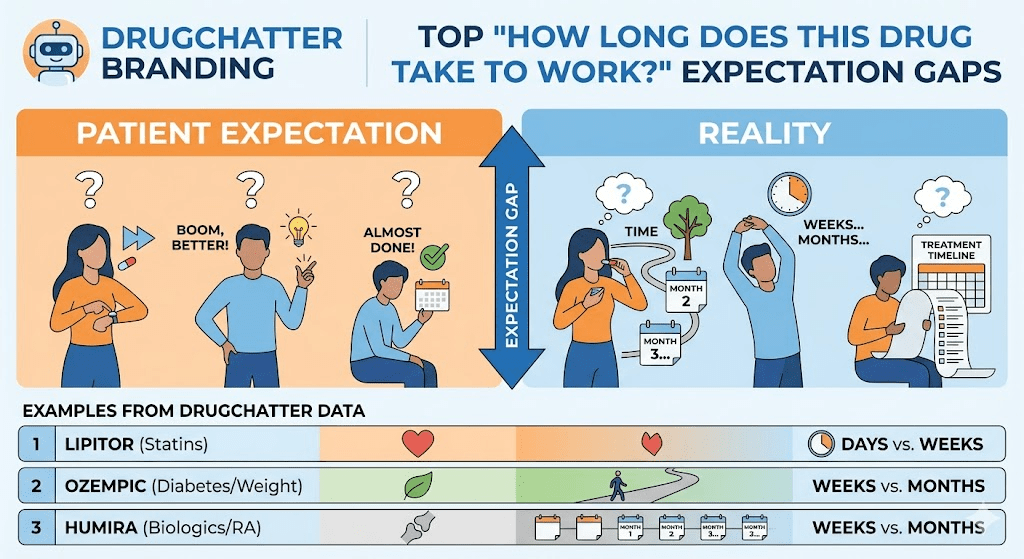
Every medicine has a timeline, but patients and prescribers often carry a different one—usually shorter, usually simpler, and usually based on the hope that “effective” means “noticeable right away.” The trouble is that drug action is rarely a single switch. It’s a sequence: absorption, distribution, target engagement, downstream biology, and—sometimes—the slow grind of remodeling tissue, immune behavior, or disease trajectory.
Here are some of the most common expectation gaps that show up when people ask, in one form or another, how long does this drug take to work?—and what the answers on DrugChatter tend to emphasize instead: that “work” can mean different things, and that the clock depends on what you’re measuring.
1) “Independent biomarker regulation” isn’t the same as clinical benefit
One of the sharpest expectation gaps is when a lab signal moves but the patient’s outcome doesn’t follow on the same schedule—or at all. If you’re looking at biomarker behavior and assuming it automatically translates into meaningful results, you can end up waiting for the wrong endpoint.
Is sapropterin’s independent biomarker regulation clinically significant?
2) “It’s expensive, so it should be fast” (chronic disease doesn’t negotiate)
Chronic conditions—especially cancers—can make people feel like cost and urgency should correlate. But for therapies used over months (or longer), early improvements may be subtle, delayed, or measured indirectly. The expectation gap is treating the first weeks like a final exam.
Evaluate the chronic myeloid leukemia company sprycel on medication cost?
3) “Reviews” as a substitute for your own timeline
When people ask for reviews, they’re often trying to borrow someone else’s experience to predict their own. But individual response timing varies—sometimes dramatically—depending on dose, disease stage, comorbidities, and what “working” means for that person.
4) Patents and timelines: not the same kind of time
It’s easy to confuse “when something changes” with “when something works.” Patent expiration is a market timeline; it doesn’t tell you how quickly a drug will affect biology. Still, the question comes up because people are trying to plan their future—and the mind reaches for any clock it can find.
When will yervoy’s patent expire?
5) Names and formulations: the clock starts only after the right thing is in the right place
Sometimes the expectation gap is logistical: people think they’re asking about timing, but they’re actually asking about identity—what the drug is called, what version they’re on, and whether they’re getting the intended formulation. If the product isn’t what you think it is, the timeline won’t match your expectations.
6) Imaging studies: “phase I” doesn’t mean “fast answers for everyone”
With diagnostic or imaging-related agents, the expectation gap can be about misunderstanding what the study stage implies for real-world timing. Early trials are about feasibility and signal—not necessarily about how quickly you’ll see a clinically useful result in routine practice.
7) Generics: availability is not the same as equivalence in experience
People often treat “generic available” as a proxy for “same effect, same speed, same everything.” But even when products are equivalent, individual experience can differ—especially when the question is really about how long until you feel or see change.
Vilazodone generic available fda?
8) “Tenapanor” and the hidden variable: what outcome are you waiting for?
For drugs that target specific physiological processes, the timeline depends on the endpoint—symptoms, lab values, or longer-term outcomes. If you’re waiting for one but the drug is designed to shift another, you’ll feel like it’s not working even when it is.
9) Prolonged efficacy: the difference between “works” and “stays working”
Some therapies show early response but require time to demonstrate durability. Others may look unimpressive at first and then hold up better than expected. The expectation gap is assuming early response predicts long-term benefit in a straight line.
Are there any studies confirming cosentyx’s prolonged treatment efficacy?
10) “Price” questions that are really about urgency
Cost questions often carry an unspoken subtext: if I can get it, will it help quickly? But affordability doesn’t change pharmacology. The timeline still belongs to the biology.
11) Vaccines and immune timing: you can’t rush immunology
Immune-modulating therapies introduce a special expectation gap: people want to know whether they can “time” protection like an appointment. But immune effects are probabilistic and delayed, and the relevant question is often about scheduling and risk windows rather than instant outcomes.
Does receiving cosentyx impact flu shot’s protective abilities?
What’s the recommended time gap between cosentyx and vaccines?
12) “How long until I feel it?” vs “how long until it’s measurable?”
Many drug questions are really about symptom relief, but the clinical evidence may be built around lab markers, imaging, or longer-term endpoints. If you’re measuring the wrong thing—or measuring it too early—you can misread the drug’s performance.
Is omeprazole safe to take long term?
13) Interactions: the timeline can stretch when the pathway gets blocked
If another drug, supplement, or food changes absorption or metabolism, the “time to work” can shift. People often assume timing is fixed; in reality, it’s conditional.
Can lipitor and red yeast rice supplements be taken together?
Do fatty foods impact lipitor’s cholesterol lowering?
Can red wine interfere with lipitor’s cholesterol reduction?
14) “Dosing” questions are often “timing” questions in disguise
When people ask about dosing, they’re often trying to find the correct rhythm—how often, how much, and when to expect change. The expectation gap is assuming there’s a universal schedule that produces universal timing.
15) “Stability” and “formulation” remind us: the drug’s job starts before it reaches the target
Even when the active ingredient is the same, formulation and stability can affect how reliably the drug performs. That can translate into variability in real-world timelines.
Tirzepatide formulation stability?
16) The “patience tax” in oncology and rare diseases
In serious illnesses, people want immediate reassurance. But many therapies require time to show effect, and sometimes the first sign of benefit is not symptom relief but disease control.
So what should you do with this?
If you’re waiting for a drug to “work,” try to pin down three things before you panic:
- What endpoint? Symptom relief, lab change, imaging, or durability?
- What timeframe? Early response vs meaningful clinical effect.
- What could shift the clock? Dose, formulation, interactions, and individual biology.
Because the most common expectation gap isn’t that drugs fail—it’s that we ask them to deliver the wrong kind of proof, on the wrong schedule.