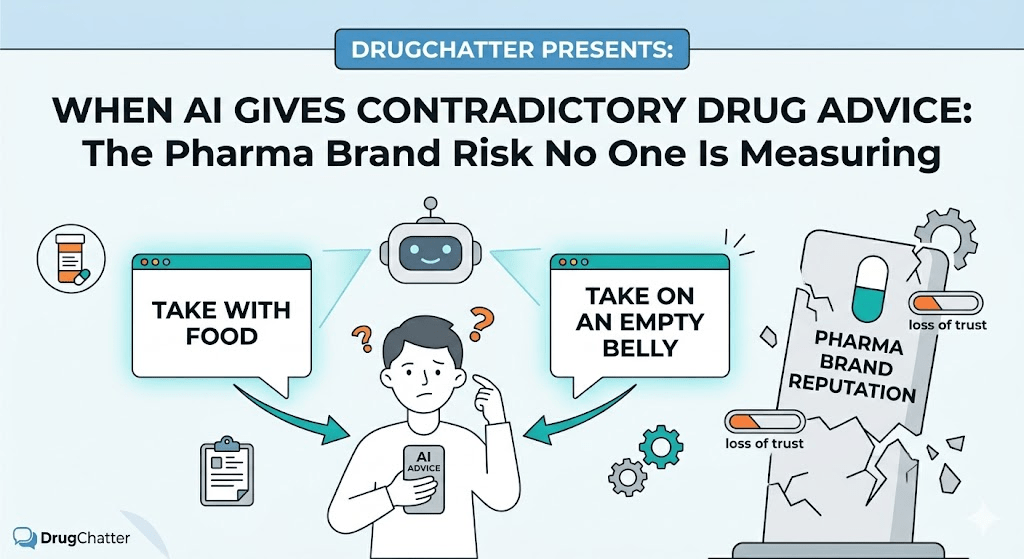
Ask ChatGPT whether Ozempic is safe for patients with a history of pancreatitis. Then ask Gemini. Then ask Perplexity. You will get three different answers, each delivered with the calm authority of a clinician who has seen thousands of patients.
None of them has seen a single patient.
The answers will differ not just in tone but in substance — recommended dosing thresholds, contraindication severity, even the fundamental question of whether the drug should be used at all in that population. One model might cite the FDA label. Another might synthesize Reddit threads, clinical trial abstracts, and a 2021 meta-analysis that has since been contested. A third might hallucinate a drug interaction entirely.
For pharmaceutical companies, this is no longer a hypothetical problem. It is a live regulatory, brand, and pharmacovigilance challenge that most drug makers are barely beginning to understand.
“Across a sample of 1,800 AI-generated responses to drug safety questions, researchers at the University of California San Diego found that 28 percent contained at least one clinically meaningful inaccuracy — with 11 percent describing contraindications that were either fabricated or directly contradicted by the current FDA label.” — Journal of the American Medical Informatics Association, 2024
This article examines what contradictory AI drug advice looks like in practice, why it happens, what the regulatory exposure means for pharma brand teams, and how leading companies are beginning to monitor and respond to it.
Why AI Models Disagree About the Same Drug
How Training Data Shapes What an LLM ‘Knows’ About a Medicine
Large language models do not retrieve drug information from a live, curated database. They compress statistical patterns from text corpora that may include FDA labels, PubMed abstracts, patient forum posts, news articles, drug manufacturer press releases, and miscellaneous web content — all weighted together without explicit hierarchy.
The result is that a model’s response to a drug safety question reflects whatever the preponderance of its training data said about that topic, at whatever moment the corpus was assembled. If the majority of online text about a drug was written before a black box warning was added, the model may underweight that warning. If a single high-traffic patient forum had an active thread claiming a drug causes hair loss (a known nocebo effect unsupported by clinical evidence), that signal may appear in the model’s outputs at a frequency far exceeding its clinical relevance.
This is not a bug that can be patched. It is a structural property of how large language models work.
Why Different LLMs Give Different Answers to the Same Drug Question
OpenAI’s GPT-4o, Google’s Gemini 1.5 Pro, Anthropic’s Claude, Meta’s Llama 3, and Perplexity’s retrieval-augmented models were each trained on different corpora, with different cutoff dates, different fine-tuning instructions, and different safety filters applied post-training.
When you ask all five whether a patient on warfarin can safely take ibuprofen, the responses diverge across several dimensions:
Whether the interaction is described as “contraindicated,” “use with caution,” or simply “monitor closely”
Whether bleeding risk is quantified or described qualitatively
Whether the model recommends the patient call their pharmacist, consult their physician, or simply avoid the combination
Whether any specific INR thresholds are mentioned — and if so, which ones
A patient navigating these answers without clinical training has no framework for evaluating which response is correct. A physician using an AI tool for quick reference has little visibility into which training corpus the model drew from or how current it is.
The Role of Retrieval Augmentation — and Its Limits
Perplexity and Bing Copilot use retrieval-augmented generation (RAG), pulling live web content into their responses. This addresses the training cutoff problem but creates a different one: the quality of the answer depends on the quality of the retrieved sources. If the top search results for a drug query include a patient blog, a competitor’s branded content, and a Wikipedia article last edited by an anonymous user in 2019, those sources shape the answer.
RAG also introduces citation inconsistency. Two identical queries submitted minutes apart may retrieve different source documents and produce materially different responses. For a pharmaceutical company trying to understand what AI is saying about their drug, this makes systematic monitoring harder, not easier.
What AI Hallucinations About Drugs Actually Look Like
Real Examples of AI Getting Drug Safety Wrong
The academic literature on LLM medical accuracy is growing fast. A 2023 study published in JAMA Internal Medicine tested ChatGPT on 284 questions from the USMLE Step 1 and Step 2 clinical knowledge exams. The model passed both — but on drug-specific pharmacology questions, accuracy dropped to 71 percent, with error rates climbing when questions involved drug interactions, contraindications, or pregnancy categories.
Specific documented failure patterns include:
Misattributing side effects from one drug to a structurally similar but clinically distinct drug in the same class (e.g., conflating SGLT-2 inhibitor adverse event profiles)
Describing drugs as FDA-approved for indications where they are only approved under accelerated approval with post-marketing requirements still pending
Providing dosing guidance that reflects European Medicines Agency labeling rather than FDA labeling, without flagging the geographic discrepancy
Describing drug interactions that appear in older pharmacology references but have been revised or downgraded in current clinical guidelines
When AI Recommends the Wrong Drug Entirely: Case Patterns
In mid-2024, researchers at Stanford published results from a study in which they posed 60 clinical drug queries to multiple LLMs. In 14 percent of cases, the model recommended a pharmacological alternative that was either contraindicated in the stated patient population or not indicated for the described condition.
One illustrative pattern: queries about managing breakthrough pain in patients already on opioid therapy. Several models recommended starting doses of opioids without flagging that the patient’s existing regimen should be considered first — a clinically dangerous omission in a population at elevated overdose risk.
Another recurring failure: queries about medications during pregnancy. Models inconsistently applied FDA pregnancy categories (themselves phased out in 2015 in favor of the Pregnancy and Lactation Labeling Rule), sometimes reverting to deprecated Category A/B/C/D/X language rather than the current labeling framework.
Off-Label Drug Recommendations in AI Search: What’s Actually Happening
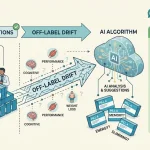
Off-label drug use is legal and clinically common. What is not legal is pharmaceutical manufacturers promoting off-label uses. AI models occupy a regulatory gray zone: they are not pharmaceutical companies, and they are not physicians. But they are telling patients things about drugs that the FDA has not approved those drugs to treat.
A 2024 analysis by researchers at Harvard Medical School found that when patients queried AI chatbots about conditions for which no approved therapy exists, models recommended off-label use of existing drugs in 67 percent of cases — often without flagging that the use was off-label. For pharma brand teams, this is a double-edged issue: AI may be driving patients toward their drug for unapproved uses, which could be seen as creating commercial opportunity, or it may be driving patients away from their drug toward a competitor’s product used off-label.
Either scenario has regulatory implications. FDA’s Office of Prescription Drug Promotion has not yet issued formal guidance on AI-generated off-label mentions, but the agency has signaled that it is watching the space closely.
The FDA’s Position on AI-Generated Drug Misinformation
Can AI Hallucinations About Drugs Trigger FDA Action?
The short answer is: not directly, not yet — but indirectly, yes, and the exposure is growing.
FDA’s current authority over drug information applies to manufacturers, distributors, and certain third parties who promote or label drugs. AI companies are generally not in that regulatory chain unless they are making specific therapeutic claims in a commercial context. A general-purpose chatbot that inaccurately describes a drug’s side effect profile is, at least under current frameworks, not subject to FDA enforcement action in the way a pharmaceutical company’s promotional material would be.
But the implications for pharma companies are real on several dimensions:
Adverse event reporting obligations may be triggered if a company becomes aware, through AI monitoring or other channels, that patients are experiencing harm related to AI-generated drug advice
FDA warning letters have cited companies for failing to correct third-party drug misinformation in contexts where the company had a relationship with the publisher — a principle that could theoretically extend to AI platforms where a company has a commercial arrangement
The FTC has authority over health misinformation that causes consumer harm, separate from FDA’s jurisdiction
FDA Warning Letters and the Third-Party Correction Doctrine
FDA’s position on third-party drug information has evolved through enforcement practice rather than formal rulemaking. In 2014, the agency issued a warning letter to a pharmaceutical company for failing to correct misleading drug information on an independent physician-rating website — even though the company did not create or control the content. The theory was that the company had a financial relationship with the platform and had failed to exercise reasonable oversight.
The principle has not yet been tested against AI platforms, but the logic is there. If a pharmaceutical company maintains a promotional agreement with an AI health platform and that platform’s outputs systematically misrepresent the company’s drug, questions about the company’s disclosure and correction obligations will arise.
Pharmacovigilance in the Age of AI: What the EMA Is Watching
Europe’s regulatory posture is, characteristically, more prescriptive. The European Medicines Agency’s good pharmacovigilance practice (GVP) guidelines already require marketing authorization holders to monitor social media and digital channels for adverse event signals. The EMA has indicated that AI-generated content falls within the definition of “digital channels” for GVP purposes.
What this means practically is that a European drug company with a pharmacovigilance system that does not include AI-generated content in its signal detection scope may be out of compliance with GVP Module VI. The FDA has not issued equivalent formal guidance, but its 2022 Real-World Evidence framework and subsequent AI/ML guidance documents signal a trajectory toward similar requirements.
How Patients Are Actually Using AI to Ask About Their Medications
What Drug Questions Patients Ask ChatGPT, Gemini, and Perplexity
The shift from search engine to AI assistant for health queries is measurable and accelerating. A 2024 survey by the Kaiser Family Foundation found that 38 percent of U.S. adults had used an AI chatbot to get health information in the past year, up from 18 percent in 2022. Among adults under 35, the figure was 54 percent.
Drug-specific queries dominate health AI usage. The most common query categories, based on search pattern analysis and user surveys:
Side effect questions (“does Metformin cause weight loss?”)
Drug interaction checks (“can I take Tylenol with Eliquis?”)
Dosing questions (“what is the maximum daily dose of Adderall for adults?”)
Comparison questions (“is Mounjaro better than Ozempic for weight loss?”)
Each of these query types carries different risk profiles for both patients and pharma companies. Side effect questions answered incorrectly may cause patients to discontinue effective therapy. Interaction questions answered incorrectly may cause harm. Comparison questions answered by models with outdated or biased training data may distort market dynamics.
How Patient Drug Queries Differ Between AI Chat and Google Search
AI queries about drugs tend to be longer, more context-specific, and more likely to include patient-specific variables than traditional search queries. A patient searching Google might type “Jardiance side effects.” The same patient asking Claude might write: “I’m a 62-year-old woman with Type 2 diabetes and mild CKD. My doctor wants to put me on Jardiance but I’m worried about UTI risk because I’ve had recurrent UTIs. Is this a real concern and what should I ask my doctor?”
That level of specificity creates a fundamentally different information retrieval problem. Google returns web pages; the patient can evaluate sources. An AI model synthesizes an answer that feels authoritative and personalized, without disclosing the uncertainty or the source mix that generated it.
For pharma brand teams, this distinction matters. Traditional search monitoring — tracking Google rankings for branded drug terms — captures a fundamentally different data stream than monitoring what AI assistants say in response to specific patient questions. The two require different tools and different analytical frameworks.
Are Patients Following AI Drug Advice? What the Data Shows
There is limited but growing evidence that patients do act on AI drug advice, particularly for decisions that feel low-stakes or that confirm what they wanted to hear. A 2024 study from the Mayo Clinic found that 22 percent of patients who had used AI for medication questions reported changing their medication behavior — including stopping a prescribed medication, adjusting their dose, or starting an OTC drug — based on AI guidance, without consulting their physician.
The implications for adherence are significant. For chronic disease drugs, adherence rates are already a major commercial challenge. If patients are using AI to rationalize discontinuation of effective therapy based on AI-generated side effect information that may be inaccurate or miscontextualized, that is both a patient safety issue and a commercial one.
How Often Do LLMs Mention Ozempic, Wegovy, and Mounjaro?
Tracking AI Share of Voice for GLP-1 Drugs
The GLP-1 receptor agonist market offers the clearest current example of AI drug mention dynamics, simply because of the volume of AI queries these drugs generate. Ozempic (semaglutide, Novo Nordisk), Wegovy (semaglutide higher dose, Novo Nordisk), and Mounjaro/Zepbound (tirzepatide, Eli Lilly) dominate AI health conversations in a way that no other drug class currently does.
Analysis of AI chatbot responses to standardized weight management queries shows consistent patterns: Ozempic is mentioned more frequently than Wegovy despite Wegovy holding the FDA-approved obesity indication, because Ozempic accumulated more internet text during the years of off-label use as a weight loss drug. This creates a brand visibility asymmetry that Novo Nordisk’s brand team cannot correct through traditional promotional channels.
For Eli Lilly, the picture is different. Mounjaro’s conversion to Zepbound for the obesity indication has not fully propagated through AI model training data. Models trained before mid-2024 may refer to Mounjaro in contexts where Zepbound is now the correct commercial reference, creating brand confusion that neither traditional SEO nor paid media can address.
Do AI Models Recommend Generic Drugs More Often Than Branded Drugs?
There is a structural bias in large language model outputs toward generic drugs in therapeutic classes where generics are available. This bias appears to stem from two sources: the preponderance of cost-related health literacy content in training data (which consistently recommends generics for cost reasons), and the fact that generic drugs have longer publication histories and therefore more accumulated text.
A systematic audit of LLM responses to treatment queries across 10 common conditions found that models recommended generic first-line therapy in 83 percent of cases where a generic equivalent was available, compared to 71 percent in standard prescribing practice data. The delta suggests that AI may be amplifying generic substitution preferences beyond what physicians themselves apply in practice.
For branded drug companies in categories with available generics — Humira biosimilars being the most dramatic current example — this AI-driven generic bias represents a concrete share-of-voice challenge that has no historical analog in pharmaceutical marketing.
Which Drugs Are Most Frequently Mentioned by AI Health Assistants?
Mention frequency in AI outputs correlates with a combination of drug familiarity (how widely known the drug is in the general population), controversy (drugs that generated significant media coverage appear more frequently), and recency relative to training cutoff. Based on available query analysis:
Ozempic, Humira, Lipitor (atorvastatin), Adderall, and metformin consistently generate the highest mention frequencies across general health queries
Newer biologics and specialty drugs are underrepresented relative to their clinical significance, because they have shorter publication histories
Drugs associated with major safety events (Vioxx, opioids, Zantac/ranitidine) appear disproportionately in responses to queries about drug safety in general, creating halo effects that affect patient perception of drug safety broadly
The Brand Risk of AI Contradictions: What Pharma Marketing Teams Are Missing
AI Share of Voice vs. Traditional Brand Tracking: What’s Different
Pharmaceutical brand teams have tracked share of voice in traditional media, physician panels, and patient surveys for decades. AI share of voice is different in three specific ways.
First, it is generative rather than editorial. A newspaper article about Keytruda is a fixed artifact. An AI response about Keytruda is generated fresh each time, with probabilistic variation. Two patients asking the same question may get meaningfully different answers. Traditional brand tracking measures what was published; AI monitoring must capture what was said, to whom, in what context.
Second, AI outputs affect decision-making at the moment of information-seeking. Search engine results direct users to content they then evaluate. AI assistants synthesize a recommendation directly. The influence is more proximate to action.
Third, AI outputs cannot be corrected through the usual channels. If a journalist writes something inaccurate about a drug, a communications team can issue a correction. If an AI model systematically mischaracterizes a drug, the correction pathway is unclear — model retraining is not something pharmaceutical companies can request on demand.
How AI Can Distort Physician Perception of a Drug Brand
Physician use of AI assistants for clinical reference is growing rapidly. A 2024 AMA survey found that 38 percent of physicians used AI tools at least occasionally for drug information — up from 14 percent in 2022. The tools most commonly cited were ChatGPT, followed by specialty clinical AI tools including Doximity’s GPT integration and Epic’s AI assistant.
When physicians use these tools to look up dosing, interactions, or clinical evidence for a specific drug, the quality of what they receive directly affects their prescribing confidence. A model that systematically underrepresents a drug’s efficacy data — because the training corpus included more skeptical commentary than supportive trial results — may subtly depress physician confidence in that drug relative to alternatives.
This is not detectable through traditional physician perception surveys that ask about drug attributes in the abstract. It requires monitoring what AI actually says about the drug when physicians ask about it.
Can AI Misinformation About Your Drug Affect Adverse Event Reporting Obligations?
This is the question that pharma regulatory affairs teams are beginning to wrestle with seriously, and the answer involves several layers.
Under 21 CFR 314.81 and equivalent regulations, manufacturers have reporting obligations when they become aware of adverse events associated with their drugs. “Awareness” has traditionally been defined around information received from healthcare providers, patients, and published literature. FDA’s 2022 guidance on electronic postmarketing safety reporting extended this to digital channels, including social media.
If AI-generated drug advice causes a patient to take a drug incorrectly and experience an adverse event, and the company becomes aware of this through patient contact or AI monitoring, a reportable adverse event may exist. The chain of causation runs through the AI model, but the company’s reporting obligation is triggered by awareness of the event, not its cause.
This creates a practical dilemma: the more systematically a company monitors AI outputs about its drugs, the more likely it is to become “aware” of potential adverse event signals — and thus the more rigorous its pharmacovigilance infrastructure needs to be to handle those signals appropriately.
How Eli Lilly and Novo Nordisk Are Responding to AI Drug Mentions
What We Know About Big Pharma’s AI Monitoring Programs
Neither Eli Lilly nor Novo Nordisk has publicly disclosed the specifics of their AI monitoring programs, but public filings, conference presentations, and vendor disclosures offer a partial picture.
Lilly’s digital health and medical affairs teams have been particularly active in the GLP-1 monitoring space. Lilly has acknowledged at multiple industry conferences that AI misinformation — particularly about Mounjaro’s efficacy claims, supply constraints, and off-label use in non-diabetic populations — represents a priority monitoring category for their brand protection function.
Novo Nordisk has a documented history of aggressive digital monitoring, partly out of necessity: no drug in recent years has attracted the volume of AI-generated content, patient forum discussion, and social media attention as Ozempic. The company’s global communications team tracks AI mentions as part of a broader brand intelligence function that also covers Reddit, TikTok, and news media.
Both companies have invested in monitoring vendors who can systematically query multiple AI platforms with standardized drug question sets, track response patterns over time, and flag deviations from approved label language. DrugChatter is among the platforms used by pharma brand and medical affairs teams for this purpose — offering AI-specific drug mention monitoring that covers branded and generic drug references across LLM outputs.
The Emerging Role of Medical Affairs in LLM Response Quality
Medical affairs functions are acquiring a new mandate: ensuring that accurate, label-consistent information about a company’s drugs has sufficient presence in the sources that AI models draw from. This is not promotional activity — it is information ecosystem management.
The practical interventions available include publishing high-quality, label-consistent clinical content through channels that AI models index, ensuring that clinical trial results are published in formats accessible to AI training pipelines, and working with AI platform vendors on accuracy initiatives — some of which are now soliciting pharmaceutical company engagement.
Microsoft’s Bing team, Google’s Health AI team, and OpenAI have all initiated some form of healthcare accuracy program. These programs offer pharmaceutical and healthcare companies limited but real opportunities to flag systematic inaccuracies in AI outputs about their products.
Building a Pharmaceutical AI Monitoring Program: What Works
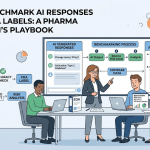
How to Track AI Mentions of Your Drug Across ChatGPT, Gemini, and Perplexity
The foundational challenge in pharmaceutical AI monitoring is that AI outputs are not static, indexed, or crawlable in the way web content is. You cannot run a Google search and find what ChatGPT said about your drug yesterday. You have to query the models directly, systematically, and repeatedly.
An effective monitoring program covers four elements:
Query library design: developing a standardized set of questions that represent how real patients and physicians actually ask about the drug, covering safety, efficacy, dosing, interactions, and comparisons
Multi-model coverage: running queries across at minimum ChatGPT (GPT-4o), Gemini 1.5 Pro, Claude, Perplexity, and Bing Copilot — with separate tracking for each because responses vary significantly
Temporal tracking: repeating the same queries over time to detect changes as models are updated, retrained, or have safety filters adjusted
Deviation flagging: comparing AI outputs against the current approved label, flagging instances where the AI’s claims deviate from label language in clinically meaningful ways
What to Do When AI Says Something Clinically Wrong About Your Drug
There is no clean playbook for this, because the enforcement and correction mechanisms are still evolving. But several response strategies have emerged from early-mover companies.
First, document everything. Capture the query, the model version, the date, and the full response. This documentation may be relevant for regulatory purposes, and it establishes a record of awareness for pharmacovigilance and legal functions.
Second, engage the platform’s healthcare accuracy channels where they exist. Google, Microsoft, and OpenAI each have some form of health content accuracy program. These programs are imperfect and slow, but they represent a legitimate escalation path.
Third, address the information ecosystem. If AI models are saying something clinically wrong about a drug because the available training data is thin, biased, or outdated, the most durable fix is publishing better data — through peer-reviewed journals, clinical evidence databases, and medical education content that AI models are likely to incorporate in future training cycles.
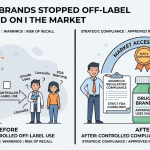
How to Detect Off-Label AI Recommendations Before They Become a Compliance Problem
Off-label AI recommendations are particularly difficult to manage because they often represent things the AI is saying in the company’s commercial interest — recommending the drug for uses beyond the label — while simultaneously creating regulatory exposure. A company that becomes aware that AI models are consistently recommending its drug for an off-label use has to navigate a compliance question: does awareness of that recommendation create any obligation?
The most defensible position is to document the awareness, consult with regulatory counsel on reporting implications, and refrain from any activity that could be construed as encouraging or amplifying the off-label recommendation. The monitoring program itself should be designed so that its outputs feed into the pharmacovigilance function, not the commercial function — creating an internal information barrier that protects the company from the appearance of exploiting off-label AI signals commercially.
Can AI Outputs Be Used Directly for Pharmacovigilance Signal Detection?
Several pharma companies and academic groups are now exploring whether AI-generated drug content — specifically, AI responses to patient-submitted drug queries — can serve as a pharmacovigilance signal source. The logic is straightforward: if thousands of patients are asking AI assistants about a specific side effect of a specific drug, that query pattern may represent an emerging safety signal before it appears in adverse event databases.
This is a legitimate and promising area, but it requires careful methodology. AI queries reflect what patients are worried about, which is not the same as what patients are experiencing. Fear, media coverage, and social contagion drive query patterns as powerfully as actual adverse events. A pharmacovigilance system that treats AI query frequency as a primary signal without appropriate validation risks generating false signals that divert attention from real ones.
The better use of AI query data in pharmacovigilance is as a hypothesis-generation layer — a source of candidate signals that are then validated against traditional FAERS data, claims data, and epidemiological sources before being escalated.
The Competitive Intelligence Dimension: What AI Says About Your Rivals
Comparing AI Share of Voice: Branded vs. Generic Drugs Across Query Types
AI share of voice analysis is not just about what AI says about your drug. It is about what AI says about your drug relative to competitors — including generics, biosimilars, and drugs in adjacent therapeutic categories.
A structured competitive AI monitoring program tracks:
How often your drug is mentioned relative to competitors in response to the same treatment-seeking query
Whether your drug is mentioned first, middle, or last in multi-drug responses (position matters for salience)
Whether AI describes your drug’s efficacy and safety in comparable terms to how it describes competitors, or whether there is systematic asymmetry
How AI models handle head-to-head comparison queries between your drug and specific competitors
What Reddit Drug Discussions Are Teaching AI Models About Your Brand
Reddit is a significant training data source for many large language models. The platform’s health-related communities — r/Ozempic has over 150,000 members; r/ChronicPain has over 220,000; r/diabetes has over 200,000 — generate enormous volumes of patient-generated drug experience content that is overwhelmingly anecdotal, emotionally charged, and unfiltered by clinical context.
When Reddit content becomes training data for AI models, the anecdotes become embedded in the model’s priors. A drug that generated a significant number of horror-story posts on Reddit — even if those posts were unrepresentative of typical patient experience — may be characterized by AI models in systematically more negative terms than clinical evidence supports.
Monitoring what Reddit communities are saying about your drug is therefore not just a social listening exercise. It is a forward-looking indicator of how AI models trained on that content will represent your drug in the future.
AI Drug Comparisons: When Models Recommend a Competitor Without Being Asked
One consistent pattern in pharmaceutical AI query analysis: models frequently volunteer competitive comparisons that were not requested. A patient asking “how does Dupixent work?” may receive a response that includes unprompted mention of Rinvoq or Skyrizi as alternatives. A patient asking about Entresto’s mechanism may receive a comparison to sacubitril/valsartan generics that are not yet widely available.
These unprompted mentions represent a share-of-voice dynamic that is entirely absent from traditional pharmaceutical marketing analysis. No media buy drives it. No detail call influences it. It reflects the model’s learned associations — and those associations are shaped by training data that the pharmaceutical company did not write, cannot control, and can only influence indirectly through the information ecosystem strategies described above.
AI Search Optimization for Pharma: A Different Game From SEO
How LLM Search Optimization Differs From Traditional Drug SEO
Traditional pharmaceutical SEO operates on well-understood principles: produce high-quality, label-consistent content optimized for the keywords patients and physicians search for, build domain authority, earn links from credible health sources. Google’s algorithms reward this approach.
AI search optimization is different in almost every dimension. LLMs do not rank pages. They synthesize responses from patterns in training data, and in retrieval-augmented systems, from the documents retrieved in response to the query. The principles that govern which information those models amplify are not fully documented and change with each model version.
What can be said with reasonable confidence:
Clinical evidence published in high-authority journals is weighted more heavily than commercial content in most health-related AI responses
Information that appears across multiple independent sources is more likely to appear in AI outputs than information available in only one source
Content that is structured for human comprehension — clear, direct, factual, well-organized — tends to be reproduced more accurately than dense, jargon-heavy content
For retrieval-augmented systems, the discoverability of your content through standard web indexing remains important as a prerequisite
What Pharma Medical Affairs Teams Can Do to Influence AI Drug Outputs
The influence pathways available to pharmaceutical medical affairs teams are limited but real. The most effective interventions operate on the information supply side rather than through direct model manipulation:
Publish clinical content in formats that AI training pipelines index and value — peer-reviewed open-access publications, structured clinical data in standard formats, evidence-based patient education content through credible health portals
Ensure that label language is prominently and accurately represented in medical reference databases that AI systems use — Drugs.com, Epocrates, Medscape, DailyMed — because these are high-signal sources for health AI systems
Engage with accuracy programs offered by major AI platforms, which are increasingly soliciting pharmaceutical and healthcare company input on drug-specific accuracy issues
Work with AI drug monitoring platforms to establish systematic baselines so that changes in AI output — positive or negative — can be detected and responded to quickly
The Future Regulatory Landscape: What’s Coming for AI Drug Information
FDA’s AI Drug Information Guidance: What’s on the Horizon
FDA has been explicit about the fact that its existing frameworks do not fully address AI-generated drug information. The agency’s Digital Health Center of Excellence has published discussion papers on AI in health, and Congressional pressure — particularly following high-profile examples of AI medical misinformation — is pushing FDA toward more formal guidance.
The most likely near-term regulatory development is guidance clarifying pharmaceutical manufacturer obligations when they become aware of systematic AI misinformation about their drugs. This guidance would likely address adverse event reporting triggers, correction obligations, and monitoring expectations — drawing on the existing social media pharmacovigilance framework as a model.
Longer term, FDA may pursue rulemaking that requires AI health platforms to meet accuracy standards for drug information, analogous to the standards applied to physician labeling and patient medication guides. This would be a significant regulatory intervention and would face First Amendment and jurisdictional challenges, but the trajectory is there.
EU AI Act Implications for Drug Information in AI Systems
The EU AI Act, which entered into force in 2024, classifies AI systems that provide medical advice or drug information in certain contexts as high-risk systems subject to conformity assessment, transparency requirements, and human oversight obligations. This affects AI health platforms operating in European markets and, indirectly, global pharmaceutical companies whose drugs are discussed on those platforms.
For multinational pharmaceutical companies, the EU AI Act creates a compliance planning imperative: map which AI platforms with significant European user bases are providing information about your drugs, assess whether those platforms are meeting their obligations under the Act, and document your own awareness and response activities in a way that demonstrates good faith compliance with GVP requirements.
What Pharmaceutical Companies Should Do Right Now
The regulatory landscape is unsettled, but the practical risk is present today. The following priorities are well-established across the companies that are ahead of this issue:
Establish a baseline: query the major AI platforms systematically about your priority drugs and document what they currently say. This baseline is necessary for detecting change and for demonstrating proactive awareness to regulators.
Build AI monitoring into the pharmacovigilance SOPs: define the triggers and processes for when AI-detected information requires adverse event assessment.
Engage regulatory affairs and legal counsel now: the time to clarify internal policy on AI monitoring, correction obligations, and off-label exposure is before an incident, not during one.
Invest in information ecosystem quality: the most durable competitive and compliance strategy is ensuring that accurate, label-consistent information about your drugs has strong representation in the sources AI models learn from.
Key Takeaways
AI models including ChatGPT, Gemini, Claude, and Perplexity regularly give contradictory, outdated, or clinically inaccurate drug information — and patients are acting on it.
The inaccuracy is structural, not incidental: it reflects training data composition, corpus cutoff dates, and the absence of clinical judgment in model outputs.
FDA and EMA pharmacovigilance frameworks are beginning to extend to AI-generated drug content, with European requirements already in place and U.S. guidance likely forthcoming.
Pharmaceutical brand teams face a new share-of-voice challenge: AI systems recommend generic drugs more frequently, misattribute clinical evidence, and volunteer competitive comparisons that no marketing budget drives.
The correction pathways available to pharmaceutical companies are indirect — information ecosystem management, engagement with AI platform accuracy programs, and systematic publication of label-consistent clinical evidence.
Monitoring what AI says about your drugs is not optional for companies that take pharmacovigilance obligations seriously. The tools to do it systematically exist, and the cost of not knowing is rising.
FAQ: AI Drug Information and Pharmaceutical Brand Risk
Can a pharmaceutical company be held responsible for what AI says about its drug?
Not directly, under current regulatory frameworks — AI companies are not subject to FDA promotional labeling requirements the way manufacturers are. But indirect exposure exists. If a company becomes aware of systematic AI misinformation about its drug, it may have pharmacovigilance obligations triggered by that awareness. And if a company has a commercial relationship with an AI health platform, FDA’s third-party correction doctrine — developed in the context of website and journal publisher relationships — could theoretically apply. The practical risk is concentrated in awareness: the more a company monitors AI outputs, the more it needs to be prepared to act on what it finds.
How often do AI models update their drug information?
For models that use static training data, updates occur only when the model is retrained — which for major commercial LLMs typically happens every 6 to 18 months. In the interim, the model’s drug information reflects the state of knowledge at training cutoff. For retrieval-augmented models like Perplexity or Bing Copilot, the source content updates in near-real time, but accuracy depends entirely on which sources are retrieved. A drug with a black box warning added six months ago may still be described without that warning by a static-training model — and with or without it by a retrieval-augmented model depending on which sources happen to be retrieved for that query.
What is the best way to detect if AI is recommending competitor drugs more than mine?
Systematic competitive AI monitoring requires a structured query library covering the therapeutic area, regular querying of multiple AI platforms using standardized questions, and a scoring methodology that tracks mention frequency, position, and characterization sentiment across the competitive set. This cannot be done manually at scale — it requires either dedicated in-house tooling or specialist vendors. Platforms like DrugChatter are designed specifically for this pharmaceutical AI monitoring use case, covering branded drug mentions, competitive share-of-voice, and label deviation detection across major LLMs.
Are AI companies liable for drug misinformation that causes patient harm?
This question has not been definitively resolved in U.S. courts. AI companies typically disclaim medical advice in their terms of service and prompt users to consult healthcare providers. Whether those disclaimers are sufficient to defeat negligence claims in cases of demonstrable harm is an open question that litigators are actively exploring. Several personal injury law firms have publicly stated they are investigating AI health misinformation cases. The first major AI drug misinformation litigation will establish precedents that shape both AI company liability exposure and, potentially, pharmaceutical company obligations to monitor and correct AI content about their drugs.
How is AI drug monitoring different from traditional social media listening?
Traditional pharmaceutical social media listening scans for drug mentions in user-generated content — patient posts, physician comments, news coverage. AI drug monitoring is different in two fundamental ways. First, AI outputs are generative: you are not monitoring what people said about the drug, but what an AI model synthesizes in response to questions about the drug. Second, AI outputs directly influence patient and physician decision-making at the point of information-seeking, with a directness that passive social media content does not. A patient reading a forum post is exposed to one person’s opinion. A patient asking an AI assistant receives a synthesized answer that feels authoritative and personalized. The proximity to decision is different, the influence mechanism is different, and the monitoring infrastructure required to capture it is different.