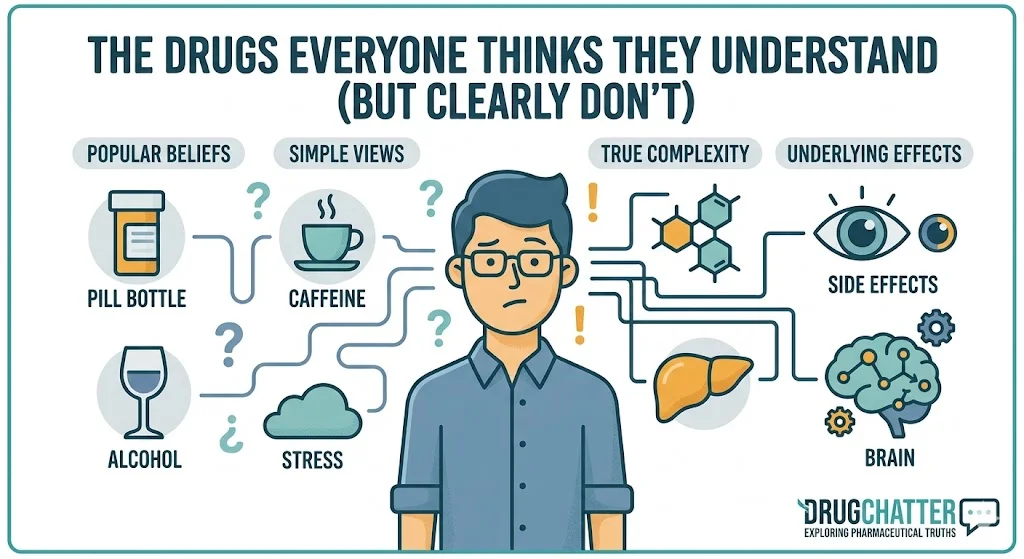
There’s a revealing pattern hidden inside patient search behavior. It’s not the ultra-rare oncology agents or impossible-to-pronounce biologics generating the most confusion. It’s the drugs people think they already know.
The statin in the medicine cabinet. The painkiller in the kitchen drawer. The diabetes injection all over TikTok. The “safe” supplements sold beside the checkout line.
Look at enough patient questions and a taxonomy of misunderstanding emerges. Not ignorance, exactly — more like pharmacology colliding with internet folklore, marketing shorthand, and half-remembered doctor visits.
DrugChatter’s question volume paints a pretty clear picture of which drugs patients most consistently misunderstand.
Here are the leaders.
Lipitor: The Most Confused Drug in America?
No drug in this dataset generated more “Wait, can I take this with…” questions than Lipitor.
Patients asked whether avocado, grapefruit oil, nicotine, raspberry compounds, almond milk, yoga supplements, chlorine pools, essential oils, iron-rich foods, antihistamines, Benadryl, ibuprofen, alcohol, aspirin, and glucosamine could alter its effects.
That’s not exaggeration. That’s the actual search pattern.
This is what happens when a blockbuster drug becomes culturally familiar. Patients stop thinking of it as a potent metabolic intervention and start treating it like nutritional middleware.
The grapefruit fixation is particularly durable. The actual mechanism — CYP3A4 inhibition altering atorvastatin exposure — has been simplified online into “fruit good/fruit bad” mythology.
Meanwhile, the real clinically important questions are often the quieter ones: liver monitoring, muscle symptoms, polypharmacy, age sensitivity.
Ozempic: No Longer a Drug, Now a Cultural Object
Ozempic questions aren’t really about diabetes anymore.
They’re about identity, appetite, routines, body image, side effects, and increasingly, optimization culture.
One fascinating feature of GLP-1 discourse: patients often talk about these drugs as if they’re nutritional software upgrades rather than endocrine agents.
Questions about sulfur burps, snack timing, workout synergy, morning-vs-evening injections, and “food interactions” reflect something broader: patients are trying to reverse-engineer the lived pharmacology.
And then there’s the persistent confusion between Wegovy and Ozempic:
People routinely combine NSAIDs with antihypertensives, anticoagulants, steroids, alcohol, or other NSAIDs without fully realizing they’re stacking renal, gastrointestinal, or bleeding risks.
The “it’s sold without a prescription so it must be mild” heuristic remains undefeated.
Vascepa: The Drug Nobody Understands Because It Looks Like Fish Oil
Vascepa generated an unusually high number of cost, coupon, coverage, and substitution questions — alongside persistent confusion about whether it’s “basically omega-3 supplements.”
This is a branding problem masquerading as a pharmacology problem.
To many patients, prescription omega-3s occupy the same conceptual bucket as supplement-store fish oil gummies. Clinicians know the evidence base is far more specific than that. Patients see “fish oil, but expensive.”
Cosentyx and the Immune-System Anxiety Era
Questions around Cosentyx clustered heavily around immune suppression, vaccines, allergies, metabolism, and long-term effectiveness.
Biologics increasingly occupy an uncomfortable middle ground in public understanding. Patients know they’re “advanced,” know they alter immune signaling, but often don’t know exactly how targeted — or how limited — those effects are.
COVID amplified every one of those concerns.
Supplements: The Internet’s Favorite Unregulated Clinical Trial
Some of the most revealing searches weren’t about prescription drugs at all.
They were about supplements trying very hard to sound medicinal.