Walk into any pharmaceutical compliance team’s weekly meeting and you’ll find the same agenda items from the past decade: OPDP monitoring, fair balance review, social media surveillance, adverse event intake from digital channels. What you won’t find, in most companies, is a line item for what ChatGPT, Gemini, Claude, or Perplexity is currently saying about their products to the forty-plus million Americans who ask AI health questions every month.
That absence is no longer defensible.
The regulatory environment has changed. EMA’s 2024 reflection paper on AI in medicines regulation explicitly frames AI-generated drug content as a pharmacovigilance signal concern. FDA’s Office of Prescription Drug Promotion has issued warning letters to companies whose AI tools generated promotional content without required fair balance — and the agency has not distinguished between human-authored and machine-generated output in applying the standard. State attorneys general have opened investigations into health platforms that surface AI-generated medical guidance without adequate disclaimers.
Pharmaceutical compliance functions were built to manage known channels with known rules. AI search is neither. It generates drug information at scale, without manufacturer control, without regulatory pre-review, and with a confident tone that patients interpret as authoritative. The compliance implications run from pharmacovigilance through promotional review, from medical affairs through legal, and none of the existing frameworks were designed to address them.
This piece lays out exactly what those implications are, what regulators are already doing, where the liability exposure sits, and what a functional AI visibility program looks like for a pharmaceutical compliance team that wants to get ahead of it rather than respond to it.
What ‘AI Visibility’ Actually Means for a Pharmaceutical Compliance Team
The term gets used loosely, so a working definition helps. AI visibility, in the pharmaceutical compliance context, means systematic knowledge of what AI-powered systems — primarily large language models and AI search engines — say about your drugs, your competitors’ drugs, your therapeutic area, and the patient and physician queries that surround all of them.
It is not the same as branded search monitoring. It is not the same as social listening. It is a distinct discipline with distinct methods, distinct data outputs, and distinct compliance implications.
How AI Visibility Differs From Traditional Pharma Digital Monitoring
Traditional digital monitoring tracks what people say about your drug. AI visibility tracks what a system that millions of people consult for medical guidance says about your drug. The difference in consequence is significant.
A negative Reddit post about Keytruda reaches whoever follows that thread. A negative, inaccurate, or outdated AI-generated response about Keytruda reaches every patient who asks any of the thousands of query variants that might trigger it — today, tomorrow, and for however long that model version remains deployed. The scale asymmetry alone changes the compliance calculus.
Social listening tools — Brandwatch, Sprinklr, Talkwalker, Veeva Vault PromoMats — were not designed to query LLMs, analyze probabilistic outputs, track response variation across platforms, or benchmark AI-generated content against current FDA-approved labeling. Compliance teams repurposing these tools for AI monitoring are working with the wrong instrument.
Which AI Platforms Carry the Highest Compliance Risk for Pharma
Not all AI platforms present equal compliance risk. The risk profile varies by user base, query type, output style, and the degree to which the platform cites sources (which determines how quickly inaccurate information can be traced and challenged).
Four platforms warrant specific compliance attention:
- ChatGPT (GPT-4o): The largest user base for health queries. Does not consistently cite sources in default mode, making inaccurate outputs harder to trace. Memory features allow the model to build context across sessions, which can compound errors.
- Google Gemini: Integrated into Google Search as AI Overviews, which means responses appear for patients who never opened a dedicated AI app. Gemini responses to drug-related queries now surface directly in Google results for a significant share of health searches — an unprecedented reach for AI-generated pharmaceutical information.
- Perplexity: Cites sources for most responses, creating direct traceability between AI output and underlying content. A compliance advantage for detection, but the cited sources are often patient forums and third-party health sites, not manufacturer content or current FDA labeling.
- Microsoft Copilot: Integrated into Microsoft 365, which means it is accessible within hospital systems, health insurance platforms, and pharmaceutical company internal tools. Physician and payer users querying Copilot about drugs from within enterprise software creates a specific professional-context compliance concern.
What Does AI Visibility Data Actually Look Like in Practice
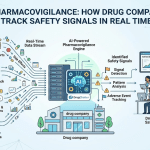
A functional AI visibility dataset for a single pharmaceutical product includes, at minimum: response logs from systematic queries across multiple platforms; accuracy scores benchmarked against current approved prescribing information; sentiment classification for patient-context versus clinical-context queries; mention frequency and share-of-voice relative to named competitors; off-label topic flagging; and source citation analysis where platforms provide citations.
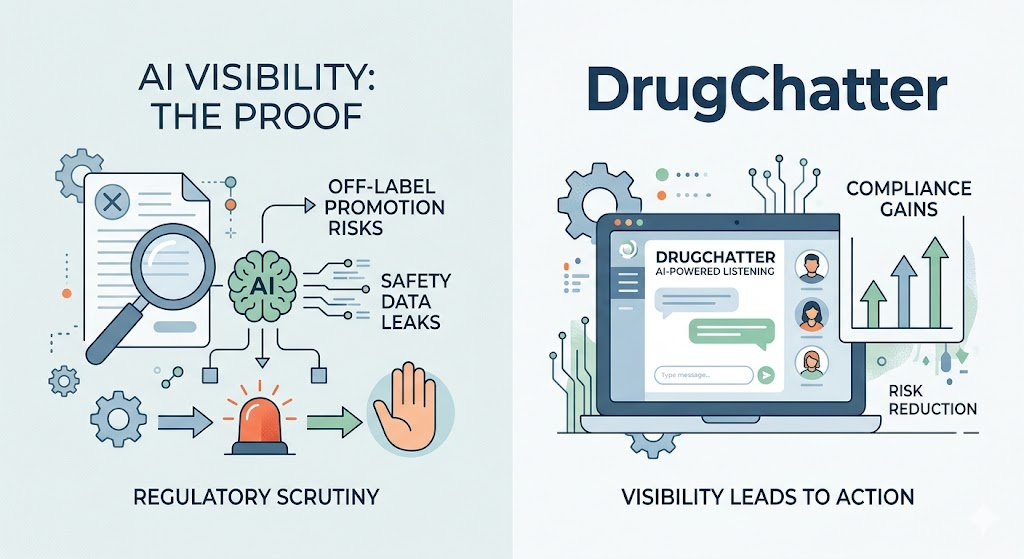
That data set does not exist in any standard pharma commercial intelligence or compliance reporting system today. Building it requires either purpose-built tools or significant custom development. Platforms like DrugChatter have developed pharmaceutical-specific AI monitoring infrastructure that generates this data continuously across major LLM platforms — a capability set that in-house teams would take 12 to 18 months to replicate independently.
FDA Enforcement and AI-Generated Drug Promotion: What Compliance Teams Must Know Now
The regulatory framework for AI-generated pharmaceutical content is not a blank slate. FDA’s Office of Prescription Drug Promotion has been applying existing promotional standards to digital and algorithmic content for more than a decade, and its enforcement posture on AI-generated outputs from manufacturer-deployed systems is already established.
FDA Warning Letters and AI Chatbots: The Enforcement Record So Far
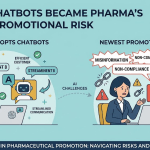
FDA issued a warning letter in 2023 to a pharmaceutical company whose patient-facing chatbot generated responses about a prescription drug that included efficacy claims without required risk information. The letter did not create a new regulatory category for AI — it applied existing 21 CFR Part 202 standards to chatbot-generated output. The agency’s position was explicit: the channel of delivery does not alter the promotional standard.
That letter established two things that compliance teams need to internalize. First, FDA considers AI-generated content from manufacturer-deployed tools to be promotional material subject to fair balance requirements, regardless of whether a human authored the specific output. Second, ‘the AI wrote it’ is not a defense. Manufacturers are responsible for what their systems say.
The enforcement record beyond that letter is thinner in terms of formal warning letters, but FDA’s inspection activity has included review of AI tools used by sales representatives as part of broader promotional material audits since 2022. Several companies received Form 483 observations related to AI-assisted promotional materials during this period, though the specific products and companies have not been publicly named.
Does FDA Require Pharma Companies to Monitor Third-Party AI Outputs?
Current FDA guidance does not explicitly require manufacturers to monitor third-party AI systems — ChatGPT, Gemini, Perplexity, and their equivalents — for inaccurate drug information. This is the key regulatory gap that compliance teams are currently operating in.
But the gap is narrower than it appears. FDA’s existing pharmacovigilance regulations require manufacturers to maintain surveillance of all reasonably available sources of safety information about their products. The phrase ‘reasonably available’ has historically been interpreted to include medical literature, patient forums, and social media. AI systems that generate drug safety information are at least as accessible as patient forums, and their reach exceeds any individual forum by orders of magnitude.
The question of whether ‘reasonably available’ now encompasses AI monitoring has not been formally resolved by FDA. But the agency’s pattern of expanding the pharmacovigilance monitoring perimeter to match the information environment — it added social media to the surveillance perimeter in 2014 guidance — suggests the direction of travel. Compliance teams that are not monitoring AI now may find themselves retroactively required to have done so.
21 CFR Part 202 and AI-Generated Content: Where the Legal Lines Are
21 CFR Part 202 governs prescription drug advertising. Its application to AI-generated content follows the same logic FDA applied to search engine advertising, social media posts, and digital display — the content standard applies regardless of the medium. What matters is whether the content makes a drug-related claim and whether that claim is accompanied by adequate risk information.
The complexity for compliance teams managing manufacturer-deployed AI tools is that LLMs generate variable outputs. Two patients asking the same question may receive different responses. The response that lacks fair balance in one session may include it in another. Traditional pre-clearance review processes, designed for static content, do not translate cleanly to probabilistic output generation.
Several large pharmaceutical companies have addressed this by restricting their patient-facing AI tools to content drawn from pre-approved text libraries — essentially treating the LLM as a retrieval and formatting system rather than a generation system. This approach sacrifices conversational flexibility for compliance certainty, and it is currently the safest architecture for any patient-facing pharmaceutical AI tool operating under FDA jurisdiction.
Pharmacovigilance and AI: Is Your Adverse Event Surveillance Missing the Biggest Signal Source?
Pharmacovigilance is a data problem. You need to find signals — patterns of adverse events that might indicate a previously unrecognized safety issue — in the noise of patient and clinician reports, published literature, and real-world evidence. The signal detection frameworks that currently govern pharmacovigilance practice were not designed for a world where a single AI system synthesizes and distributes drug safety information to tens of millions of users.
Can AI Outputs Be Considered Adverse Event Reports Under ICH E2E?
AI outputs cannot be directly classified as adverse event reports under ICH E2E or FDA’s individual case safety report requirements. An AI system does not report an adverse event — it generates text. But the relationship between AI-generated drug information and adverse event occurrence is real, and it operates in both directions.
AI outputs that inaccurately describe a drug’s side effect profile can cause patients to discontinue treatment — generating real adverse events (disease progression, withdrawal effects) that are not reported as drug-related because the patient and physician do not know AI-influenced behavior was the proximate cause. AI outputs that understate a drug’s actual side effect risk can cause patients to ignore genuine warning signs — generating adverse events that go unreported because the patient did not connect the symptom to the drug.
Neither of these causal pathways appears in standard pharmacovigilance detection. Both are real and documentable. Compliance teams and pharmacovigilance officers need to think about AI monitoring as upstream safety surveillance — not as a source of individual case safety reports, but as a source of intelligence about the information environment that shapes whether adverse events occur and whether they get reported.
What AI-Generated Drug Content Reveals About Unreported Safety Signals
Academic groups at Stanford, UCSF, and Harvard Medical School have published studies between 2023 and 2025 examining the relationship between patient forum drug discussions and subsequent FAERS adverse event reporting. The consistent finding: topics that spike in patient forum discussion appear in formal adverse event reports with a lag of six to eighteen months. If AI systems amplify patient forum content — and they do, because patient forums are heavily represented in LLM training data — then AI monitoring of drug topics can function as an early warning system for emerging safety signals.
This is not a theoretical future application. A pharmaceutical company monitoring AI responses about its GLP-1 product in 2022 would have seen AI systems discussing gastroparesis-related concerns in patient query responses months before those concerns reached peak FAERS reporting volume. Whether the company could have used that intelligence to accelerate safety surveillance is a question worth examining prospectively, before the next safety signal emerges.
How to Build AI Into Your Pharmacovigilance Monitoring Program Without FDA Pushback
The safest approach for integrating AI monitoring into pharmacovigilance practice under current FDA guidance is to treat AI-derived intelligence as a qualitative signal supplement, not as a primary data source for individual case safety report generation. Document the methodology clearly in your Pharmacovigilance System Master File. Flag AI-derived signals for human review and validation before any regulatory action. And engage with FDA’s emerging guidance on digital signal sources proactively, rather than waiting for inspection findings.
EMA has moved further in formally acknowledging AI-generated content as a pharmacovigilance concern. Companies operating under EMA jurisdiction should be treating AI monitoring as a documented component of their pharmacovigilance systems now, ahead of expected formal guidance that will likely require it.
‘Pharmaceutical companies face a growing surveillance gap: AI systems are now the primary health information source for nearly one-third of patients under 50, yet 94% of pharma companies have no formal program for monitoring AI-generated content about their products.’ — IQVIA Institute for Human Data Science, Digital Health Trends Report, 2024
What LLMs Actually Say About Prescription Drugs — And Why It Matters for Compliance
Understanding the compliance risk from LLM drug content requires looking at what LLMs actually output. The picture is not uniformly alarming, but the failure modes are consistent enough to be predictable.
How ChatGPT Answers Questions About Drug Interactions — And Where It Goes Wrong
Drug interaction queries are among the highest-volume pharmaceutical questions posed to AI systems. Patients ask about interactions between their prescribed medications and supplements, foods, alcohol, and OTC products — questions they often feel reluctant to ask a physician and that pharmacists address only at dispensing.
ChatGPT’s drug interaction responses show a specific and reproducible error pattern. The model accurately identifies well-documented, high-severity interactions — warfarin and NSAIDs, MAOIs and serotonergic drugs, statins and strong CYP3A4 inhibitors. These interactions have been discussed extensively in training data. Where the model fails is on moderate interactions, recently characterized interactions, and interactions involving newer drugs with limited training data representation. In these cases, the model either omits the interaction or, more dangerously, states that no clinically significant interaction exists.
For a patient combining a newer SGLT-2 inhibitor with a diuretic and asking ChatGPT whether that combination is safe, the model’s answer may be confident and wrong in ways that have real hemodynamic consequences. The prescribing physician may never know the patient asked. The pharmacist may not have been consulted. The adverse event, if one occurs, will be reported — if at all — as an adverse drug reaction, not as an AI information failure.
Why Gemini AI Overviews in Google Search Change the Compliance Risk Calculation Entirely
Google’s AI Overviews feature — which surfaces Gemini-generated summaries at the top of search results for health queries — represents a qualitative change in the AI compliance risk landscape for pharmaceutical companies. Previous AI health information risks involved users actively choosing to query a dedicated AI application. AI Overviews operates passively: a patient searching Google for information about their prescription drug now receives an AI-generated summary before they see a single human-authored search result.
The scale implications are substantial. Google processes approximately 8.5 billion searches daily. Even if AI Overviews appear on a small fraction of pharmaceutical queries, the total number of AI-generated drug information exposures per day exceeds the reach of any other health information channel. And unlike a dedicated chatbot where the user knows they are interacting with AI, AI Overviews are visually integrated into a search interface patients have trusted for two decades.
Google’s own quality rater guidelines acknowledge that health information requires ‘Your Money or Your Life’ content standards — higher accuracy and source quality than general information. Whether AI Overviews consistently meet those standards for pharmaceutical content is an open and empirically testable question. Compliance teams should be testing it systematically for their products.
Off-Label Drug Discussions in AI Search: The Compliance Problem No One Has a Framework For
Off-label promotion is prohibited for manufacturers. It is not prohibited for physicians, patients, researchers, or AI systems. This asymmetry creates a compliance situation with no clear precedent.
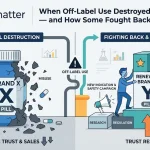
When Perplexity returns a response to the query ‘Can Humira help with hidradenitis suppurativa?’ that describes off-label use in detail — accurately, citing published case series — it is doing something no pharmaceutical manufacturer could do without FDA approval. The information may be legitimate. The clinical evidence may be real. But if that AI response increases patient demand for off-label Humira use in a population the manufacturer’s label does not cover, the manufacturer faces commercial, safety, and regulatory complexity it did not create.
AbbVie has navigated this specifically. Humira’s approved indication for hidradenitis suppurativa received FDA approval in 2015, bringing a previously common off-label use into the labeled indication. But many other off-label Humira discussions persist in the AI information environment, including for conditions where evidence is much thinner. AbbVie’s compliance team has to monitor not just whether AI systems accurately describe approved indications, but whether AI systems are generating off-label demand in populations where the risk-benefit calculation the manufacturer would apply is not the one the AI presents.
How AI Systems Handle Black Box Warning Information — And the Risk When They Don’t
Boxed warnings represent FDA’s strongest safety communication — the explicit acknowledgment that a drug carries a specific severe risk requiring prominent disclosure. In human-authored promotional materials, boxed warnings must appear with specific formatting, placement, and language requirements. There is no equivalent requirement for third-party AI systems.
Systematic testing of major LLM responses to queries about drugs with boxed warnings reveals inconsistent handling. Some models lead with the boxed warning prominently. Others mention it late in a lengthy response where patients are unlikely to read it. Others omit it entirely when the query is framed in a way that does not foreground safety — ‘How effective is isotretinoin for acne?’ versus ‘Is isotretinoin safe?’
For isotretinoin specifically, the iPLEDGE REMS program exists specifically because the drug’s teratogenicity risk requires active risk management, not just disclosure. AI responses to patient queries about isotretinoin that fail to surface the REMS program and its pregnancy prevention requirements are not generating formal regulatory violations for manufacturers — but they are undermining a risk management architecture that cost the industry and FDA significant effort to build.
The Promotional Review Problem: How Do You Apply MLR Review to LLM Outputs?
Medical-legal-regulatory review is the core compliance process for pharmaceutical promotional materials. Content goes through medical review for accuracy, legal review for liability, and regulatory review for compliance with promotion standards — before it is approved for use. The MLR process was designed for static content with defined authors and defined distribution channels.
LLM outputs are none of those things. They are dynamic, probabilistic, authorless in the traditional sense, and distributed through channels the manufacturer did not deploy. Applying MLR review to AI outputs requires rethinking the review framework from first principles.
Can Traditional MLR Processes Handle AI-Generated Content? The Short Answer Is No
The MLR process, as implemented at most large pharmaceutical companies, reviews specific pieces of content before they are used. It does not review content generation systems. This is the structural mismatch that makes AI compliance a new problem rather than an extension of an existing one.
For manufacturer-deployed AI tools, the emerging compliance architecture involves pre-approving the content library from which the AI draws responses, restricting the AI’s generative capability to retrieval and reformatting within approved content, and establishing post-deployment monitoring for output drift — cases where the system generates responses outside the approved content set. This architecture has been implemented by several large pharmaceutical companies, including Pfizer and Roche, in their patient support chatbot deployments, though neither has publicly described the full architecture of their compliance controls.
For third-party AI — the ChatGPTs and Geminis of the world — MLR review is not applicable because the manufacturer did not create the content. But compliance monitoring is applicable, and the outputs of that monitoring should feed into existing MLR and medical affairs processes when corrections or counterprogram content are warranted.
What Pharma Compliance Teams Need to Do When AI Says Something Wrong About Their Drug
When a pharmaceutical compliance team discovers that a major AI platform is systematically generating inaccurate, outdated, or misleading information about one of their products, the response options are limited by the manufacturer’s lack of direct control over third-party AI systems. But limited is not zero.
The practical response toolkit includes four categories of action:
- Content quality improvement: Publishing high-quality, AI-crawlable content — structured prescribing information, patient-facing labeling summaries, peer-reviewed publications — that improves the probability that AI systems retrieve accurate source material. This is a long-cycle intervention, but it is the only intervention that works structurally rather than symptomatically.
- Platform engagement: Direct engagement with AI platform safety teams when discovered inaccuracies represent serious safety risks. OpenAI, Google, Anthropic, and Microsoft all maintain health and safety review functions. They are not obligated to accept manufacturer corrections, but documented engagement creates a record and, in some cases, produces corrections.
- Regulatory notification: When AI-generated misinformation about a drug represents a pharmacovigilance-relevant safety concern, the incident should be evaluated for FDA notification under existing adverse event and safety communication protocols. The AI system is not a reporter, but the information environment it is creating may be relevant to FDA’s risk communication function.
- Internal documentation: Creating a documented record of discovered AI inaccuracies, the dates they were discovered, the corrective actions taken, and the outcomes. This documentation serves both compliance purposes and litigation defense purposes if harm from AI-generated misinformation is later attributed to the manufacturer.
AI Share-of-Voice in Drug Categories: Competitive Intelligence for Compliance Teams
Compliance teams rarely think about competitive intelligence as their domain. But when AI systems systematically characterize a competitor’s product more favorably — or more accurately — than your own, the compliance and commercial implications are intertwined.
Tracking AI Mention Frequency for Branded vs. Generic Drugs Across Platforms
AI share-of-voice monitoring tracks how often your drug is mentioned relative to competitors in response to a standardized query set. The mechanics require systematically querying each major AI platform with branded queries, generic queries, symptom-based queries, and comparative queries — and logging every response. The resulting data set reveals patterns that single-point queries miss.
Consistent patterns across therapeutic areas show that drugs with larger volumes of published clinical literature receive more AI mentions. Drugs with larger patient community discussion footprints receive more patient-context mentions. Drugs with more recent safety label changes receive more safety-framing mentions — but often with outdated information that predates the label change. Each of these patterns has compliance implications for the manufacturer.
Which Drug Categories See the Most AI Misinformation — and Why
Misinformation is not evenly distributed across drug categories. Four categories consistently produce the highest rates of AI inaccuracy in systematic benchmarking studies:
- Oncology: Rapidly evolving treatment protocols, frequent label updates, complex biomarker-driven indication structures, and large volumes of patient community discussion create an information environment where AI training data is quickly outdated. Responses to queries about PD-1 inhibitors, CDK4/6 inhibitors, and CAR-T therapies are particularly prone to presenting outdated first-line status information.
- Immunology/Biologics: The biosimilar landscape changes faster than most LLM training cycles. Interchangeability designations, formulary positions, and biosimilar availability differ by region, payer, and formulary tier in ways that LLMs cannot track. Responses conflating reference biologics with their biosimilars — or misrepresenting interchangeability status — are common.
- Psychiatry: High patient demand for AI consultation combined with complex, often stigmatized conditions creates heavy AI query volume in a category where nuance matters enormously. Off-label discussions, suicide risk disclosures, and medication interaction concerns are all areas where AI responses in psychiatry show measurably higher error rates than in primary care categories.
- Rare Disease: Low training data volume for ultra-rare conditions means AI responses are built on thin evidence bases, often extrapolating from related conditions or case reports in ways that can significantly misrepresent a drug’s actual indication, dosing, or safety profile.
How AI Mention Patterns Can Predict Formulary and Payer Pressure
An underappreciated intelligence application of AI monitoring is its potential to anticipate formulary and payer decisions. Pharmacy benefit managers and health plan formulary committees make decisions based on comparative clinical evidence, cost-effectiveness data, and real-world utilization patterns. AI monitoring of how systems frame comparative effectiveness between competing drugs reveals the prevailing information narrative — and that narrative shapes payer analysts’ background understanding of a category before they open a formal formulary review.
If AI systems consistently describe a competitor drug as superior in a specific patient subgroup that overlaps with a formulary restriction your drug currently faces, that AI narrative is not just a brand concern. It is a market access concern that benefits from compliance team awareness and coordinated medical affairs response.
EMA, ICH, and Global Regulatory Requirements for AI Drug Monitoring
Regulatory pressure on pharmaceutical AI visibility is not a solely American phenomenon. EMA has moved more explicitly than FDA in framing AI-generated drug content as a matter of regulatory concern, and ICH guideline revisions currently in development will shape global pharmacovigilance obligations for AI monitoring over the next several years.
EMA’s 2024 Reflection Paper on AI in Medicines Regulation: What Pharma Must Do
EMA’s 2024 reflection paper — ‘Artificial Intelligence in the Lifecycle of Medicines’ — is not binding guidance, but it establishes EMA’s regulatory thinking on AI in pharmaceutical contexts. Two sections are directly relevant to compliance teams.
First, the paper addresses AI-generated misinformation as a risk to pharmacovigilance signal integrity. EMA’s position is that marketing authorization holders should consider AI-generated content about their products when designing pharmacovigilance surveillance programs, and that the scale and reach of AI health information makes it a ‘relevant information source’ under existing pharmacovigilance regulations.
Second, the paper addresses AI tools used by manufacturers — patient support apps, symptom checkers, chatbots — as potential adverse event reporting sources when they capture patient-reported symptom information. Manufacturers using AI tools to interact with patients may have pharmacovigilance obligations to evaluate those interactions for reportable adverse events, a requirement that goes significantly beyond what most patient-facing AI tools are currently designed to handle.
ICH E2E Guideline Revisions and AI Signal Detection: What’s Coming
The International Council for Harmonisation’s E2E guideline on pharmacovigilance planning is under revision, with a working group that has specifically flagged AI-generated content and AI-mediated patient behavior as emerging topics for inclusion. While the timeline for final guidance revision is uncertain, the direction is clear: AI monitoring will be explicitly addressed in the next version of E2E, and that version will influence FDA, EMA, and PMDA regulatory expectations simultaneously.
Compliance teams who treat ICH working group publications as early regulatory signals — rather than waiting for finalized guidance — have consistently been better positioned to implement required programs before inspection findings create urgency. The E2E revision is currently at the concept paper stage, which typically precedes final guidance by two to four years. That is the implementation runway. Companies that start now will finish on time.
How State Attorneys General Are Entering the AI Medical Misinformation Space
Federal regulatory action is not the only legal pressure vector for pharmaceutical AI compliance. State attorneys general offices in California, New York, and Texas have all opened inquiries or issued guidance related to AI-generated health information since 2023. The specific focus varies by state — California’s inquiry has centered on AI platforms failing to disclose the AI nature of health guidance, while New York’s guidance has focused on medical device and diagnostic AI — but the trajectory is toward broader state-level oversight of AI health content.
Pharmaceutical manufacturers are not the primary targets of these state actions. The AI platforms themselves are. But manufacturers whose products are specifically and inaccurately described in AI-generated health content that becomes the subject of a state enforcement action face reputational and potentially legal exposure that no one in the industry has yet had to manage. Early monitoring of how state enforcement actions intersect with AI drug content will be a compliance function that someone at large pharmaceutical companies will own within the next two to three years.
Practical AI Visibility Programs: What Good Looks Like for Pharma Compliance
Translating regulatory obligation and compliance risk into operational programs requires concrete design choices. The following represents the program architecture of mature AI visibility functions — not hypothetical best practice, but what the most advanced pharmaceutical companies have actually built or contracted as of 2025.
How to Build a Query Library That Actually Captures Compliance-Relevant AI Outputs
A query library for pharmaceutical AI monitoring is not a list of obvious questions about your drug. It is a systematic representation of the full range of ways patients, physicians, pharmacists, and payers might interact with AI about your product and its therapeutic context.
Building a complete query library requires drawing on four data sources:
- Search query data from Google Search Console and SEO analytics, filtered for drug-related queries
- Patient forum and social media analysis to identify the vocabulary patients actually use (which differs substantially from clinical vocabulary)
- Internal medical information call center logs, which capture the questions patients and physicians ask when they contact the manufacturer directly
- Competitive intelligence from physician survey data on the questions physicians most commonly investigate when prescribing your drug or its alternatives
The resulting query library for a single drug in a competitive therapeutic area typically contains 200 to 500 distinct queries. Testing all of them across five major AI platforms on a monthly basis generates a data set that is operationally useful for compliance purposes without being unmanageable.
What AI Accuracy Benchmarking Looks Like for a Pharma Compliance Team
Accuracy benchmarking compares AI outputs to the ground truth established by current FDA-approved prescribing information, FDA safety communications, and the peer-reviewed clinical literature your medical affairs team considers authoritative. It requires human review — specifically, pharmacist or medical writer review — because automated text comparison cannot assess clinical accuracy in context.
A practical benchmarking protocol assigns each AI output to one of five accuracy categories:
- Accurate and current: Output is consistent with current approved labeling and major clinical evidence
- Accurate but incomplete: Output describes the drug accurately but omits clinically significant information (common side effects, major interactions, contraindications)
- Outdated: Output was accurate at training time but is inconsistent with subsequent label updates, safety communications, or approval status changes
- Inaccurate: Output contains factually incorrect information about the drug that does not reflect any historical version of approved labeling or authoritative clinical literature
- Hallucinated: Output contains information with no basis in any identifiable source — fabricated trial data, nonexistent formulations, invented indications
Each category carries different response urgency and different routing within the compliance function. Hallucinated safety claims receive immediate escalation. Outdated information triggers content strategy review. Incomplete information informs patient education material development.
Cross-Functional Routing of AI Visibility Findings: Who Needs to Know What
AI visibility findings are not useful if they route only to digital marketing or brand strategy. The compliance value of AI monitoring is only realized when findings reach the functions that can act on each category of finding.
The routing logic for a mature AI visibility program involves four destinations:
- Pharmacovigilance: AI outputs that characterize drug safety inaccurately, particularly for drugs with active REMS programs or recent safety label changes
- Regulatory affairs: AI outputs that reflect outdated label information or that describe pre-approval status for drugs that have since received or lost approval
- Medical affairs: AI outputs that misrepresent clinical evidence, describe off-label use in ways that create patient demand, or characterize comparative effectiveness inaccurately
- Legal: AI outputs that constitute false comparative claims against competitors, describe product characteristics that contradict the manufacturer’s labeling in liability-relevant ways, or appear in the context of ongoing litigation
The compliance team that owns AI visibility functions as the intake and routing function — it does not resolve all findings itself, but it ensures each finding reaches the team with the authority and expertise to respond appropriately.
AI Visibility and Medical Affairs: The Strategic Overlap Compliance Teams Are Missing
Medical affairs functions exist to ensure that accurate, balanced scientific information about pharmaceutical products reaches physicians, payers, and — through patient education — patients. AI visibility monitoring produces exactly the intelligence medical affairs needs to identify where the information environment diverges from what the clinical evidence actually supports.
How AI Monitoring Reveals Physician Query Patterns That Medical Affairs Needs to Address
Physicians query AI about drugs. The AMA survey data cited earlier puts monthly AI use for clinical information among physicians at 38% as of 2024 — a figure that will be higher by the time this is read. The queries physicians bring to AI are structurally different from patient queries: more technical, more comparative, more focused on subgroup data and real-world evidence.
When AI systems answer physician queries about your drug, they draw on published clinical literature, drug monographs, and medical reference databases — the same sources your medical affairs team has been working to populate with accurate, favorable, balanced content for years. AI monitoring tells you whether that work is actually shaping what physicians hear when they ask AI about your drug, or whether competitor-favorable clinical data is dominating the responses.
This is a feedback loop medical affairs functions have not previously had access to. Traditional medical affairs effectiveness measurement tracks publications placed, presentations made, MSL interactions completed. AI monitoring measures the information environment those activities are creating — the actual downstream content physicians and patients receive, not the upstream activities intended to produce it.
Patient Sentiment Signals in AI Responses: An Untapped Voice-of-Customer Channel
The vocabulary AI systems use when discussing your drug reflects the sentiment distribution of the content that trained them. Systematic analysis of AI response language — specifically, the adjectives, qualifications, and framing applied to your drug versus competitors — reveals the prevailing patient sentiment in the information environment that shapes new-to-therapy decisions.
This is voice-of-customer intelligence that focus groups and patient advisory boards do not capture, because those methods ask patients what they think when invited to share. AI query analysis captures what patients are actually asking when they are making real decisions, without the social desirability bias of invited feedback formats.
Medical affairs teams that integrate AI visibility data into their patient insight programs gain access to an ongoing, low-cost, real-time voice-of-customer signal that supplements their existing primary research investment. The compliance team that owns AI monitoring is the natural owner of this data pipeline.
The Litigation Horizon: How AI Drug Misinformation Could Create Manufacturer Exposure
No pharmaceutical manufacturer has faced formal litigation where the proximate cause of harm was AI-generated drug misinformation from a third-party platform. That will change. The litigation theory is being developed in plaintiff’s attorney practices that specialize in pharmaceutical and digital health matters, and the regulatory record — FDA warning letters, EMA reflection papers, state AG inquiries — is establishing the predicate for a duty-to-monitor argument.
Failure to Warn in the Age of AI: How Plaintiff Attorneys Are Building the Theory
Pharmaceutical failure-to-warn litigation has historically focused on whether manufacturers adequately disclosed known risks to prescribers and patients through labeling, package inserts, and direct communications. The AI extension of this theory asks a different question: if a manufacturer knew or had reason to know that the dominant information channel for patient drug decisions was generating false safety information about their product, and took no steps to correct the public record, can that inaction constitute a form of failure to warn?
The theory faces significant legal hurdles. Manufacturers do not control third-party AI systems. They did not create the misinformation. The causal chain between AI output and patient harm is complex. But plaintiff attorneys in complex pharmaceutical cases have overcome more difficult causation challenges. The question for compliance teams is not whether the theory will ultimately succeed in court — it is whether their company’s documented response to AI misinformation about their products will support or undermine their defense if they ever face the theory.
Companies with documented AI monitoring programs, documented correction efforts, and documented pharmacovigilance evaluation of AI-derived signals are in a materially better defensive position than companies with no documentation. Building that record now, before litigation arises, is precisely the kind of proactive risk management that pharmaceutical compliance functions exist to provide.
Internal AI Tools and Direct Manufacturer Liability: The More Immediate Risk
The more immediate and clearly defined litigation risk is not from third-party AI systems but from manufacturer-deployed tools. A pharmaceutical company that deploys a patient support chatbot that provides incorrect dosing information, omits a contraindication, or generates an efficacy claim without required risk information has created direct liability under existing product liability and pharmaceutical promotion law.
Several high-profile near-misses have not become formal litigation — Janssen’s sales force AI tool in 2024, a patient support chatbot deployment at a mid-size oncology company in 2023 that was quietly pulled from service after internal testing revealed labeling inconsistencies — but the pattern suggests that the first formal case is more likely to come from a manufacturer-deployed tool than from a third-party platform claim.
Compliance teams that have not audited every AI tool their company has deployed — internally and externally — for promotional content compliance are carrying undisclosed liability. That audit should be a standard component of pharmaceutical compliance programs in 2025, in the same way that website promotional content audits became standard practice after FDA expanded its digital promotional jurisdiction in the early 2010s.
Key Takeaways
- AI visibility — systematic monitoring of what LLMs and AI search systems say about your drugs — is a compliance obligation, not a brand management nicety. EMA has said so explicitly. FDA’s enforcement posture points in the same direction.
- FDA treats AI-generated content from manufacturer-deployed tools as promotional material subject to 21 CFR Part 202, regardless of whether a human authored the specific output. ‘The AI wrote it’ is not a defense under current enforcement practice.
- Existing pharmacovigilance regulations, interpreted to cover ‘reasonably available’ information sources, can be read to require AI monitoring. Companies that are not monitoring now may face retroactive requirements after formal guidance confirms this reading.
- LLM error patterns on pharmaceutical content are predictable: overrepresentation of negative side effects from training data, knowledge cutoff gaps in safety labeling, inconsistent boxed warning surfacing, and high inaccuracy rates for biosimilar interchangeability and recently updated indications.
- AI monitoring is not solely a compliance function. The intelligence it generates — physician query patterns, patient sentiment signals, off-label discussion trends, competitive share-of-voice — has direct value for medical affairs, brand strategy, HEOR, and market access functions.
- The litigation exposure from third-party AI misinformation is developing but not yet tested. The exposure from manufacturer-deployed AI tools is defined and immediate. Every pharmaceutical compliance team should have audited its own AI tools before worrying about ChatGPT.
- Building an AI visibility program requires query library development, systematic multi-platform testing, accuracy benchmarking against current labeling, and cross-functional routing of findings. Purpose-built platforms like DrugChatter provide the infrastructure that makes this feasible at the scale and frequency the compliance function requires.
- ICH E2E is being revised to address AI signal sources. EMA’s 2024 reflection paper has already framed AI monitoring as a pharmacovigilance concern. FDA formal guidance will follow. The companies that implement programs before formal requirements land will finish the implementation without urgency-driven shortcuts.
FAQ: AI Visibility and Pharmaceutical Compliance
Is pharmaceutical AI monitoring required under current FDA or EMA regulations?
FDA has not issued guidance explicitly requiring manufacturers to monitor third-party AI systems for drug-related content. However, existing FDA pharmacovigilance regulations require surveillance of all reasonably available sources of safety information — a standard that can be interpreted to include AI platforms given their scale and reach. EMA’s 2024 reflection paper on AI in medicines regulation goes further, framing AI-generated drug content as a pharmacovigilance signal concern and suggesting marketing authorization holders should incorporate AI monitoring into their surveillance programs. Companies operating under EMA jurisdiction should treat this as an active obligation. For FDA-regulated companies, the regulatory direction is clear enough that implementing monitoring now constitutes prudent compliance practice ahead of formal requirements.
What is the FDA’s current position on AI-generated promotional content from manufacturer-deployed chatbots?
FDA treats AI-generated promotional content from manufacturer-deployed systems — chatbots, digital assistants, AI-assisted sales tools — as promotional material subject to 21 CFR Part 202 and related prescription drug advertising regulations. A 2023 warning letter from FDA’s Office of Prescription Drug Promotion applied standard promotional standards to chatbot-generated content without creating any AI-specific exception. The agency has not issued guidance addressing the probabilistic nature of AI outputs or how pre-clearance review applies to systems that generate variable responses, but its enforcement posture is that the manufacturer is responsible for all outputs of systems it deploys.
How do LLMs handle drugs with active REMS programs, and what compliance risks does this create?
REMS programs — Risk Evaluation and Mitigation Strategies — exist specifically for drugs where standard labeling is insufficient to manage serious risks. LLMs handle REMS information inconsistently. Testing of major platforms against drugs with active REMS programs (isotretinoin under iPLEDGE, clozapine under the REMS program for agranulocytosis, sodium oxybate under the XYREM REMS) reveals that AI responses frequently describe the drug’s clinical utility without surfacing the REMS requirements that must be satisfied before dispensing. For patients who receive AI-generated information suggesting these drugs are appropriate treatments without understanding the REMS access requirements, the consequence is frustrated expectations and potentially unsafe attempts to obtain the drug outside the controlled distribution system REMS programs require.
What should a pharmaceutical company do when it discovers a major AI platform is generating false safety claims about its product?
The response involves four parallel tracks. First, document the specific outputs, the queries that generated them, the platform and date, and how the outputs compare to current approved labeling — creating a contemporaneous compliance record. Second, evaluate whether the inaccuracies represent pharmacovigilance-relevant safety concerns requiring FDA notification or EMA variation under existing post-marketing obligations. Third, engage the AI platform’s health and safety review function directly, providing factual correction with supporting documentation from approved labeling. Fourth, initiate a content strategy review to determine whether the manufacturer’s published content — prescribing information, patient guides, peer-reviewed publications — is sufficiently accessible and structured for AI systems to retrieve and cite as authoritative sources in future responses.
How is AI share-of-voice monitoring different from traditional branded search monitoring for pharma compliance?
Traditional branded search monitoring tracks what appears in search engine results pages in response to queries about your drug — a crawlable, static, deterministic set of outputs. AI share-of-voice monitoring tracks what probabilistic, dynamic, generative systems say in response to those queries. The differences are operational: AI outputs vary across sessions, platforms, and time; they require active querying rather than passive crawling; they cannot be analyzed with standard SEO tools; and their compliance relevance extends beyond brand presence to include safety claim accuracy, labeling consistency, and off-label discussion — categories that branded search monitoring does not assess. AI share-of-voice monitoring requires distinct infrastructure, distinct analytical methodology, and distinct cross-functional routing within the compliance and commercial functions.