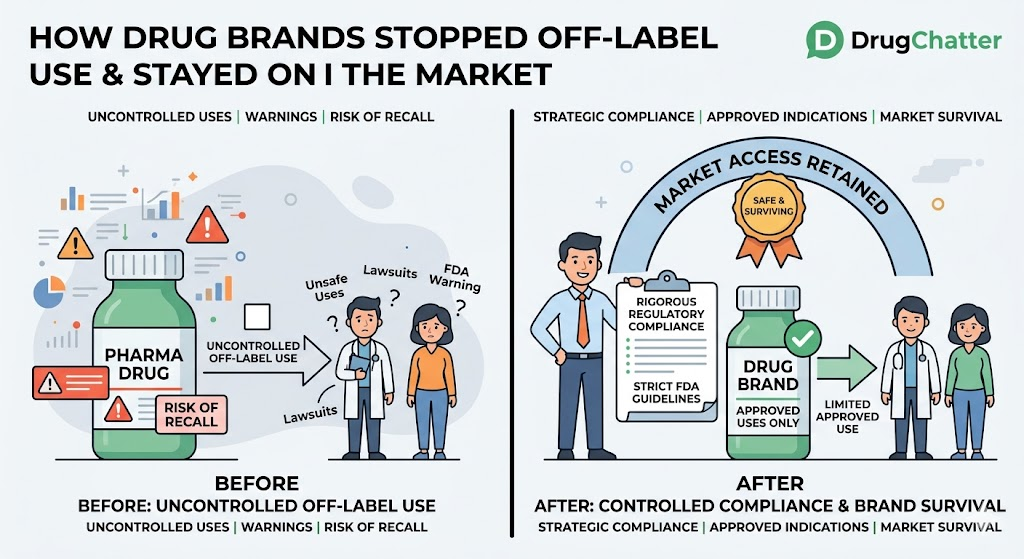
How drug brands fought off-label prescribing to survive: real FDA cases, litigation wins, and what AI monitoring means for pharmacovigilance today.
When a drug becomes popular for something it was never approved to treat, the manufacturer faces a choice that looks simple from the outside but is rarely simple in practice. Let the off-label use grow unchecked and you risk adverse event signals that reframe the entire risk-benefit conversation at the FDA. Push back too hard on prescribers and you trigger accusations of interfering with the practice of medicine. Promote the new use, even subtly, and you hand a federal prosecutor a misbranding case.
Several drug companies have navigated that terrain successfully. A few have not. The cases below are not cautionary tales or success stories in the motivational sense. They are operational blueprints, showing what brand teams, regulatory affairs departments, and medical affairs units actually did when off-label prescribing threatened to destabilize an approved drug’s commercial and regulatory standing.
The stakes are rising because AI is now part of the problem. ChatGPT, Gemini, Claude, and Perplexity routinely describe off-label uses of branded drugs, recommend generic substitutes, and reproduce outdated safety language. Pharma companies that are not tracking what LLMs say about their products are flying blind at a moment when patients are increasingly using AI chatbots as a first line of drug information. [Internal Link: AI Drug Monitoring]
Why Off-Label Use Puts Drug Approvals at Risk
The Food, Drug, and Cosmetic Act does not prohibit physicians from prescribing approved drugs for unapproved indications. It prohibits manufacturers from promoting those uses. That legal asymmetry is the central tension in every case below.
The withdrawal risk enters through two channels. First, adverse events associated with off-label use accumulate in FDA’s Adverse Event Reporting System (FAERS). If those events suggest a safety signal that was not present in the original approval dataset, the agency can require label changes, REMS implementation, or in severe cases, initiation of market withdrawal proceedings. Second, when a manufacturer gets caught promoting off-label uses, the resulting DOJ investigations, consent decrees, and corporate integrity agreements often include enhanced pharmacovigilance requirements that expose previously buried safety signals.
Off-label use is not inherently dangerous. In oncology, roughly 50 percent of chemotherapy prescribing is off-label. In pediatrics, nearly 75 percent of drugs used in children were approved only for adults. The problem arises when off-label use extends into populations where the drug’s safety profile is genuinely unknown, or when manufacturers exploit that prescribing without the surveillance infrastructure to detect emerging harms. [Internal Link: Pharmacovigilance]
What FDA Considers When Evaluating Off-Label Prescribing Patterns
The FDA looks at whether adverse events in FAERS are clustering around unapproved uses, whether the volume of off-label prescribing is large enough that the labeled population no longer represents the real-world patient exposure, and whether any post-marketing commitments are generating data that undermine the original risk-benefit calculation. A drug approved for a narrow indication that gets widely prescribed off-label effectively loses the evidentiary foundation of its approval without ever going back through the approval process. That asymmetry is what brand teams must manage.
The Role of Pharmacovigilance in Catching Off-Label Safety Signals Early
Pharmacovigilance systems that only monitor labeled indications are structurally inadequate for a world where off-label use may represent the majority of a drug’s real-world exposure. Signal detection algorithms in safety databases need to be calibrated to flag events occurring in populations outside the approved indication, not just events that match the labeled adverse reaction profile. Companies that made this operational shift early were better positioned to manage the cases described below.
Gabapentin: When the Government Stepped In Before the Brand Could
How Pfizer’s Neurontin Off-Label Promotion Led to a $430 Million Settlement
Neurontin (gabapentin) is the case that defined the modern legal framework for off-label pharmaceutical promotion. Approved by the FDA in 1993 for epilepsy and later for postherpetic neuralgia, gabapentin’s prescribing expanded rapidly through the late 1990s and early 2000s to cover bipolar disorder, neuropathic pain, migraine, and attention disorders.
Pfizer, which acquired Warner-Lambert in 2000, inherited a promotional infrastructure that paid physician speakers to deliver off-label messages, funded medical education programs that functionally served as promotional vehicles, and used sales representatives to discuss unapproved uses directly. In 2004, Pfizer pleaded guilty to criminal charges and settled for $430 million under the False Claims Act. The settlement included a corporate integrity agreement that required enhanced monitoring of promotional activities and adverse event reporting.
The legal architecture here is worth examining carefully. The government’s False Claims Act case did not rest on the off-label prescribing itself. It rested on Pfizer submitting claims to Medicare and Medicaid for prescriptions written as a result of illegal promotion. That framing shifted the litigation from a regulatory matter to a fraud matter, which changed both the available remedies and the evidentiary standard.
What the Neurontin Litigation Changed About Off-Label Promotion Compliance
The Neurontin case established several practices that became standard in pharma compliance programs. Medical affairs functions were structurally separated from commercial operations. Speaker bureau programs required documented evidence that speakers were not delivering off-label content. Medical information requests from physicians were handled through separate channels with documented responses. None of these were new ideas, but Neurontin made them non-negotiable.
Gabapentin is now generic. The branded promotion infrastructure is gone. But the drug’s off-label use has continued to expand, and it now appears prominently in AI-generated responses about pain management, anxiety, and alcohol withdrawal. When patients ask ChatGPT whether gabapentin helps with anxiety, they typically receive a response that describes off-label use without labeling it as such. That information gap is exactly the kind of pharmacovigilance blind spot that AI monitoring tools are designed to detect.
Xyrem: How Jazz Pharmaceuticals Controlled a Dangerous Drug’s Off-Label Spread
Managing a Schedule III Controlled Substance Under Heightened FDA Scrutiny
Xyrem (sodium oxybate), approved for narcolepsy with cataplexy, is gamma-hydroxybutyrate, the same compound classified as a Schedule I substance when used illicitly. Jazz Pharmaceuticals built a REMS program around Xyrem that became one of the most restrictive distribution systems for any approved drug in U.S. history, precisely because off-label or diverted use carried catastrophic safety risks.
The Xyrem Success Program required that all prescriptions route through a single central pharmacy. Patients received the drug only after completing a mandatory education program. Prescribers had to enroll in the program and certify patient counseling. The system was not primarily designed to prevent off-label prescribing. It was designed to prevent diversion. But its effect on off-label use was significant, because the enrollment burden functionally limited prescribing to specialists who had a documented clinical rationale.
Why the Xyrem REMS Model Is Referenced in FDA Off-Label Risk Discussions
The FDA has cited Xyrem’s REMS as a model for drugs where the therapeutic benefit in a narrow approved population exists alongside severe safety risks in broader, unapproved populations. The program’s structure acknowledged something regulators rarely state plainly: that keeping a useful drug on the market sometimes requires building a distribution infrastructure that makes casual off-label prescribing operationally difficult rather than legally prohibited.
Jazz faced its own legal challenges. In 2021, it settled Department of Justice investigations related to off-label promotion of Xyrem for approximately $57 million. The settlement’s resolution agreements required enhanced monitoring of speaker programs and stricter controls on medical affairs communications. The company later launched Lumryz, a once-nightly formulation, while the original Xyrem faced generic entry challenges in a separate legal proceeding.
‘In fiscal year 2023, FAERS received over 2.4 million individual safety reports, yet industry analysis suggests fewer than 10 percent of real-world adverse events are formally reported, a gap that patient-facing AI systems are now widening by directing affected patients away from reporting channels.’ — IQVIA Institute, 2024 Global Use of Medicines Report
Risperdal: How Johnson & Johnson Fought Off-Label Pediatric Use Claims
The $2.2 Billion Settlement and What It Means for Pediatric Off-Label Promotion
Risperdal (risperidone) was approved for schizophrenia in adults. Johnson & Johnson and its subsidiary Janssen promoted it for off-label uses in children and the elderly, two populations with substantially different risk profiles from the adult schizophrenic population in the original approval studies.
In 2013, J&J agreed to pay $2.2 billion to resolve DOJ investigations into off-label promotion of Risperdal and two other drugs. The Risperdal portion of the settlement covered allegations that Janssen promoted risperidone for use in children and adolescents before the FDA approved it for those indications, and for use in elderly dementia patients despite FDA warnings that antipsychotics increased mortality risk in that population.
The FDA had required a black box warning for antipsychotics in elderly patients with dementia-related psychosis in 2005. The allegation was that Janssen continued to market the drug to nursing homes and geriatric care facilities after that warning was issued, effectively promoting a use the FDA had flagged as dangerous.
How J&J’s Medical Affairs Team Eventually Secured Pediatric Approval
Rather than simply defending off-label use as the clinical standard, Janssen conducted the studies required to secure pediatric approval. The FDA approved Risperdal for irritability associated with autistic disorder in children in 2006, and for adolescent schizophrenia and bipolar disorder in 2007 and 2009. That sequence matters: the company ran the trials while simultaneously facing legal exposure for promoting the uses before approval. The regulatory strategy and the litigation defense had to run in parallel.
This is the operational lesson that brand teams cite most often from the Risperdal case. When off-label use has become clinically entrenched, the path to protecting the brand long-term often requires converting that use to an approved indication, not trying to suppress the prescribing. The legal exposure comes from the promotion, not the prescribing. Resolving the promotion liability while building the evidentiary base for approval is a viable, if expensive, strategy.
Vioxx vs. Celebrex: Why One Drug Was Withdrawn and the Other Survived
The Cardiovascular Risk Signal That Killed Rofecoxib
Vioxx (rofecoxib) and Celebrex (celecoxib) launched within weeks of each other in 1999 as COX-2 selective inhibitors targeting arthritis pain with a reduced gastrointestinal side effect profile compared to older NSAIDs. Both drugs accumulated extensive off-label use in conditions ranging from acute pain to cancer prevention. Only one survived.
Merck withdrew Vioxx voluntarily in September 2004 after the APPROVe trial, a colorectal polyp prevention study, showed a significant increase in cardiovascular events in patients taking rofecoxib for 18 months or longer. The withdrawal came after years of controversy about whether Merck had suppressed early cardiovascular signals, including data from the VIGOR trial in 2000 that showed a higher heart attack rate in Vioxx patients compared to naproxen.
Pfizer’s Celebrex survived despite similar cardiovascular concerns because the safety profile, while problematic, was judged to sit within an acceptable therapeutic window relative to benefits for specific patient populations. The FDA required significant label revisions and a REMS program. But the drug remained on the market.
What Pfizer Did Differently to Keep Celebrex Approved
Several factors separated Celebrex’s outcome from Vioxx’s. Pfizer ran additional post-marketing cardiovascular outcomes studies proactively, generating data that helped characterize the risk at different dose levels and patient populations. The company engaged the FDA early and consistently when new safety signals emerged rather than allowing the evidentiary record to develop adversarially.
The PRECISION trial, published in 2016, enrolled over 24,000 patients across three anti-inflammatory drugs and provided the most comprehensive cardiovascular outcomes data for any NSAID class to that point. The trial supported continued approval of Celebrex at the lowest effective dose with appropriate patient selection. That outcome was not accidental. It reflected a regulatory strategy built on generating the data necessary to define the boundaries of acceptable use rather than defending the full prescribing population.
How AI Search Engines Now Describe the Vioxx-Celebrex Cardiovascular History
This is where AI monitoring becomes directly relevant to legacy pharmacovigilance. LLMs frequently conflate the cardiovascular risk profiles of rofecoxib and celecoxib, describing both as carrying similar withdrawal risks. When patients or physicians ask Perplexity or ChatGPT about COX-2 inhibitor cardiovascular safety, the responses often reference the Vioxx withdrawal without adequately distinguishing Celebrex’s different risk characterization. Brand teams for celecoxib’s generic manufacturers have no active monitoring infrastructure to correct this, which means the AI-generated record is increasingly inaccurate over time.
Can AI Hallucinations Trigger FDA Risk for a Drug Brand?
When an LLM Gets Drug Safety Wrong: The Pharmacovigilance Implications
The regulatory framework for adverse event reporting does not currently require pharmaceutical companies to monitor AI-generated content about their products. But the practical pharmacovigilance implications are real. If a significant patient population is receiving incorrect safety information from AI chatbots, three things can happen: patients discontinue medications based on hallucinated side effects; patients combine drugs based on incorrect interaction information; or patients delay reporting genuine adverse events because AI described their symptoms as expected and benign.
All three outcomes affect the quality of real-world evidence that feeds into post-marketing safety surveillance. The FDA’s FAERS database depends on voluntary reporting from patients and healthcare providers. A patient who asks ChatGPT whether their symptom is an expected side effect and receives an incorrect ‘yes’ will not report that symptom. That reporting gap creates a surveillance blind spot that could delay detection of genuine safety signals.
How Often Claude Mentions Ozempic vs. Wegovy: A Case Study in AI Brand Confusion
Semaglutide is one of the most queried pharmaceutical substances in AI systems today. Novo Nordisk markets it under two brand names: Ozempic, approved for type 2 diabetes, and Wegovy, approved for chronic weight management. Both contain semaglutide at the same active ingredient but differ in their maximum approved doses and approved indications.
In queries about weight loss medication, AI systems including ChatGPT, Gemini, and Claude frequently mention Ozempic in contexts where Wegovy would be the technically accurate reference, because Ozempic’s cultural prevalence in media coverage has made it the default semaglutide brand in the AI training corpus. This creates a systematic misattribution: patients asking about weight loss medication receive information about a drug whose primary approved indication is diabetes management. The adverse event profile and dosing schedule differ between products. A patient who takes Ozempic at Wegovy doses based on AI-informed guidance is outside the labeled use for both products.
Novo Nordisk’s brand team has had to manage this AI-amplified confusion alongside the broader off-label prescribing of Ozempic for weight loss. The company was placed in the unusual position of seeing one of its own branded products (Ozempic) effectively substituted in AI responses for another of its branded products (Wegovy), creating pharmacovigilance complexity that no traditional media monitoring system was designed to capture. Tools like DrugChatter, which queries LLMs across ChatGPT, Gemini, Claude, and Perplexity to compare how different models represent a drug, provide the monitoring infrastructure to detect and track these patterns systematically.
Tracking Share of Voice Across ChatGPT, Gemini, and Claude for Branded Drugs
Share of voice in AI search is a nascent but rapidly growing discipline. In traditional search, share of voice measures how often a brand appears in paid and organic results relative to competitors. In AI search, the equivalent metric tracks how often an LLM mentions a specific branded drug when responding to queries about a therapeutic category, a symptom, or a specific condition.
The dynamics are different in meaningful ways. Traditional search results are deterministic within a session: a specific query returns a predictable set of results. LLM responses are probabilistic: the same query asked ten times may return different brand mentions across responses. Measuring AI share of voice requires sampling across multiple queries, multiple LLMs, and multiple time points to produce stable estimates. That measurement infrastructure does not yet exist in most pharma commercial organizations.
Thalidomide’s Return: How Celgene Built the Most Restrictive Drug Approval in History
S.T.E.P.S. Program: Turning Off-Label Terror Into a Controlled Approval
Thalidomide was withdrawn from global markets in the early 1960s after causing severe birth defects in thousands of children when used by pregnant women for morning sickness. The drug was never approved in the United States, though it was available in clinical trials and illegally imported. Its reapproval in 1998 by the FDA for erythema nodosum leprosum (ENL) is the most aggressive risk management strategy ever built around a single drug approval.
Celgene’s S.T.E.P.S. program (System for Thalidomide Education and Prescribing Safety) required that all prescribers, pharmacies, and patients register in a central database. Female patients of childbearing potential had to use two forms of contraception simultaneously and receive monthly pregnancy testing. Male patients were required to use condoms. Prescriptions were limited to 28-day supplies. The entire supply chain was closed and auditable.
The FDA approved thalidomide under these conditions because the S.T.E.P.S. program made unsupervised off-label use structurally difficult. A physician who wanted to prescribe thalidomide for an unapproved indication had to register in the program and accept its documentation requirements. That friction did not eliminate off-label prescribing, but it concentrated it among specialists with the clinical infrastructure to manage the safety requirements.
How Celgene Extended the Thalidomide Model to Revlimid
When Celgene developed lenalidomide, a thalidomide analog, it built a nearly identical REMS program called REVASSIST. Revlimid was approved for multiple myeloma and myelodysplastic syndromes. The REVASSIST infrastructure allowed the company to defend against off-label prescribing concerns by demonstrating to the FDA that the distribution system would prevent the specific harm, teratogenicity, that made thalidomide historically catastrophic.
Celgene was acquired by Bristol-Myers Squibb in 2019 for $74 billion. The Revlimid franchise, which generated over $12 billion in annual revenue at peak, was built entirely on the premise that a dangerous drug’s worst risk could be operationally managed rather than used as grounds for broad restriction. That premise has influenced every subsequent REMS design for teratogenic oncology agents.
Do LLMs Recommend Generic Drugs More Often Than Branded Drugs?
The Generic Substitution Bias in AI-Generated Prescribing Discussions
Multiple industry analyses have found that AI chatbots default to generic drug recommendations when discussing treatment options, even in contexts where the branded formulation has clinical or formulation differences that matter. This is partly a training data effect: medical literature, patient forums, and clinical guidelines tend to reference generic names (international nonproprietary names) more than brand names, and LLMs trained on that corpus develop a statistical preference for generic terminology.
For brand teams, this creates a systematic AI share-of-voice disadvantage. When a patient asks ChatGPT what medication to ask their doctor about for a specific condition, the response is more likely to mention the generic name or a generic product than the branded innovator drug, even when the innovator has superior clinical evidence or formulation advantages. That bias accumulates across millions of AI interactions and shapes the information environment before any commercial promotion reaches the patient.
Which Drugs Are Most Frequently Mentioned by AI? Patterns Across Therapeutic Areas
AI training corpora overrepresent drugs that have received heavy media coverage. Ozempic, Humira, Keytruda, Enbrel, and Eliquis appear with disproportionate frequency in LLM responses about their respective therapeutic categories, not necessarily because they are the optimal clinical choice, but because they are the drugs that appear most often in the text the models were trained on.
This creates an AI visibility asymmetry that pharmaceutical companies have begun to recognize as a business intelligence challenge. A drug with a superior clinical profile but lower media footprint may receive minimal AI mentions relative to an older competitor with higher brand name recognition in the training corpus. That asymmetry is not fixed: it changes as new data enters model training cycles. Pharmaceutical companies that generate high-quality, widely published clinical evidence are inadvertently improving their AI share of voice without any deliberate AI optimization strategy.
DrugPatentWatch data on generic entry timelines is increasingly relevant here. When a drug loses patent protection and generic versions enter the market, the AI recommendation landscape shifts rapidly toward the generic name, often within a single model training cycle. Brand teams managing the final years of exclusivity can use AI monitoring to track how quickly their brand mention share is declining relative to the generic INN.
Oxycontin and Purdue: What Happens When Off-Label Promotion Goes Catastrophically Wrong
Why the OxyContin Case Remains the Defining Reference Point for Promotional Compliance
No pharmaceutical case study on off-label promotion is complete without Purdue Pharma’s OxyContin program, and not because Purdue succeeded in managing off-label risk. They failed. The case is studied because its failure was systematic, documented in discovery, and illustrates exactly what the compliance systems in the successful cases above were designed to prevent.
OxyContin was approved in 1995 for moderate-to-severe pain severe enough to require daily, around-the-clock opioid treatment. Purdue’s sales force promoted it for a substantially broader population: patients with chronic musculoskeletal pain, dental pain, and other non-cancer pain conditions that did not require the intensity of pain management that the label described. The company also promoted the false claim that the extended-release formulation made OxyContin less susceptible to abuse than immediate-release opioids, a claim the FDA had explicitly rejected.
Purdue paid $600 million in a 2007 criminal and civil settlement. Three executives pleaded guilty. The company filed for bankruptcy in 2019. In 2022, a federal court approved a reorganization plan that required the Sackler family to contribute billions to a national opioid settlement. The FDA eventually required significant label revisions restricting OxyContin to opioid-tolerant patients who had failed alternative treatments.
How Opioid Pharmacovigilance Failed and What AI Monitoring Could Have Changed
The opioid crisis is, in substantial part, a pharmacovigilance failure. Adverse events from opioid misuse were systematically underreported in FAERS because the drug’s primary misuse population, patients with substance use disorders, was not effectively captured by standard reporting channels. Social media signals, patient forum discussions, and emergency department data all showed opioid-related harm escalating years before FDA label changes reflected the full scope of the risk.
AI monitoring tools represent a structural improvement in this kind of signal detection. Platforms that track drug mentions across Reddit, patient forums, clinical discussion boards, and now directly across LLM responses can detect sentiment shifts, adverse event language, and misuse discussions that never enter formal reporting systems. Whether that infrastructure would have changed OxyContin’s trajectory is counterfactual. That it represents a gap that pharma companies should now fill is not.
How Patients Ask About Drug Interactions in AI Search: What Pharma Needs to Know
The Query Patterns That Signal Off-Label Use in LLM Conversations
Patient behavior in AI search is instructively different from patient behavior in traditional web search. In Google, patients typically search for specific drug names or condition keywords. In ChatGPT or Perplexity, patients ask conversational questions that reveal their actual clinical context in ways a keyword search never would.
A patient asking ‘Can I take gabapentin for anxiety if I am already on Lexapro’ is revealing an off-label use (gabapentin for anxiety), a potential drug interaction, and a co-treatment pattern, all in a single query. That kind of information, aggregated across thousands of similar queries, would give a pharmaceutical company’s pharmacovigilance team direct insight into how their drug is actually being used in the real world, independent of what the prescribing record shows.
The challenge is that pharmaceutical companies do not have access to LLM query logs. ChatGPT’s query data sits inside OpenAI’s infrastructure. Gemini’s query data sits inside Google’s. The signal-rich information environment that patients are creating through AI drug conversations is largely invisible to the manufacturers of the drugs being discussed. AI monitoring platforms address this partially by systematically prompting LLMs with the kinds of queries that patients and physicians actually ask, then analyzing the outputs for brand mentions, safety claims, off-label characterizations, and competitive framing.
What Pharma Brand Teams Can Learn From Reddit AI Citations
Reddit is now one of the most commonly cited sources when AI systems discuss drugs, because its forums appear frequently in the training data of major LLMs and because Perplexity and similar AI search tools actively retrieve Reddit content as source material. The r/pharmacy, r/askdocs, r/ChronicPain, and condition-specific subreddits contain dense, authentic discussions of drug use, side effects, dosing, and off-label applications.
When Perplexity cites a Reddit thread about off-label use of a drug to answer a patient’s question, that citation pathway creates a direct line from patient-generated forum content to AI-mediated health advice. Brand teams that monitor Reddit for drug mentions are inadvertently monitoring one of the primary source feeds for AI drug information. The causal chain now runs in both directions: patient forums influence AI training data and AI retrieval, and AI outputs send patients back to patient forums for confirmation.
Aduhelm: A Near-Withdrawal Case That Shows How Quickly Things Can Unravel
How Biogen’s Alzheimer’s Drug Lost 99% of Its Hospital Formulary Listings
Biogen’s Aduhelm (aducanumab) received accelerated approval from the FDA in June 2021 for Alzheimer’s disease, over the objections of the agency’s own advisory committee, which had voted 10-0 against approval. The FDA approved it based on a surrogate endpoint, amyloid plaque reduction, rather than demonstrated clinical benefit. Three committee members resigned in protest.
Within weeks of approval, major health systems including Cleveland Clinic, Mount Sinai, and the Department of Veterans Affairs announced they would not use Aduhelm. The Centers for Medicare and Medicaid Services (CMS) announced it would cover the drug only in the context of clinical trials, a coverage restriction without modern precedent. The price Biogen initially set, $56,000 per year, amplified the controversy.
Biogen ultimately reduced the price to $28,200 per year in December 2021, an acknowledgment that the original pricing was indefensible. In early 2024, Biogen discontinued Aduhelm’s commercialization, pivoting resources to Leqembi (lecanemab), a different amyloid antibody that had demonstrated clinical benefit in a Phase 3 trial.
What Aduhelm Teaches About Off-Label Use in a Contested Approval
Aduhelm’s case is unusual because the drug was technically approved. Its near-withdrawal stemmed not from off-label promotion but from a combination of payer rejection, clinical community skepticism, and a coverage decision that effectively removed the drug from the reimbursable prescribing landscape. The lesson is that regulatory approval does not guarantee clinical adoption, and that a drug’s survival depends on a payer and formulary coverage ecosystem that is increasingly shaped by the same kind of real-world evidence discussions that appear in AI-mediated health information.
Physicians who asked AI chatbots about Aduhelm in 2021 and 2022 received inconsistent responses ranging from descriptions of the controversial approval to summaries of the resigned committee members’ objections. No brand monitoring infrastructure Biogen had could detect or manage that AI information environment. The commercial failure was downstream of a regulatory and clinical controversy that AI amplified rather than created.
How Eli Lilly and Novo Nordisk Monitor AI Mentions of GLP-1 Drugs
Real-Time AI Brand Monitoring for Mounjaro, Zepbound, Ozempic, and Wegovy
GLP-1 receptor agonists are the most discussed pharmaceutical class in AI-mediated health conversations as of 2025. Eli Lilly’s Mounjaro (tirzepatide), approved for type 2 diabetes, and Zepbound, approved for weight loss, along with Novo Nordisk’s Ozempic and Wegovy, generate continuous AI discussion across every major LLM and AI search platform.
Both companies have confirmed, in various investor briefings and conference presentations, that they are investing in digital monitoring infrastructure that includes AI search tracking. The operational challenge is scale: GLP-1 queries number in the hundreds of millions annually across AI platforms. Sampling strategies that capture representative brand mention data without requiring query-by-query manual review are necessary. DrugChatter addresses this by running standardized query sets across multiple LLMs simultaneously, producing comparative brand mention data across ChatGPT, Gemini, Claude, and Perplexity.
The specific monitoring concerns for GLP-1 manufacturers are:
- AI systems describing off-label dosing schedules that exceed labeled maximums
- AI systems recommending Ozempic for weight loss in patients without type 2 diabetes
- AI systems describing compounded semaglutide as equivalent to branded products (a safety concern the FDA has acted on separately)
- AI systems underreporting gastrointestinal adverse events or pancreatitis signals
- AI systems presenting tirzepatide and semaglutide as interchangeable without noting their different mechanism profiles
Can AI Outputs Be Used for Pharmacovigilance? What Regulators Are Considering
The European Medicines Agency published its ‘Reflection Paper on the Use of Artificial Intelligence in Medicines Development’ in 2023, which acknowledged AI’s potential role in pharmacovigilance signal detection. The paper did not specifically address LLM-generated content as a pharmacovigilance data source, but the framework it established for evaluating AI-generated evidence in regulatory submissions creates a logical basis for future guidance.
The FDA’s ‘Artificial Intelligence/Machine Learning-Based Software as a Medical Device Action Plan,’ updated in 2023, similarly focuses on AI in drug development and device regulation rather than AI-generated consumer health information. The gap in guidance is real. Pharmaceutical companies have no regulatory obligation to monitor what ChatGPT says about their drugs and no clear pathway to submit AI-generated adverse event signals to FAERS even if they identified them.
Industry working groups, including partnerships between PhRMA and several academic pharmacovigilance centers, are developing methodologies for extracting adverse event signals from AI-mediated patient conversations. The fundamental challenge is provenance: an adverse event identified because a patient mentioned it to ChatGPT requires independent verification before it can enter a formal pharmacovigilance database, and the chain of evidence from AI query to FAERS report is not yet standardized.
The Commercial Intelligence Case for AI Drug Monitoring
Why AI Search Visibility Is Now a Drug Launch KPI
Pharmaceutical launches in 2024 and 2025 are being evaluated against AI search visibility metrics that did not exist three years ago. When a patient or physician asks Perplexity or ChatGPT about treatment options for a specific condition, the drugs mentioned in the AI response function as an organic endorsement, not unlike appearing in the top three positions of a Google search result. Brands that are not mentioned in AI responses for their target condition queries are effectively invisible to the portion of the patient journey that begins with AI search.
The calculus for brand teams is straightforward. If 40 percent of patients researching a new diagnosis now use an AI chatbot as their first information source, and your drug is not mentioned in the AI response to the most common queries about that diagnosis, you have a patient education and market access problem that cannot be solved by traditional media or digital advertising. The drug has not changed. The information environment has.
How Physician Perception of AI Drug Recommendations Is Changing Prescribing Conversations
Physicians report increasing frequency of patient visits where the patient arrives with AI-generated drug recommendations. A 2024 survey by the American Medical Association found that approximately 38 percent of primary care physicians had received patient-initiated requests for drugs based on AI chatbot recommendations in the preceding six months. The quality of those AI recommendations varied substantially across the responses described by physicians, ranging from medically accurate summaries to hallucinated dosing regimens and fabricated clinical trials.
Brand teams can monitor this dynamic directly by tracking what AI systems say about their drugs in response to physician-oriented queries as well as patient-oriented queries. A physician asking Claude ‘What is the appropriate second-line therapy for treatment-resistant hypertension’ receives a different response than a patient asking the same question in colloquial language. Monitoring both query types provides a complete picture of how the drug’s profile is represented across the full prescribing chain.
Detecting Emerging Patient Concerns Before They Trend: AI as an Early Warning System
One of AI monitoring’s most underutilized applications for pharmaceutical companies is early detection of emerging patient concerns. AI chatbots aggregate and reflect the information patterns in their training data, but they also, through retrieval-augmented generation, incorporate very recent content including new clinical publications, FDA communications, and media coverage. When a new adverse event signal emerges in the scientific literature, AI responses to drug safety questions shift within weeks, before that signal has accumulated enough FAERS reports to trigger a formal pharmacovigilance review.
A company that monitors AI responses to safety queries about its drugs can detect these information shifts early. If Claude’s responses to questions about a specific drug’s cardiac risk profile changed significantly between two monitoring periods, that change is an indicator that new information has entered the AI’s training or retrieval corpus. Investigating the source of that change, whether it is a new clinical publication, an FDA communication, or a media story, gives the brand team earlier warning than waiting for the formal pharmacovigilance signal.
What Pharmaceutical Brand Teams Should Do Now
Building an AI Drug Monitoring Workflow: From Query Design to Regulatory Reporting
An operational AI drug monitoring program has four components. The first is query design: developing a standardized set of queries that simulate the actual questions patients, physicians, and pharmacists ask about a specific drug. These queries should cover the approved indication, common off-label uses, adverse events, drug interactions, dosing, generic alternatives, and competitive comparisons. Query sets should be developed by medical affairs and regulatory teams, not just commercial teams, because the safety monitoring function requires different query coverage than brand monitoring.
The second component is multi-LLM sampling. Because responses vary across models and over time, monitoring a single AI system provides an incomplete picture. A robust program queries ChatGPT (GPT-4 and GPT-4o), Gemini, Claude, Perplexity, and Microsoft Copilot at minimum. Tools like DrugChatter automate this by running identical query sets across multiple systems simultaneously and producing comparative reports. [Internal Link: AI Drug Monitoring]
The third component is adverse event signal extraction. Responses that describe symptoms, interactions, or safety concerns not reflected in the current label should be flagged for pharmacovigilance review. This does not mean submitting every AI-described symptom to FAERS. It means having a clinical pharmacovigilance reviewer assess whether the AI content reflects a genuine emerging signal, a known labeled event described inaccurately, or a hallucination with no clinical basis.
The fourth component is regulatory documentation. If an AI monitoring program detects hallucinated safety claims about a specific drug, the company needs a clear internal process for deciding whether and how to respond. Options include correcting the AI system’s knowledge base through published literature, filing FDA comments if the hallucination relates to an ongoing safety communication, or updating patient-facing materials to proactively address the misinformation.
How to Analyze AI Citation Sources for Drug Information Accuracy
AI systems that use retrieval-augmented generation cite their sources, or at minimum indicate which types of sources they drew on. Analyzing those citation patterns reveals which clinical guidelines, publications, or patient resources are driving AI drug characterizations. A brand team that discovers its drug’s AI description is primarily drawn from a 2014 meta-analysis that predates significant labeling updates has an actionable intelligence finding: publishing updated evidence and getting it into widely indexed clinical databases will, over model training cycles, shift the AI information landscape.
This is the positive feedback loop that pharmaceutical medical affairs teams can exploit. The drugs with the most current, comprehensive, and accurately indexed clinical evidence in PubMed, DailyMed, and recognized clinical guideline databases will tend to have the most accurate AI representations, because those databases are primary training and retrieval sources for medical AI applications. Evidence generation and AI search visibility are not separate strategies; they are the same strategy operating on different time scales. [Internal Link: Pharmacovigilance]
Key Takeaways
- Off-label prescribing itself is legal. The legal exposure for pharmaceutical companies comes from promoting unapproved uses, and the financial exposure from adverse events that accumulate in populations outside the approved indication.
- The successful cases, Celebrex, thalidomide’s reapproval, Xyrem’s REMS program, share a common element: the companies built evidentiary and operational infrastructure to define the boundaries of acceptable use rather than simply defending the status quo.
- The Neurontin and Risperdal settlements established the current compliance architecture for pharmaceutical promotional programs. Every major pharma company now operates under policies shaped by those cases.
- AI chatbots are now a significant channel through which patients and physicians receive drug information, including information about off-label uses, adverse events, and generic alternatives. That channel is largely unmonitored by pharmaceutical companies.
- AI monitoring platforms like DrugChatter provide the infrastructure to track brand mentions, safety claims, off-label characterizations, and competitive framing across ChatGPT, Gemini, Claude, and Perplexity simultaneously.
- The gap between AI-described drug information and labeled drug information is a pharmacovigilance problem, not just a commercial problem. Adverse event signals, generic substitution recommendations, and off-label dosing descriptions in AI outputs can affect real-world prescribing and patient safety outcomes.
- Pharmaceutical companies that generate current, comprehensive clinical evidence and get it indexed in major medical databases are inadvertently improving their AI share of voice. Evidence quality and AI visibility are linked outcomes.
Frequently Asked Questions
What is the difference between off-label use and illegal promotion?
Off-label use by physicians is legal under federal law. Manufacturers promoting unapproved uses to healthcare providers is illegal under the FDCA and can trigger FDA warning letters, consent decrees, and criminal prosecution. The legal risk sits with the company, not the prescriber. The line is crossed when a manufacturer’s sales force, speaker programs, or medical education activities are structured to encourage prescribing for unapproved indications.
Can a drug company lose FDA approval because of off-label prescribing patterns?
Not directly from physician prescribing. Approval risk rises when a company actively promotes off-label uses, when serious adverse events cluster around unapproved uses, or when the FDA determines the labeled indication no longer justifies the risk-benefit profile. Misbranding violations and fraud are more common withdrawal triggers. The Vioxx withdrawal was driven by a safety signal from a polyp prevention trial, not by the off-label use itself.
How do AI chatbots like ChatGPT handle off-label drug information?
LLMs frequently describe off-label uses without clearly flagging them as unapproved. Research shows models like ChatGPT and Gemini conflate approved indications with common off-label practices, particularly for drugs like gabapentin, metformin, and low-dose naltrexone. The models reflect the usage patterns in their training data, which includes medical literature, patient forums, and clinical practice discussions that treat off-label use as standard practice without regulatory context.
What tools do pharmaceutical companies use to monitor AI mentions of their drugs?
Pharma companies use platforms like DrugChatter, which queries multiple LLMs simultaneously to track brand mentions, sentiment, and safety claims across AI systems. Social listening tools, AI search monitoring dashboards, and pharmacovigilance software are being adapted to capture AI-generated content. The monitoring challenge is response variability: the same query asked to the same LLM at different times may produce different drug mentions, requiring systematic sampling rather than one-time audits.
Has the FDA issued guidance on AI-generated drug misinformation?
As of 2025, the FDA has not issued specific guidance on LLM-generated drug content. Existing frameworks under 21 CFR Parts 202 and 314 govern pharmaceutical promotion broadly but were written for human-generated content. The FDA has signaled interest in digital health misinformation, and its AI/ML Software as a Medical Device framework touches adjacent issues, but formal AI-specific guidance for pharmaceutical companies on LLM monitoring remains pending. The EMA’s 2023 reflection paper on AI in medicines development provides the most current regulatory framework touching on this space.