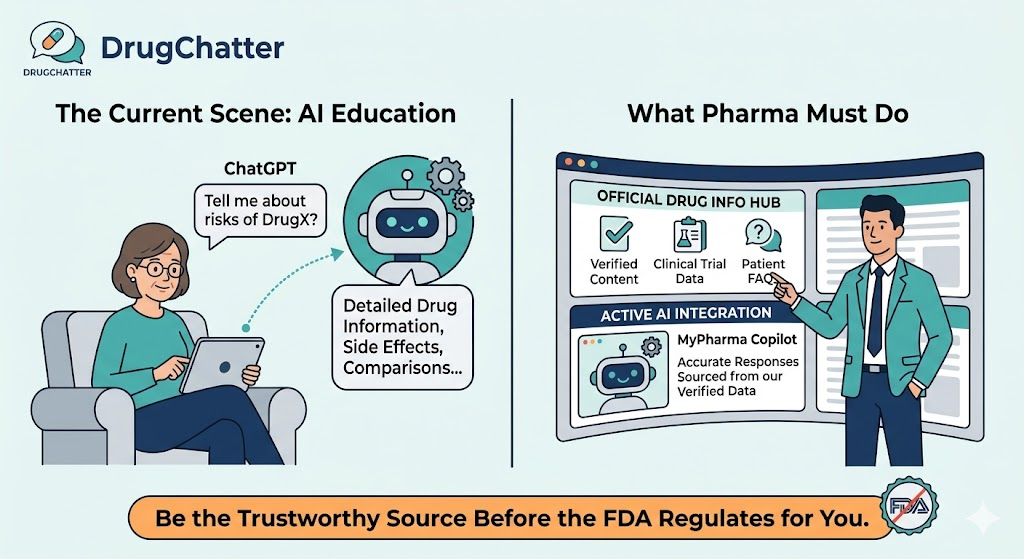
The shift happened without a product launch, without a press release, and without a single pharmaceutical company authorizing it. Sometime in the past two years, conversational AI became the default starting point for patients who have questions about their medications.
Not WebMD. Not the drug’s official website. Not their pharmacist. ChatGPT.
A 2024 survey by the Journal of Medical Internet Research found that 58 percent of respondents had used a generative AI tool to answer a health or medication question in the prior six months — and that more than half of those users took some form of action based on the answer. They adjusted a dose. They stopped a medication. They decided against filling a prescription. They asked their doctor about a drug they had not previously heard of.
That behavior change is not a trend to watch. It is the current reality of how drug information reaches patients, and pharmaceutical companies are, by and large, structurally unprepared for it.
The front door of drug information used to be a search results page. It is now a text box. The person on the other side of that text box is not a static algorithm returning ranked links — it is a language model generating confident, synthesized, conversational answers that may or may not reflect what the FDA approved.
This article examines how conversational AI has reshaped drug information access, what pharmaceutical companies stand to lose by ignoring it, and what the companies that are taking it seriously are actually doing.
How Conversational AI Replaced Google as the Front Door for Drug Questions
For two decades, the dominant model of patient drug research was search-and-click: a patient typed a drug name or symptom into Google, received a list of results, and navigated to WebMD, RxList, Drugs.com, or the manufacturer’s website. The information was static. The patient did the synthesis.
Conversational AI inverts that model. The patient describes their situation in natural language — ‘I take metformin for diabetes and my doctor just added lisinopril, is that safe?’ — and the AI synthesizes an answer from its training data and, in retrieval-augmented systems, from live sources. The answer is immediate, personalized in tone, and delivered as confident prose.
For many patients, that experience is simply better than keyword search. It answers the actual question rather than returning a list of links that may or may not contain the answer. It accommodates follow-up questions. It does not require the user to evaluate source credibility across five different websites.
What Changed Between 2022 and 2025 in Patient AI Behavior
The inflection point was November 2022, when OpenAI released ChatGPT publicly. Within three months, it became the fastest-growing consumer application in history. But the shift in health-seeking behavior took longer to materialize, because early ChatGPT users treated the tool primarily as a productivity aid.
By late 2023, behavioral patterns had shifted. Studies tracking patient portal queries, pharmacy call volumes, and physician appointment preparation showed patients arriving with AI-sourced information at measurably higher rates. By 2024, some academic medical centers reported that more than 30 percent of patients in certain specialties mentioned AI-generated content during consultations.
The driver was not sophistication — it was ease. Patients with chronic conditions, who manage complex medication regimens and have standing questions about interactions, tolerability, and alternatives, found conversational AI dramatically more efficient than prior information-seeking methods.
Which AI Platforms Are Patients Actually Using for Drug Questions?
ChatGPT is the highest-volume platform for health queries, by a wide margin. But the distribution across platforms matters for pharmaceutical monitoring strategy, because different models produce different answers from the same question.
Google’s Gemini benefits from integration across Google Search and Google’s health data partnerships. A patient searching for drug information on Google increasingly receives an AI-generated summary before organic results appear — a format called an ‘AI Overview’ that effectively replaces the traditional search results page for many health queries.
Perplexity has built a niche in the research-oriented segment of health information seekers. It provides cited answers, which creates an appearance of sourced authority. The citations do not guarantee accuracy — they guarantee that the answer came from somewhere, not that the somewhere was correct or that the synthesis was faithful.
Claude, developed by Anthropic, has positioned itself more cautiously on medical content, with stronger default guardrails around health claims. That caution does not prevent efficacy or safety errors; it reduces their frequency but does not eliminate them.
For pharmaceutical companies designing AI monitoring programs, each platform requires separate query testing. The same drug question asked across ChatGPT, Gemini, Perplexity, and Claude can produce four materially different answers.
Why the Shift Away from Branded Drug Websites Is Permanent
Pharmaceutical companies invested heavily in branded drug websites over the past decade: patient support portals, dosing calculators, side effect trackers, financial assistance finders. Those websites are still used. But they are no longer where most patients start.
The reason is structural. Branded drug websites answer questions about one drug. Conversational AI answers questions in context — including comparisons, alternatives, and combinations that a branded site has no incentive to address honestly. Patients who want to know whether their drug is better than a competitor’s drug, or whether they should switch, cannot find a useful answer on the manufacturer’s own website. They can ask ChatGPT.
That shift in starting point is a fundamental change in pharmaceutical information architecture, and it has not been matched by a corresponding change in pharmaceutical monitoring and engagement strategy at most companies.
What Conversational AI Actually Says When Patients Ask About Their Drugs
The gap between what AI systems say and what FDA-approved labeling supports is not uniform. It varies by drug, by question type, by platform, and by the phrasing of the question. But systematic analysis reveals consistent patterns that pharmaceutical companies need to understand.
How LLMs Answer ‘Is This Drug Safe for Me?’ Differently Than FDA Label Language
FDA labeling is written for healthcare providers. It uses clinical terminology, statistical language, and structured formatting — Warnings and Precautions, Adverse Reactions, Drug Interactions — that assumes a medically literate reader. It is not designed for conversational delivery.
When a patient asks ‘Is [drug] safe for me?’ in natural language, the AI faces a translation problem. It must convert label information into accessible language, adapt to the patient’s stated context, and calibrate its confidence appropriately. Most models do the first two reasonably well. They consistently fail at the third.
AI systems tend to be more reassuring about drug safety than label language warrants, because the training data includes large volumes of physician-authored content, patient advocacy materials, and pharmaceutical-sponsored educational resources that present a favorable benefit-risk picture. The model learns the genre conventions of drug communication — which trend toward reassurance — and reproduces them.
The Interaction Query Problem: Where AI Drug Answers Are Most Dangerous
Drug interaction queries are where AI drug information failure is most clinically consequential and most technically predictable. Interactions are complex, context-dependent, and constantly updated as post-marketing data accumulates. No LLM’s training data is current enough to capture the full interaction profile for every drug pair, and the model has no mechanism to signal that its knowledge may be outdated.
A patient taking warfarin who asks an AI whether it is safe to take ibuprofen for a headache needs a definitive ‘no’ with a clear explanation. AI systems frequently provide a nuanced answer that acknowledges the interaction but frames it as manageable with caution — a framing that the patient may interpret as permissive.
A 2024 analysis published in Drug Safety examined AI responses to 50 high-risk drug interaction queries. The models produced the correct interaction warning in 71 percent of cases. In 29 percent of cases, they either missed the interaction entirely or understated its severity. For drugs with narrow therapeutic indices — warfarin, digoxin, lithium, phenytoin — the error rate was higher.
What Happens When Patients Ask AI About Off-Label Drug Use
Off-label use is where conversational AI and pharmaceutical regulatory compliance intersect most directly. Patients ask AI systems about off-label applications at high rates — particularly for drugs that have generated strong anecdotal or social media interest for non-approved uses.
Low-dose naltrexone is one of the most instructive examples. The drug is FDA-approved at doses of 50mg for opioid use disorder and alcohol use disorder. A substantial community of patients and practitioners uses it at doses of 1.5mg to 4.5mg — so-called LDN — for conditions including fibromyalgia, multiple sclerosis, Crohn’s disease, and long COVID. None of those applications is FDA-approved. The evidence base is limited and mixed.
When patients ask ChatGPT, Gemini, or Claude about LDN for these conditions, AI systems routinely describe the evidence in more favorable terms than a rigorous clinical appraisal would support. They describe anecdotal reports and small trials as if they constitute meaningful evidence of efficacy. They do not adequately communicate that they are describing off-label use with limited clinical validation.
AbbVie, which manufactures the branded form, has no promotional role in these discussions. But when patients make prescribing requests based on AI-generated off-label information, the broader dynamics of off-label prescribing — including physician liability and insurance coverage challenges — are set in motion by an information channel the industry does not control.
How AI Handles Biosimilar and Generic Substitution Questions
The biosimilar and generic substitution space is commercially critical for a large segment of the pharmaceutical industry, and AI handles it inconsistently.
For small-molecule generics, where FDA bioequivalence standards are well-established, AI systems generally handle substitution questions appropriately — noting that AB-rated generics are therapeutically equivalent and suggesting patients consult their pharmacist. The errors that appear tend to be about which generics are available for which drugs, information that changes frequently and sits outside the model’s knowledge cutoff.
For biosimilars, the situation is substantially more complex. Biosimilars are not identical to their reference biologics, and interchangeability designations from FDA carry specific legal and clinical meaning. AI systems frequently overstate the similarity of biosimilars to reference products, understate the clinical considerations that apply to switching, and conflate interchangeable biosimilars with non-interchangeable ones.
For companies like Amgen, AbbVie, Johnson and Johnson, and Pfizer — all of which have significant exposure to either reference biologic defense or biosimilar market entry — the way AI handles biosimilar questions is a material commercial issue, not just a compliance concern.
The Regulatory Gray Zone: Does the FDA Have Jurisdiction Over AI Drug Answers?
FDA’s regulatory authority over drug information is clearly established for pharmaceutical companies, their agents, and content they control or influence. AI-generated drug information sits in a zone where that authority has not yet been clearly defined — and where the agency is actively working to define it.
How FDA’s Office of Prescription Drug Promotion Is Watching AI
OPDP has not issued guidance specifically addressing AI-generated drug content. But the office has signaled its attention through public statements, conference participation, and its ongoing review of digital promotional practices.
At the 2024 FDA/CMS Summit, OPDP representatives discussed how the agency conceptualizes the boundary between pharmaceutical company responsibility and platform responsibility for drug information accuracy. The office’s position — that pharmaceutical companies retain responsibility for ensuring accurate drug information reaches patients through channels they influence — has implications for AI, even where direct causal influence is difficult to establish.
FDA issued a draft guidance in 2023 on prescription drug promotion using paid search — a guidance that addressed digital advertising rather than AI-generated content directly, but that established the principle that the medium does not change the promotional standards that apply to the content. That principle, applied to AI, would hold that drug information delivered via conversational AI is subject to the same fair balance and accuracy requirements as any other promotional channel.
Can Pharmaceutical Companies Face Liability for AI Answers They Did Not Write?
The liability question is not academic. It has three distinct pathways, each with different evidentiary requirements.
The first is FDA regulatory action under the misbranding framework. A drug is misbranded if information associated with it is false or misleading. The question is whether AI-generated answers about a drug constitute ‘information associated with’ the drug in a regulatory sense. FDA has not yet answered that question definitively, but the agency’s pattern of extending its authority to new digital channels suggests the answer will eventually be yes.
The second is civil liability under state tort law. A patient who takes an action based on AI-generated drug information and suffers harm might pursue a products liability or negligence claim against the AI platform. If that claim involves a theory that the platform’s drug information came from, or was shaped by, the pharmaceutical company’s own content — press releases, sponsored content, medical education materials — the pharmaceutical company becomes a potential co-defendant.
The third is the duty-to-correct doctrine, which creates an obligation to act once a company has knowledge of misinformation about its product. Systematic AI monitoring that documents AI inaccuracies creates a paper trail. Companies that have monitoring records showing they detected errors and did nothing are in a worse regulatory position than companies with no monitoring at all, and far worse than companies with documented corrective actions.
EMA’s Position on AI Drug Information: Stricter, Sooner
The European Medicines Agency has moved faster than FDA on AI in health contexts. The EU AI Act, which began applying its highest-risk provisions in August 2024 and reaches full applicability in August 2026, classifies AI systems that influence health decisions as high-risk, requiring human oversight mechanisms, accuracy documentation, and audit logs.
For pharmaceutical companies operating in European markets, the EU AI Act creates concrete compliance requirements around AI-generated drug information. Companies that use AI tools for patient or physician communication — chatbots, decision support tools, AI-enhanced medical information services — must comply with accuracy and oversight requirements that go well beyond FDA’s current standards.
EMA’s pharmacovigilance working group has specifically flagged AI-generated patient information as a signal monitoring priority. The agency expects pharmaceutical companies to track how AI represents their products, and to report material discrepancies through existing pharmacovigilance channels.
Pharmacovigilance in the Age of Conversational AI: What Changes and What Stays the Same
Pharmacovigilance — the systematic monitoring of drug safety after approval — has always depended on information flows that are incomplete, delayed, and biased toward underreporting. Conversational AI creates both new data sources for pharmacovigilance and new safety risks that existing pharmacovigilance frameworks were not designed to handle.
Can Patient AI Conversations Be Mined for Adverse Event Signals?
Patients describe symptoms, side effects, and drug experiences to AI chatbots in substantial volume. Some of that description contains information that would qualify as an adverse event report under ICH E2D definitions — an identifiable patient, an identifiable reporter, a suspect drug, and a suspected adverse event. Most of it is not submitted to FDA’s FAERS database.
Several research groups and contract research organizations are piloting methods for extracting pharmacovigilance signals from publicly available AI interaction data. The technical barriers are real: patient-language symptom descriptions do not map cleanly to MedDRA terminology, the absence of a verified patient identity complicates signal validation, and AI responses to patient descriptions may shape subsequent patient language in ways that introduce bias.
The signal detection opportunity is proportional to the volume disadvantage of traditional reporting. FAERS receives approximately 2 million reports annually. Conservative estimates of health-related AI queries in the United States alone exceed 400 million per month. Even a 0.1 percent adverse event signal rate in that query volume would generate more potential signals than FAERS captures in a year.
Pharmaceutical companies that develop the capability to integrate AI-sourced signals into pharmacovigilance programs will have an information advantage that translates directly into faster safety signal detection — and into regulatory goodwill with agencies that have been pushing for more proactive signal detection for years.
AI-Generated Drug Information as a Safety Risk: The Reverse Pharmacovigilance Problem
The pharmacovigilance opportunity runs in both directions. AI can be a source of safety signals. It can also be a cause of safety events — when patients act on inaccurate AI drug information in ways that harm them.
This reverse pharmacovigilance problem is largely invisible to existing safety surveillance systems. When a patient stops a medication because an AI told them it was unnecessary, or doubles a dose because an AI described the standard dose as subtherapeutic for their condition, or takes a contraindicated drug combination because an AI failed to flag the interaction — those events generate adverse outcomes. The adverse outcome may eventually appear in a FAERS report or a hospital record. The AI role in causing it will not.
Pharmaceutical companies have a safety monitoring interest in the accuracy of AI drug information that is separate from any commercial interest. A drug that patients stop taking because AI described it inaccurately fails both patients and the company that developed it.
How to Build AI Signal Detection Into Existing Pharmacovigilance Workflows
The practical path for most pharmaceutical companies is not to build standalone AI pharmacovigilance infrastructure from scratch. It is to extend existing signal detection infrastructure to include AI-sourced inputs.
Signal detection currently aggregates data from FAERS, EudraVigilance, the Yellow Card system in the UK, published literature, and social media monitoring. Adding AI-query monitoring to that data stream requires adapting existing NLP pipelines to handle conversational AI output formats, creating coding protocols for AI-sourced signals, and establishing validation procedures that account for the lower reliability of AI-sourced adverse event descriptions compared to structured reports.
Platforms like DrugChatter provide the AI monitoring infrastructure that feeds this pipeline — systematic capture of drug mentions in AI-generated content, with classification by mention type, sentiment, and clinical claim category. Connecting that output to existing pharmacovigilance workflows requires standard data integration work that most pharmaceutical companies’ IT environments can accommodate.
How AI Share-of-Voice Works — and Why It Is Not the Same as Search SEO
Pharmaceutical companies that frame AI visibility as an SEO problem will solve the wrong problem. AI share-of-voice and search engine share-of-voice are related but mechanistically distinct, and confusing them produces misdirected investment.
What Determines Which Drugs Appear in AI-Generated Treatment Answers
In keyword search, a drug’s visibility is a function of its website’s authority, its content relevance for specific queries, and its advertising spend for paid placements. Those inputs are measurable and directly actionable.
In AI search, a drug’s visibility in generated answers is a function of how prominently it appears in the model’s training data — across clinical literature, patient forums, medical education content, news coverage, and health websites. The relative weight of those sources varies by model and is not publicly disclosed by any of the major AI companies.
What pharmaceutical companies can observe is the output: which drugs appear in AI answers to which questions. What they cannot directly observe is why — which training data sources are driving the model’s drug preferences. That opacity makes the monitoring problem harder and the content strategy more complex.
Tracking Competitive AI Share-of-Voice: A Practical Framework
Building a competitive AI share-of-voice framework starts with query design. The question set should cover four categories:
- Class-level queries: Questions about a drug class or condition without naming a specific drug (‘What medication is most effective for rheumatoid arthritis that hasn’t responded to methotrexate?’)
- Branded queries: Questions that name the company’s drug (‘How effective is Rinvoq for RA?’) and competitor drugs (‘How does Rinvoq compare to Xeljanz?’)
- Patient-experience queries: Questions that reflect real patient experiences (‘I’ve been on Humira for six months and it stopped working — what do my options look like?’)
- Physician-pattern queries: Questions formulated in clinical language (‘What is the recommended second-line biologic for RA patients who fail anti-TNF therapy?’)
Running this question set across ChatGPT, Gemini, Perplexity, and Claude on a regular schedule — and recording which drugs are named, in what positions, and with what attributed characteristics — produces a share-of-voice matrix that tracks over time.
The value of the time series is as important as any individual snapshot. AI model outputs change as models are updated, as new training data is incorporated, and as fine-tuning adjustments are made. A drug that had strong AI share-of-voice in early 2024 may have lost ground to a competitor whose clinical data was prominently covered in mid-2024 publications that were subsequently indexed in training data.
How AI Ranking Differs for Branded vs. Generic Drug Names in Conversational Queries
Generic drug names — methotrexate, adalimumab, semaglutide — appear in AI answers at higher rates than branded names for the same molecules, in most contexts. This reflects training data composition: clinical literature, medical education content, and pharmacist-authored resources use generic names as a professional convention. Brand names dominate in patient-facing content and promotional materials, which represent a smaller share of the typical LLM training corpus.
The practical implication is that branded drugs face a systematic AI share-of-voice disadvantage relative to their generic names — not relative to competitor brands. When an AI recommends ‘adalimumab’ rather than ‘Humira,’ it is not making a preference statement; it is reproducing the nomenclature conventions of its training data. But the patient who hears ‘adalimumab’ may not connect that to Humira, and the pharmaceutical company that invested in the brand may lose the brand-recognition benefit.
For drugs with biosimilar competition, this distinction is commercially significant. When AI says ‘adalimumab’ in a context where the patient might use AbbVie’s Humira or any of its biosimilar competitors, the brand has no inherent AI share-of-voice advantage. Every biosimilar manufacturer benefits equally from the generic name reference.
Patient Sentiment in Conversational AI: What LLMs Say When They Sound Like Patients
LLMs do not just answer clinical questions in clinical language. They absorb and reproduce patient sentiment — the emotional valence, the experiential framing, and the community consensus that characterize how patients talk about their drugs in forums, support groups, and social media. That reproduced sentiment shapes how patients interpret information they receive from AI systems.
How Reddit, Patient Forums, and Social Media Shape AI Drug Sentiment
Reddit is disproportionately represented in the training data of most major foundation models. Subreddits like r/diabetes, r/Crohns, r/lupus, r/MultipleSclerosis, and hundreds of condition-specific communities contain millions of patient posts describing drug experiences in raw, unfiltered language. That language is not medically precise, but it is experientially authentic — and LLMs learn from it.
When a model is asked about the experience of taking a drug, it synthesizes a description that reflects the community consensus in its training data. A drug that generates predominantly positive patient forum content will be described in favorable experiential terms. A drug with high rates of forum complaints about tolerability, injection site reactions, or adherence challenges will be described with corresponding hesitation.
The sentiment the model reproduces is not the sentiment of the average clinical trial participant. It is the sentiment of the patients who were motivated to post about their experience — a self-selected sample that overrepresents extreme outcomes, both positive and negative. AI systems do not correct for that selection bias; they encode it.
How Pharmaceutical Companies Can Use AI Sentiment as an Early Warning System
The lead time between patient experience trends and their appearance in AI-generated answers creates a monitoring opportunity. New side effect concerns, adherence challenges, or competitive comparisons that emerge in patient communities take weeks to months to reach AI training data, and additional time before they appear consistently in AI outputs.
Companies that monitor patient forum content — not just for direct social listening, but for content that is likely to reach AI training data — can anticipate shifts in AI sentiment before those shifts occur. A wave of posts describing a new tolerability concern will, with some lag, produce AI outputs that reflect that concern more prominently. Early detection of the forum-level signal gives brand teams, medical affairs, and regulatory functions time to prepare a response before the AI shift happens.
DrugChatter’s monitoring platform integrates patient forum tracking with AI output analysis, connecting the upstream signal to the downstream AI characterization in a single view. That integration is what makes it practically useful for pharmaceutical teams rather than just analytically interesting.
Physician Perception and AI: What Doctors Are Learning From Conversational LLMs
Physician use of conversational AI for clinical decision support is growing faster than most pharmaceutical companies have accounted for in their medical affairs strategies. A 2024 survey by the American Medical Association found that 38 percent of physicians had used an AI chatbot to look up clinical information in the prior three months — up from 22 percent the year before.
Physicians use AI differently than patients do. Their queries are more specific, more clinically framed, and more skeptical of confident answers. But they are not immune to AI errors. A physician who asks Claude for a summary of the evidence on a drug they are unfamiliar with receives a synthesis that may compress, simplify, or inadvertently misrepresent the clinical literature. If that synthesis shapes the physician’s initial understanding of the drug, subsequent promotional contacts — detail visits, journal ads, speaker programs — are working to correct or reinforce an AI-shaped prior belief.
Medical affairs teams that understand what AI says about their drugs in physician-language queries can adapt their engagement strategies accordingly. If AI consistently understates a drug’s evidence base relative to a competitor, MSL conversations can specifically address that gap. If AI overstates efficacy in ways that create unrealistic physician expectations, proactive expectation management becomes a priority.
What Pharma Brand Teams Can Learn From How Patients Phrase AI Drug Queries
The text box is a research instrument. Every query a patient types into ChatGPT or Gemini is a window into what they actually want to know about a drug — unmediated by the survey design, the focus group moderator, or the market research instrument. Pharmaceutical companies that systematically analyze AI query patterns have access to voice-of-the-customer data that no traditional research method produces.
How Patient Query Language Differs From Pharmaceutical Communication Language
Pharmaceutical companies communicate about drugs using label language, promotional language, and medical education language — all of which reflect how the industry thinks about drugs. Patients query about drugs using lived-experience language, which is different in structure, vocabulary, and priority.
Patients rarely ask about ‘the mechanism of action’ of their medication. They ask why it makes them tired, whether they can drink alcohol on it, what happens if they miss a dose, and whether it is making their hair fall out. They ask whether other people have the same experience. They ask whether there is a better option.
Those questions reveal what patients actually care about — which is not always what pharmaceutical companies have prioritized in their communication strategies. A drug with excellent efficacy data and a known tolerability issue will generate AI queries that focus heavily on the tolerability issue, because that is what patients experience every day. If a company’s AI share-of-voice strategy focuses on amplifying efficacy claims without addressing the tolerability conversation, it is missing the dominant patient concern in the AI ecosystem.
What AI Query Patterns Reveal About Unmet Information Needs
When patients ask conversational AI questions that their branded drug website could answer but does not — because the website was not designed for the questions patients actually have — those queries represent unmet information needs. Systematically cataloguing those needs is a direct input into patient support program design, website content strategy, and medical affairs communication planning.
A pharmaceutical company that identifies, through AI query monitoring, that a large volume of patient queries concern a drug’s use in a specific comorbid population — say, patients with both type 2 diabetes and chronic kidney disease asking about a specific SGLT2 inhibitor — has a direct signal that clinical content addressing that population’s needs is in demand and potentially affecting prescribing decisions.
That signal is not available from traditional market research at comparable speed or granularity. It is available from systematic AI monitoring, because the AI query pattern surfaces it directly.
Detecting and Responding to AI Drug Misinformation: A Practical Playbook
Pharmaceutical companies that move from monitoring to response need a playbook that fits within existing regulatory, medical, and legal review frameworks. The tools for responding to AI misinformation are different from those for responding to, say, a misleading journal article, but the organizational infrastructure is the same.
How to Identify AI Hallucinations Specific to Your Drug Portfolio
The detection workflow has four steps: query design, output capture, claim extraction, and deviation scoring.
Query design for hallucination detection focuses on the questions most likely to elicit inaccurate responses: efficacy comparisons, off-label use questions, dosing queries for special populations, interaction queries, and questions about clinical trial results. Each question should be formulated in multiple natural-language variants — the AI’s response is sensitive to exact phrasing, and testing variant phrasings reveals the range of potential outputs a patient might encounter.
Output capture should occur across all major AI platforms, on a consistent schedule. Model outputs should be stored with full metadata: platform, model version, query text, response text, and timestamp. Model versioning is important — the same platform may run different model versions in different contexts, and model updates can change drug characterizations significantly.
Claim extraction uses NLP to identify pharmacological claims in captured outputs: efficacy claims, safety claims, dosing claims, interaction claims, and comparative claims. Each claim is tagged by type and mapped to the relevant section of the approved label or published clinical literature.
Deviation scoring compares extracted claims to approved labeling and flags discrepancies. The scoring should distinguish between different categories of deviation: factual error (the model states a fact that is demonstrably false), quantitative overstatement (the model accurately describes a direction of effect but overstates its magnitude), omission (the model fails to include required safety information), and unsupported comparison (the model makes a comparative claim without adequate clinical basis).
The Internal Review Process for AI Drug Content Deviations
Detected deviations should route to a cross-functional review process. Medical affairs evaluates clinical accuracy. Regulatory affairs assesses the regulatory implications of the deviation — whether it constitutes a duty-to-correct trigger, whether it rises to the level of a promotional compliance concern, whether it requires external reporting. Legal assesses liability exposure. The process should mirror, but not duplicate, the existing promotional review process.
Deviations that do not require immediate action still require documentation. A company that monitors AI outputs systematically and documents its review of detected deviations is building a regulatory compliance record that will be valuable if FDA or EMA inquires into the company’s handling of AI drug misinformation.
Corrective Action Options: What Pharma Companies Can Actually Do
The menu of corrective actions is narrower than for traditional media, but not empty.
Direct platform engagement: All major AI companies have trust and safety contact mechanisms. Pharmaceutical companies can submit documented reports of drug information errors, citing approved labeling, and request correction. Success rates vary by platform and error type. Clear factual errors — a drug described as approved for an indication it does not have — are most likely to be addressed. Nuanced quantitative overstatements are harder to correct through this channel.
Content investment: Publishing high-quality, clinically accurate content on indexable domains — medical affairs publications, sponsored clinical education content, patient foundation resources — creates source material that may be incorporated in future model training updates. This is a long-horizon strategy, not a rapid correction mechanism, but it compounds over time.
Regulatory documentation: Filing a record of detected deviations and corrective actions attempted with the company’s regulatory affairs function creates a trail of diligent compliance behavior. If FDA or EMA subsequently raises questions about the company’s handling of AI drug misinformation, that documentation is the company’s primary defense.
‘Pharmaceutical companies are increasingly aware that AI platforms are influencing prescribing decisions, but fewer than 15 percent have implemented systematic programs to monitor what those platforms say about their products.’ — Gartner, ‘Generative AI in Life Sciences: 2024 Adoption Survey,’ November 2024.
How AI Search Is Changing Pharmaceutical Sales and Medical Affairs Strategy
The downstream effects of the AI drug information shift reach beyond marketing and compliance into pharmaceutical commercial operations — specifically into the sales force model and the medical affairs function that has been growing in commercial importance for the past decade.
What AI Means for the Pharmaceutical Sales Force Model
The pharmaceutical sales force has been declining in size since the 2010s, driven by physician access restrictions, digital channel expansion, and prescriber preference shifts away from in-person detail visits. Conversational AI accelerates that structural pressure in a specific way: physicians who can answer a clinical question about a drug in thirty seconds via ChatGPT are less dependent on sales representatives as information sources than they were ten years ago.
That creates a priority shift for the information that sales representatives provide. The commodity information — mechanism of action, approved indications, dosing schedules — is now available from AI with lower friction than a detail visit provides. The differentiated value of a sales interaction must come from information the AI cannot provide: real-world evidence specific to the local patient population, access to patient support programs, clinical case consultation, and managed care navigation.
Sales teams that do not understand what their AI competitors are saying about the company’s drugs are operating without context. They may be reinforcing AI-accurate information needlessly, or failing to correct AI inaccuracies that are actively working against the prescribing decision.
How Medical Science Liaisons Can Address AI-Generated Drug Misinformation
Medical Science Liaisons are the function best positioned to address AI drug misinformation in physician interactions, because they operate under scientific exchange rules rather than promotional constraints. An MSL who knows that ChatGPT consistently mischaracterizes the evidence base for a drug — understating a relevant subgroup analysis, for example, or describing a surrogate endpoint benefit as a survival benefit — can address that characterization directly in physician conversations.
Doing that effectively requires systematic intelligence on what AI says. MSL field teams that receive regular AI monitoring reports — what the major AI platforms are currently saying about the company’s drugs, and where those characterizations diverge from the clinical literature — can proactively address those divergences in their scientific exchange conversations.
This is a direct, practical application of AI monitoring output. It requires the monitoring program to be operational, the output to be synthesized into actionable summaries, and the MSL training to include AI-specific communication content. All three requirements are feasible with current technology and organizational infrastructure.
The Competitive Intelligence Value of AI Monitoring for Pharmaceutical Companies
AI monitoring is not just a compliance and safety tool. It is a competitive intelligence instrument that provides information about competitor products, market dynamics, and patient behavior that is not available from traditional market research at comparable cost or speed.
What AI Tells You About Competitor Drug Positioning Without Asking
When a pharmaceutical company monitors AI answers to drug class queries, it learns how AI characterizes competitor drugs alongside its own. That characterization reflects the aggregate of competitor clinical literature, patient forum sentiment, and media coverage — an unsolicited synthesis of competitive intelligence.
A company monitoring AI answers about JAK inhibitors for rheumatoid arthritis can observe how ChatGPT, Gemini, and Claude characterize the safety profiles of upadacitinib (Rinvoq), tofacitinib (Xeljanz), and baricitinib (Olumiant) relative to each other. The AI’s characterization reflects its training data, which in turn reflects the scientific literature and media coverage. If the AI consistently describes a competitor drug with more safety caution than the company’s own drug, that is a share-of-voice advantage the company can understand and protect.
Resources like DrugPatentWatch provide the underlying patent and exclusivity data that contextualizes the competitive landscape — patent expirations, regulatory milestones, market entry dates for biosimilars and generics — and that contextual layer connects directly to AI share-of-voice strategy. A drug approaching patent expiration will face AI share-of-voice erosion as generic names begin to dominate AI training data. Anticipating that erosion allows brand teams to plan the transition rather than react to it.
How to Use AI Monitoring to Identify Emerging Market Dynamics Early
AI monitoring surfaces emerging market dynamics through changes in query patterns and AI answer composition. When a new treatment approach — a new drug class, a revised treatment guideline, an emerging off-label use — begins gaining traction in clinical practice, it generates new query volume and eventually changes the composition of AI-generated treatment recommendations.
Monitoring that change in real time gives commercial teams early warning of shifts in competitive dynamics. A treatment algorithm that did not include a specific drug class eighteen months ago may now appear in AI recommendations as a second-line option — reflecting updates in clinical practice guidelines that have propagated through AI training data. Detecting that shift in AI outputs before it registers in prescribing data provides lead time for commercial response.
What the Pharmaceutical Industry Gets Wrong About Conversational AI — and What to Do Instead
The most common failure mode in pharmaceutical AI strategy is treating conversational AI as a channel to manage rather than an environment to understand. Channel management thinking produces narrow, reactive responses: get the company’s website ranked in Perplexity, request correction of a specific ChatGPT error, monitor for brand mentions. That is necessary but insufficient.
The Difference Between AI Channel Management and AI Environment Intelligence
AI environment intelligence means understanding the entire ecosystem of conversational AI as it relates to the company’s therapeutic areas: what patients ask, what physicians ask, what the AI answers, where those answers are accurate, where they diverge from evidence, what drives the divergences, and how those divergences shift over time.
That understanding produces strategic intelligence rather than tactical responses. It informs which clinical publications to prioritize for maximum AI training data impact. It identifies patient information gaps that patient support programs can address. It reveals competitive AI positioning before it shows up in prescribing data. It provides early warning of pharmacovigilance signals. It documents compliance behavior for regulatory purposes.
The companies building that intelligence capability now — and the tools like DrugChatter that support it — will have structural advantages over companies that start later, because the historical monitoring record compounds in value. A company with two years of AI monitoring data can track trends, detect model-update effects, and demonstrate ongoing compliance effort in ways a company with two months of data cannot.
Building the Internal Case for Pharmaceutical AI Monitoring Investment
The internal business case for AI monitoring investment needs to speak to multiple functions, because the value is distributed across them.
For regulatory affairs: AI monitoring is a pharmacovigilance and duty-to-correct compliance tool. The investment protects against regulatory exposure that is currently unmanaged.
For brand management: AI share-of-voice is now a component of total brand visibility. Companies that do not measure it do not manage it.
For medical affairs: AI monitoring provides actionable intelligence for MSL field teams and medical information services. It identifies gaps in the scientific narrative that AI is filling with whatever the training data supports.
For commercial operations: AI monitoring provides competitive intelligence and early-warning signals on market dynamics that traditional market research does not capture at comparable speed.
The cross-functional value means that AI monitoring investment can be justified against multiple budget lines — regulatory, brand, medical, commercial — which makes the business case easier to build than it would be for a single-function investment.
Key Takeaways
- Conversational AI — ChatGPT, Gemini, Claude, Perplexity — is now the primary starting point for patient drug questions. That shift happened without pharmaceutical industry authorization and without regulatory framework to govern the content.
- AI-generated drug information consistently diverges from FDA-approved labeling in predictable ways: overstating efficacy, understating safety risks, mishandling interaction queries, and conflating biosimilars with interchangeable products.
- The regulatory exposure for pharmaceutical companies is real and growing across three pathways: FDA misbranding and duty-to-correct obligations, EU AI Act compliance requirements, and civil liability theories in patient harm litigation.
- AI share-of-voice is not a function of SEO investment. It reflects training data composition — and it can be measured, tracked, and influenced through systematic monitoring and strategic content investment.
- Pharmacovigilance programs need to incorporate AI-generated content as both a signal source (patient descriptions of adverse events in AI conversations) and a safety risk (patients acting on inaccurate AI drug information).
- Medical Science Liaisons are the function best positioned to address AI drug misinformation in physician interactions — but only if they receive systematic intelligence on what AI is currently saying about the company’s drugs.
- The corrective action menu is narrow but not empty: platform engagement for clear factual errors, content investment for training data influence, and regulatory documentation of detected deviations and corrective actions.
- Companies that build systematic AI monitoring programs now accumulate a historical record that compounds in regulatory, competitive, and strategic value. DrugChatter provides the platform infrastructure to support that program without building from scratch.
Frequently Asked Questions
What is AI share-of-voice in pharmaceuticals and how is it measured?
AI share-of-voice measures how frequently a drug is mentioned in AI-generated answers to drug class, condition, and treatment queries — and with what attributed characteristics. Unlike search share-of-voice, which tracks keyword ranking positions, AI share-of-voice requires running standardized queries across ChatGPT, Gemini, Claude, and Perplexity, recording full model outputs, and analyzing which drugs are named, in what context, and with what clinical claims. The result is a matrix of drug mentions across platforms and query types that can be tracked over time to reveal competitive positioning trends and shifts driven by model updates or changes in training data.
Does a pharmaceutical company have a legal obligation to correct AI misinformation about its drug?
Under FDA’s duty-to-correct doctrine, a pharmaceutical company that becomes aware of misinformation about its product has an obligation to take reasonable corrective action, even if it did not create the misinformation. The doctrine has been applied to third-party publications, social media, and digital platforms. Whether and how it applies to AI-generated content has not been definitively resolved by FDA, but the agency’s pattern of extending its authority to new digital channels makes it likely that AI will eventually be covered. Companies that document systematic monitoring and corrective action attempts are in a defensible regulatory position; companies that monitor, detect errors, and do nothing are not.
How do different AI platforms — ChatGPT, Gemini, Claude, Perplexity — compare in drug information accuracy?
Accuracy varies by drug class, question type, and the specific model version running on each platform. Claude tends to apply stronger default guardrails on medical content, reducing the frequency of confident overstatements. Perplexity provides cited answers, which improves traceability but does not guarantee synthesis accuracy. ChatGPT and Gemini produce the highest query volume in health contexts and have the widest variation in drug information accuracy depending on the question type. No platform is consistently accurate across all drug information query types. The practical implication is that pharmaceutical monitoring programs must test all major platforms separately — the same query produces materially different answers across platforms, and a company’s AI exposure cannot be assessed by monitoring only one.
Can AI conversations between patients and chatbots be used as pharmacovigilance data?
In limited circumstances, yes. Patient descriptions of drug experiences in AI conversations can contain the four elements that define a valid adverse event report: an identifiable patient, an identifiable reporter, a suspect drug, and a suspected adverse event. The practical barriers are significant — data access limitations, patient identity verification requirements, MedDRA coding challenges, and signal validation complexity. Several pharmaceutical companies and CROs are piloting AI-sourced pharmacovigilance signal detection programs. The consensus from early pilots is that AI-sourced data can generate hypothesis-generating signals that warrant follow-up in structured reporting systems, but that it should not replace, and cannot yet augment, structured FAERS reporting without substantial methodological development.
What should pharmaceutical medical affairs teams do differently in response to conversational AI?
Three changes are most actionable immediately. First, integrate AI monitoring output into MSL field intelligence briefings — MSLs need to know what AI says about the company’s drugs in physician-language queries before they walk into a physician conversation. Second, audit patient-facing medical information services to ensure they address the questions patients are actually asking AI systems, rather than the questions pharmaceutical companies assumed patients had. Third, develop a scientific content strategy that targets AI training data inclusion — publishing accurate clinical content in formats and on platforms that AI training pipelines are likely to index, coordinated through the medical-legal-regulatory review process. None of these changes requires new organizational infrastructure; all require applying existing medical affairs capabilities to a new information environment.