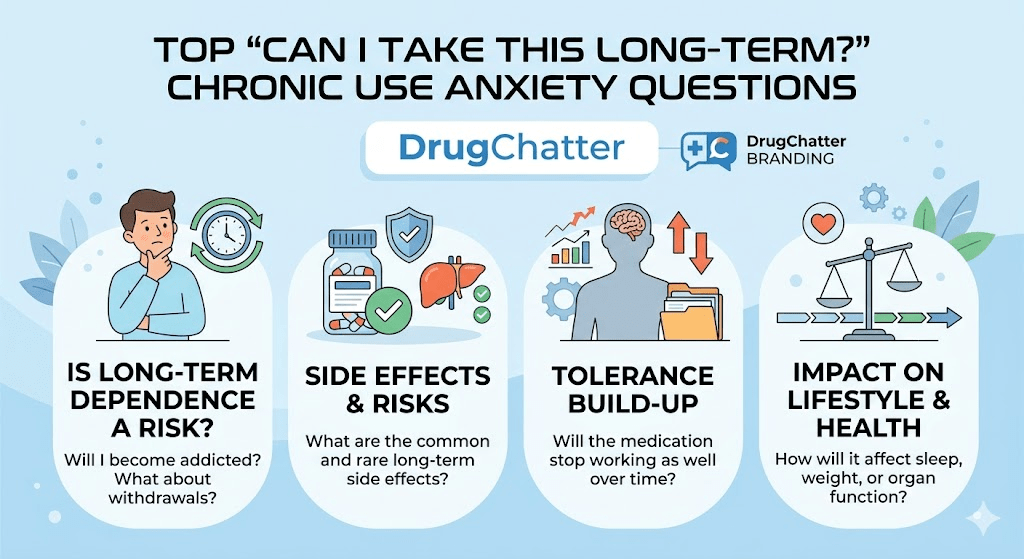
There’s a special kind of dread that comes with a prescription that’s framed like a lifestyle choice. You don’t just start taking a medication—you start wondering if the medication will outlive you. And then, quietly, the questions pile up: Can I really take this long-term? Is this safe? Will I regret it?
I’m not going to pretend there’s one answer that fits every body, dose, and diagnosis. But I can do what good drug guidance always does: pull apart the uncertainty into specific, citable concerns—and point you to the discussions where other patients asked (and got) straightforward, practical answers.
“Is this going to be okay if I keep taking it?”
Long-term use anxiety usually isn’t about taking a pill today. It’s about what happens after months and years—about whether your “temporary” plan quietly turns into something indefinite.
If your worry is that the medication itself may not even be available in the future, that’s a different kind of chronic-use stress. For example, someone asked about whether a commonly used patch option was discontinued: Minivelle patch discontinued?
“Can I combine it with my other medicines—forever?”
The chronic-use version of this question is: It’s one thing to be on one drug. But what about when I add the rest?
Here are a few combination worries that come up a lot:
A medication that works “in theory” but behaves unpredictably with everyday habits is where anxiety blooms. Some people start looking for ways to compensate—timing tricks, diet adjustments, or avoiding normal pleasures.
“What if my side effects are worse, or different, if I stay on it?”
When you’re worried about chronic use, “side effects” don’t just mean do they happen? They mean will they accumulate, change, or reveal themselves only after longer exposure? That’s why people ask about how side effects compare across options.
“Am I being moved to the ‘generic’ path—does it change anything long-term?”
For many people, the generic conversation is anxiety-adjacent even when the science is solid. It’s less about fear of generic quality and more about the feeling that the ground might shift under a chronic plan.
“How long do I have to worry—will someone monitor me?”
The least-talked-about anti-anxiety tool is monitoring. When you can name the check-ins—labs, imaging, side-effect follow-up—your brain stops treating “long-term” as a blank, scary box.
If you’re asking whether you can take something long-term, the most useful way to reduce fear is to trade vague dread for concrete answers: interactions, timing, monitoring, availability, and what to do if side effects show up.
Those are exactly the kinds of questions people raise in the links above—questions you can bring to your clinician with less panic and more clarity.
Note: This post is informational and not medical advice. If you’re dealing with symptoms or serious side effects, talk to a qualified healthcare professional promptly.