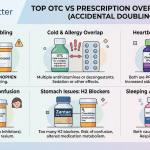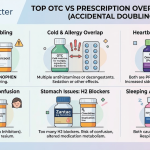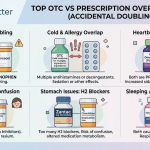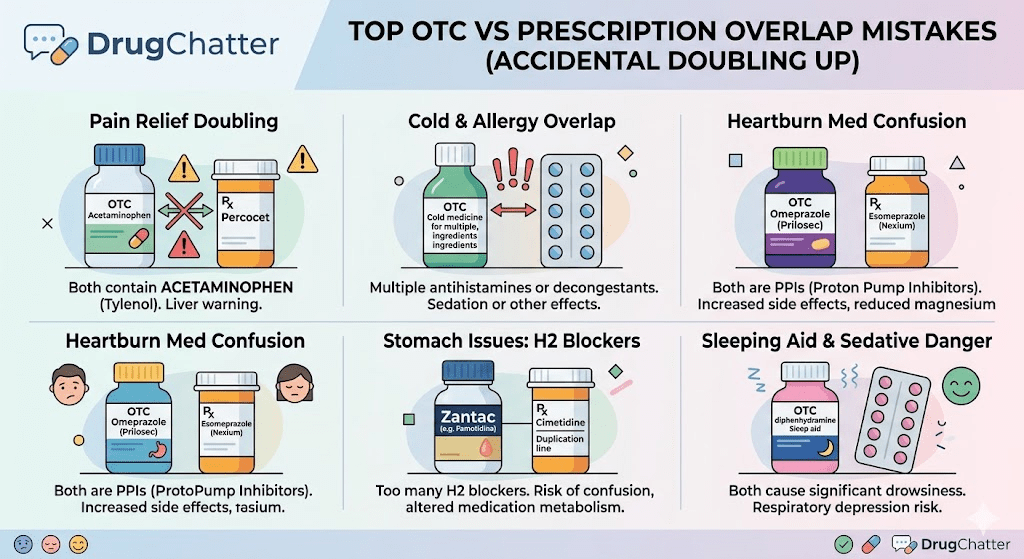
There’s a special kind of medication mistake that doesn’t feel like a mistake at all. It feels like “being thorough.” You have a bottle of something for aches. You have a bottle of something for reflux. You have a bottle of something “for cholesterol support.” And—because the labels don’t explain what they’re doing to each other—you end up doubling the same effect from two different directions: an OTC product plus a prescription.
Below are common overlap traps people fall into, and a set of DrugChatter discussions that map the underlying problem: the same drug class or the same metabolic pathway shows up in more than one place. Read them as cautionary tales—then build a habit: before taking anything OTC, verify the active ingredient(s) match (or don’t match) your prescriptions.
1) The “I only took a supplement” problem
Supplements can behave like quiet second prescriptions. If you’re already on something prescription-strength, it may be easy to assume an OTC or “natural” add-on won’t change anything. But “support” products can still alter drug handling—timing, metabolism, or effects—turning a simple add-on into a second dose of the same story.
In the same neighborhood as this warning, consider how people ask about overlap even when the supplement is framed as supportive rather than replacement therapy: Can lipitor supplements affect lipitor’s efficacy? Also, if you’re thinking in terms of OTC additions to statin therapy, the grapefruit angle is another example of “seemingly harmless” dietary additions having measurable consequences: How does lipitor’s interaction with grapefruit impact liver enzyme function?
2) The “dietary overlap” trap (bananas, garlic, grapefruit)
Some interactions are not pills at all. They’re foods and supplements that behave like pharmacology.
For example, people look for clarity on whether common foods can interfere with medication performance—like this question: Can bananas interfere with lipitor’s effectiveness? And the same theme shows up with garlic supplements: Can garlic supplements interfere with lipitor’s effectiveness?
None of this is “brand new medicine.” It’s the reality that your medication is fighting a biochemical environment—so changing the environment changes the outcome.
3) The “two meds that target the same system” mistake
Sometimes you’re not doubling the same active ingredient—you’re doubling the same effect on a system. That can happen when prescription therapy is layered with an OTC product intended for a different symptom but that still shifts the same pathway.
You can see why “what are the risks / what changes the effect” keeps coming up across totally different drugs. Take a look at how people ask about alcohol affecting an existing therapeutic plan: How does alcohol affect lyrica’s therapeutic effectiveness and another analogous question about alcohol with a cardiovascular fish-oil product: Does alcohol consumption affect vascepa’s efficacy?
The underlying overlap logic is the same as OTC duplication: two inputs can stack their impact on the same physiology even if neither one is “the same medicine.”
4) The acetaminophen “hidden ingredient” fiasco
This is the overlap everyone thinks won’t happen to them: you take a pain reliever for headaches and then you take another product for something else—only to discover later they both contain acetaminophen. Overlap isn’t just about “prescription + OTC.” It’s also about OTC + OTC (and sometimes OTC + prescriptions that already include acetaminophen).
A reminder-focused discussion can start with dose safety: What is the safe limit of acetaminophen intake? And if you’re looking at combination products in this general area, there are also specific formulation questions such as: Acetaminophen and propoxyphene hydrochloride price?
The lesson: always check the active ingredient list on every label, not the marketing headline.
5) The “same drug, different name” problem
Sometimes the overlap isn’t a pharmacology issue—it’s a paperwork/identity issue. Generic versus brand, brand versus “combo,” and brand versus “what the label calls it” can cause accidental duplication.
If you’ve ever tried to figure out what a medication actually is, you’ll recognize this confusion. People ask for generic identification like: Cangrelor generic name? And even when the med is correctly identified, overlap can still occur because it’s not the name you’re repeating—it’s the active molecule you’re re-consuming.
6) The blood-thinner layering myth (don’t let “OTC” lull you)
OTC products sometimes get treated as “harmless.” But if you’re on a prescription medication that affects clotting or bleeding risk, any OTC product that changes bleeding tendency—or any OTC product that overlaps with prescription anticoagulant/antiplatelet intentions—can increase harm.
While the DrugChatter links you provided don’t point to a single “OTC vs prescription doubling” story in this exact framing, the practical caution still fits: when clinicians are asked about medication interactions and safety profiles, the theme is consistent across drug classes. You can see how people probe the safety/uniqueness of therapeutic profiles here: What makes yervoy’s safety profile unique. Use that as a reminder that “unique safety profile” is often another way of saying “not everything stacks safely.”
How to avoid accidental double-dosing (simple rules that work)
- One master list: keep a list of every prescription and OTC you take (including “as needed”).
- Check active ingredients, not intent: marketing (“nighttime,” “sinus,” “muscle pain”) can hide overlap.
- Ask one person: pharmacy staff are good at spotting overlaps quickly when you read the label.
- Don’t “top up” early: missing the timing can feel like “I need more,” but it’s often duplication of effect.
- If it changes liver enzymes, take it seriously: food/supplement interactions with metabolism (like grapefruit and statins) aren’t vibes—they’re chemistry. See: How does lipitor’s interaction with grapefruit impact liver enzyme function?
The bottom line
Accidental double-dosing isn’t usually reckless. It’s usually bureaucratic and biochemical: a prescription reshapes your body’s drug-handling rules, and an OTC product (or even a food/supplement) shifts the same rules again—without anyone calling it “doubling.”
If you remember nothing else, remember this: labels matter, active ingredients matter more, and overlap can be hidden. The fastest way to prevent it is to verify every new OTC item against the medication list you already take.