There are two kinds of medication mistakes: the dramatic ones (the wrong drug, the wrong dose), and the quiet ones—the ones that happen because the label looks familiar and the symptom sounds familiar. The quiet ones are the dangerous ones, because they don’t feel like mistakes at all.
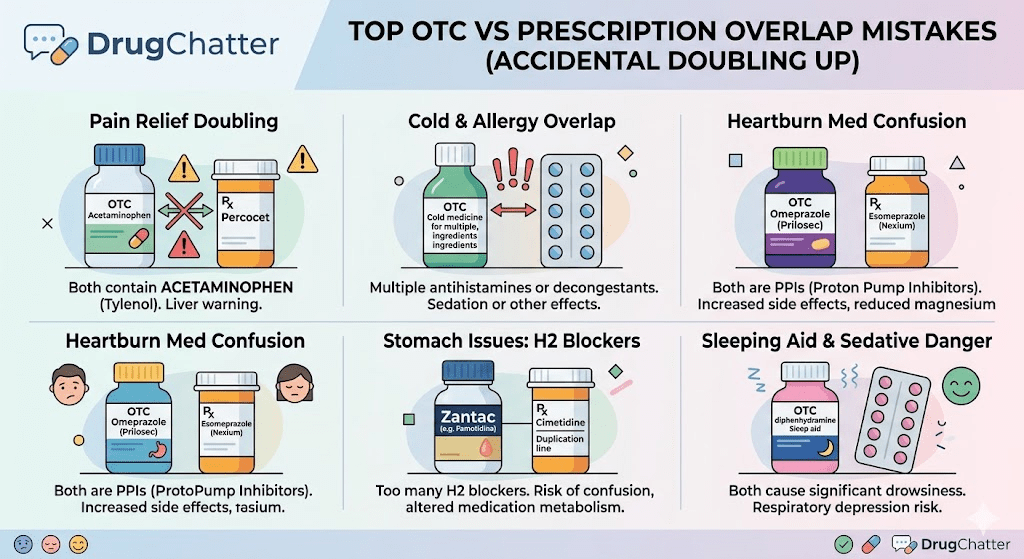
One of the most common “I meant to take my usual” errors is the OTC vs prescription overlap: people take an over-the-counter product that contains the same active ingredient as a prescription they’re already using, or they take two products that target the same pathway and stack side effects. The result is often not an immediate catastrophe, but a slow drift into trouble—more sedation, more liver stress, more bleeding risk, more muscle pain, more stomach upset, or simply “why do I feel worse?”
The classic setup: “It’s just OTC” (until it isn’t)
OTC products are designed to be convenient, and convenience is the enemy of medication reconciliation. If you’re already on a prescription and you add an OTC for the same complaint—pain, cholesterol, heart protection, reflux, allergies, cough—you may be duplicating ingredients or effects.
For example, people often treat “heart protection” as a single category and forget that aspirin is aspirin whether it’s in a prescription context or an OTC bottle. Timing and risk change with age, and the same drug can behave differently across bodies. If you’re already using aspirin, it’s worth understanding how aging affects its clot-prevention role: https://www.drugchatter.com/chat/60463/how-does-aging-affect-aspirin’s-ability-to-prevent-clots.
When “helpful” supplements become a second prescription
Another overlap trap is the supplement aisle. People assume supplements are “different” from prescriptions because they’re not dispensed in the same way. But supplements can still interact with prescription drugs, and sometimes they can blunt or amplify effects.
Take the cholesterol/statin universe. Lipitor-related questions on diet and co-factors show how easily people can misjudge what’s happening when they change what they eat or add products. For instance, fatty meals can change how well Lipitor performs: https://www.drugchatter.com/chat/49694/does-fatty-food-consumption-reduce-lipitor’s-effectiveness. And if you’re thinking “I’ll just add something to help,” you should know that probiotics can change side-effect profiles for Lipitor: https://www.drugchatter.com/chat/45805/how-do-probiotics-decrease-lipitor’s-side-effects.
None of this is about “never use OTC.” It’s about not assuming that adding a second product is automatically additive in a safe direction.
Pain relievers: the overlap that sneaks up on you
Pain is where OTC and prescription overlap most often. People take an OTC anti-inflammatory for headaches or muscle aches, then later realize they were already prescribed something that covers the same ground—or they keep dosing because the pain returns.
Even within OTC territory, dosing guidance matters. Advil intake gaps are a good example of how “more often” can become “too much”: https://www.drugchatter.com/chat/46907/what’s-the-recommended-food-advil-intake-gap. And if you’re tempted to dose by intuition, remember that Advil dosing may depend on weight: https://www.drugchatter.com/chat/25508/does-advil-dosage-depend-on-one’s-weight.
When overlap happens, it’s rarely because someone is trying to break rules. It’s because the label says “relief,” and the brain hears “safe to repeat.”
Chasing side effects with more products
One of the most common patterns is: take a drug, feel a side effect, then add another drug to counter it—without realizing you’re stacking the original problem.
For instance, Lipitor has a side-effect profile that can shift with age: https://www.drugchatter.com/chat/50341/how-does-lipitor’s-side-effect-profile-change-with-age. If someone experiences dizziness or fatigue and then self-treats with OTC products, they may be compounding sedation, dehydration, or GI irritation—depending on what they choose.
And if you’re trying to interpret what’s “normal,” it helps to know that even the timing of effects can be non-obvious. Lipitor’s effects may become apparent after a certain number of days: https://www.drugchatter.com/chat/25808/were-lipitor’s-effects-apparent-after-a-certain-number-of-days.
How to avoid the accidental double-up (practical checklist)
- Read the active ingredient, not the brand name. Two products can look different and still contain the same drug.
- Keep one “med list” that includes OTC and supplements. If it’s not on the list, it doesn’t count.
- Ask the pharmacist before adding an OTC for a symptom you already treat with a prescription. This is exactly what they’re for.
- Don’t treat side effects as permission to add more. If you’re feeling worse, pause and check.
- Watch for timing and food interactions. Even if you’re not doubling up, the same drug can behave differently depending on what you do around it (food, alcohol, etc.).
The bottom line
OTC medications are not “bad.” They’re just not automatically safe in combination. The overlap mistake happens when people treat medication categories like they’re separate worlds—when in reality, the body doesn’t care whether the pill came from a prescription pad or a shelf.
If you want one takeaway: before you add an OTC product, verify the active ingredient and compare it to what you’re already taking. That one step prevents a surprising number of “how did this happen?” moments.