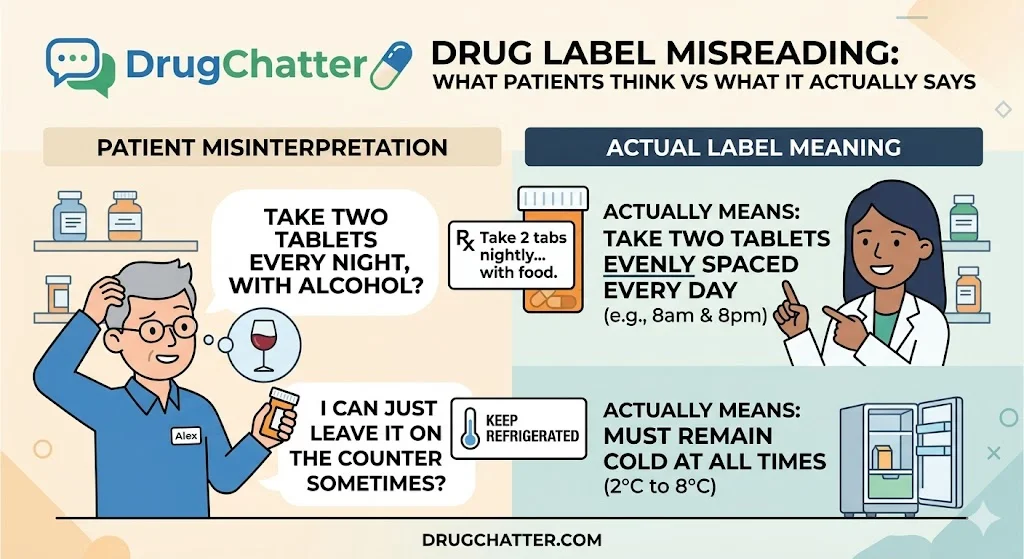
Here’s a recurring scene in clinics and pharmacies: someone reads their prescription label, nods along with a meaning that feels obvious, and then goes home acting on that meaning. The system expects the label to be unambiguous. Patients expect it to be intuitive. Unfortunately, drug labels are written for billing codes, regulatory wording, and prescriber shorthand—not for the human impulse to skim.
So the question becomes: what are people actually thinking the label says, and what does it actually say? Below are some of the most common (and most consequential) “label misreads” that show up again and again—timing, wording around generics, manufacturer confusion, dosing details, and the silent gaps where patients fill in their own assumptions.
1) “Is this the same drug?”—generic and biosimilar name traps
Patients often read a label and assume that if the name sounds similar, the intent is similar. But “generic,” “biosimilar,” and “brand” are not the same kind of promise, and labels don’t always translate cleanly into lay language.
- Is adempas a generic drug?
- Daliresp generic?
- Is there elrexfio biosimilars?
- Biosimilar kadcyla?
- Biosimilar mircera?
2) “Same dosing, right?”—what timing and instructions really mean
One of the most common label misreads is the assumption that “before/after meals” and “with/without food” are cosmetic details. They’re not. Gastric timing, absorption, and interaction risks are exactly what labels are trying to manage—yet they’re also exactly what people skim past.
- What’s the best time to take lipitor before or after meals and tums?
- Can lipitor and red yeast rice supplements be taken together?
- Can lipitor interact with common painkillers?
- Aspirin naproxen interaction?
- Eliquis und ibuprofen?
3) “How often?”—dosing frequency and the dangerous half-answer
Patients sometimes read a label and mentally convert it into a simpler routine: “take it once a day” or “take it when you remember.” But dosing frequency is where labels get technical, and where those technical details can get misremembered.
- Vyondys dosage?
- Uroxatral how supplied?
- Cosentyx pen instructions for use?
- Cosentyx travel pack?
- How does patient weight affect cosentyx dosing?
4) Manufacturer and supply confusion—when the label’s “who made it” matters
Labels usually don’t exist to educate you on the manufacturing story—but patients want that story anyway, and they often assume that the manufacturer listed (or implied) is interchangeable. Sometimes it is. Sometimes the differences are about sourcing, packaging, or regulatory history.
- Orkambi manufacturers company?
- Fulvestrant manufacturer?
- Butrans manufacturer?
- Asciminib manufacturer?
5) “Is this safe for me?”—special populations and label ambiguity
Some label messages are deliberately general: “consult your physician if…” But in real life, patients try to decode whether that’s a warning or a formality. Age, liver function, kidney issues—these are the “fine print” that can stop being fine when the stakes are high.
- Is rozerem safe for the elderly?
- Is tigecycline contraindicated in certain liver conditions?
- Was simvastatin a factor in the patient’s liver issues?
6) “Cost” questions that are really instructions questions
Patients ask about prices in the same breath as they ask about names and dosing. That’s because affordability often changes what people receive, how consistently they can take it, and how quickly they switch between versions.
- Ranexa generic cost?
- Epoprostenol cost?
- How much does ranolazine cost?
- Secuado cost?
- Nymalize cost?
- Veopoz cost?
7) Interactions: the label may warn you, but patients may not connect the dots
Interactions are a second language. The label may mention “avoid” or “caution,” but patients interpret that as something that only matters if they’ve heard of the drug before.
- Have you discussed aspirin’s potential side effects with your doctor?
- Does lipitor interfere with garlic’s cholesterol lowering effect?
- Can avocado consumption enhance lipitor’s efficacy?
- Azithromycin with advil?
8) The “what is it exactly?” category—brand names, aliases, and translations
Labels sometimes include abbreviations or brand names that don’t map cleanly to what patients think they’re holding. When the name is familiar, people assume the instructions are familiar too.
9) Expiration and “how supplied” details that people think they can ignore
Some labels carry quiet instructions about storage, expiration, and presentation. Patients assume “in date” is enough. But the label’s packaging and stability notes exist for a reason.
- Nplate expiration date?
- Uroxatral how supplied?
- Icatibant injection price in india?
- Icatibant acetate?
10) Adverse effects: when the label is a warning, but patients read it as a guarantee
Another classic misread: people take “listed side effect” to mean “will happen,” or they take “rare” to mean “safe for everyone.” Either way, the patient’s interpretation can steer decisions.
- How often do lipitor’s liver side effects occur?
- How common is lipitor induced joint damage?
- Why is lipitor’s side effect flexibility so variable among patients?
- Do lipitor’s side effects include mood swings for you?
- Trazodone dreams?
So what’s the practical fix?
Most label misreadings aren’t caused by stupidity. They’re caused by human habits: skimming, assuming, translating regulatory language into everyday certainty. The best countermeasure is simple and stubborn: when anything on a label is unclear, treat it as a question—not a guess.
Bring the exact packaging and the exact label text, and ask one question in plain language: “What do you want me to do with this—time, food, frequency, and what not to mix it with?”
And if you’re trying to sort out something like generic/biosimilar status, dosing instructions, or interaction risk, the DrugChatter threads above are a useful start—because they document precisely the misunderstandings that keep recurring.