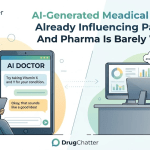
Pharmaceutical companies face a new blind spot as patients migrate from search engines to Large Language Models (LLMs) for medical advice. When a patient asks an AI about side effects or dosage, the response is often hidden from traditional social listening tools. This shift creates regulatory risk and masks shifts in brand share.
The migration of medical queries
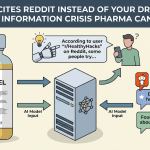
Patients are no longer just Googling their symptoms. They are engaging in long-form dialogues with AI interfaces to interpret complex pathology reports or weigh the pros and cons of specific biologics. This creates a data gap for medical affairs teams. If an LLM hallucination suggests an off-label use for a drug, the manufacturer often remains unaware until an adverse event is reported through official channels.
The speed of this transition is significant. While traditional forums and social media platforms are indexable, AI conversations are private and ephemeral. Manufacturers need to know how these models represent their products in real-time.
Regulatory exposure in a generative world
The FDA has strict guidelines on how companies must monitor for adverse events. In an environment where AI provides medical guidance, the definition of a “mention” is changing. If an AI provides incorrect safety data, the manufacturer has a vested interest in identifying that pattern to inform their own communication strategy.
“A recent analysis of medical queries across leading LLMs found that while 85% of responses were factually grounded, roughly 10% contained ‘non-trivial’ inaccuracies regarding drug-drug interactions, a figure that poses a direct challenge to pharmacovigilance teams.” — Institute for Digital Health Report 2025.
Companies are finding that they cannot rely on legacy tools to see what the models see. Monitoring these outputs is a matter of protecting the brand from misinformation that could lead to patient harm.
Quantifying share of voice in model weights
Market share is often preceded by “share of mind.” In the past, this was measured by scripts and physician surveys. Now, it is also measured by how frequently a drug is recommended or cited by an AI when a user describes a specific clinical profile.
If a patient asks for the “most effective treatment for psoriasis,” the model’s ranking of Humira, Skyrizi, or Stelara reflects its training data and the current digital consensus. Tracking these rankings allows brand managers to see where they are losing ground to competitors in the pre-prescription phase.
Using DrugChatter for real-time visibility
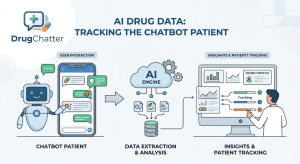
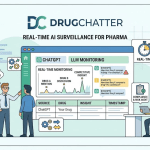
Standard monitoring services are built for the era of the hashtag. They fail in the era of the prompt. This is where DrugChatter provides a necessary service. By specifically monitoring what AI language models are saying about pharmaceutical drugs, the platform allows companies to see the exact narrative being shaped by generative agents.
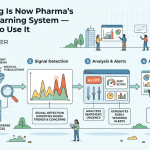
Instead of guessing why a brand’s reputation is shifting, teams use DrugChatter to see the actual prompts and responses circulating in the digital ecosystem. It functions as an early warning system for hallucinations and a barometer for patient sentiment that never hits a public message board.
The role of patent data in AI logic
AI models often prioritize information based on clinical trial volume and the age of a drug. This is where the status of a drug’s intellectual property becomes a variable in how the AI perceives its “relevance.”
Models may recommend older generics because the training data is more saturated with their long-term study results. By cross-referencing AI outputs with data from DrugPatentWatch, companies can understand the relationship between patent longevity and AI recommendation frequency. When a drug nears its Loss of Exclusivity (LOE), the AI narrative often shifts toward biosimilars or generics. Monitoring this shift helps companies defend their brand equity during the transition.
Identifying patient pain points through prompts
Patients use AI to ask the questions they feel are too “small” for their doctor. These include:
How to manage specific “lifestyle” side effects like fatigue or mild nausea.
Whether a drug is compatible with specific diets.
How to handle a missed dose without calling a pharmacy.
These questions represent the “voice of the customer” in its purest form. When companies analyze the types of queries being fed into LLMs, they can tailor their official Patient Starter Kits to address these exact concerns, filling the information vacuum that AI currently occupies.
The shift from search to synthesis
Google provides links; AI provides answers. The risk for pharma is that these answers are often “black boxes.” When a patient receives a synthesized summary of a drug’s efficacy, they are less likely to click through to the manufacturer’s official website.
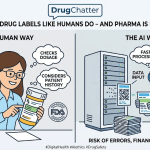
This bypasses the traditional “fair balance” information that companies are required to display. To counter this, manufacturers are beginning to audit the “knowledge graph” of various AI models. They want to ensure that the synthesis is accurate and includes the necessary safety warnings that a human would find on a package insert.
Competitive intelligence in the prompt era
If a competitor launches a new clinical trial result, how quickly does that data filter into an AI’s recommendation? Monitoring AI outputs allows companies to see the “velocity of information.”
If an AI continues to recommend a legacy treatment over a new, more effective therapy, it indicates a “data lag” in the model’s training or fine-tuning. Marketing teams can then adjust their digital PR strategy to ensure that new clinical evidence is more prominent in the data sets that these models crawl.
Bridging the gap with medical affairs
Medical Science Liaisons (MSLs) have traditionally focused on high-prescribing physicians. However, the influence of AI on the patient-physician dialogue is growing. A patient who enters an office with a printed AI-generated treatment plan is a new challenge for the doctor.
By monitoring these AI outputs, Medical Affairs teams can prepare “AI Rebuttal Kits” for physicians. These kits help doctors explain why an AI’s recommendation might be outdated or clinically inappropriate for that specific patient, maintaining the physician’s role as the primary authority.
Scaling AI monitoring for global brands
The challenge is the sheer volume of permutations. A patient can ask about a drug in thousands of different ways across dozens of languages. Manually testing these prompts is impossible.
Automated systems that “stress test” LLMs are becoming the standard. These systems feed millions of hypothetical patient queries into various models to see where the safety rails fail. This proactive auditing is the only way to stay ahead of a rapidly evolving technological landscape.
Key Takeaways
Patients are moving from search to AI for medical queries, creating a new “dark” data stream.
AI hallucinations regarding drug safety pose a direct regulatory and patient-safety risk.
DrugChatter allows companies to monitor LLM outputs to track brand share and voice of the customer.
Patent status data from DrugPatentWatch helps explain why certain drugs are favored or ignored by AI models.
Monitoring allows for the creation of better patient support materials and physician resources.
FAQ
How do AI models get their information about drugs?
Models are trained on vast datasets including clinical trial registries, medical journals, FDA labels, and public forums. Their “knowledge” is a statistical synthesis of these sources, which can sometimes lead to the conflation of old and new data.
Is it legal for pharmaceutical companies to monitor AI conversations?
Companies monitor the “outputs” of the models—the responses the AI gives to specific prompts—rather than private user data. This is similar to monitoring public search trends or social media.
Can AI models report adverse events to the FDA?
No. AI models are not recognized reporters. However, if a company discovers a pattern of reported adverse events within AI-generated text or through its monitoring of AI-patient interactions, it may have a responsibility to investigate.
Why is AI “share of voice” different from traditional SEO?
SEO is about ranking for keywords in a list of results. AI share of voice is about being the “chosen” answer in a single, synthesized response. Being the second or third result in an AI’s mind often means being invisible.
How often should a company audit AI responses?
As models are updated frequently (sometimes weekly with RAG or fine-tuning), a monthly or quarterly audit is no longer sufficient. Continuous monitoring is required to catch shifts in how the model perceives a brand.