A brand manager at a mid-size specialty pharma company opens ChatGPT, types her drug’s name, and asks about dosing in renal impairment. The answer is confident, well formatted, and about 40% wrong on the details that matter. She closes the tab, opens a spreadsheet, and starts typing the same question into Gemini, Claude, and Perplexity. This is how most pharma AI monitoring programs begin: one person, four tabs, and a growing sense that this is bigger than a side project.
The question this article answers is direct. Can a pharma brand team build its own AI monitoring operation in-house, using existing staff and free or cheap tools, or does the math eventually force a buy decision? The short answer is that manual monitoring works fine at the smallest scale and breaks down predictably once a company adds a second brand, a second market, or a compliance requirement. The rest of this piece walks through exactly where that break happens and what it costs on both sides of the ledger.
Why Pharma Brand Teams Are Suddenly Talking About AI Monitoring
Patients stopped asking Google first. According to McKinsey research cited in Spectrum Science’s 2026 pharmaceutical marketing outlook, 44% of AI-powered search users now treat AI as their main source of insight, ahead of the 31% who still lean on traditional search. Over 60% of search queries now surface a Google AI Overview before a single blue link. For a brand team, that means the first exposure a patient or caregiver has to a drug’s name is frequently an AI-generated paragraph the company never wrote, never approved, and in many cases never saw.
“According to McKinsey, 44% of AI-powered search users use AI as their main source of insight, compared to 31% who use traditional search. Over 60% of search inquiries now include Google AI Overviews.” — Spectrum Science, 2026 Pharmaceutical Marketing Predictions
That shift changes what “brand monitoring” means. It used to mean tracking press mentions, share of voice in trade media, and sentiment on patient forums. Now it means knowing what five different AI engines say about a drug’s indication, dosing, interactions, and safety profile, and knowing it before a patient, a caregiver, or a plaintiff’s attorney finds the gap first.
How Often Do Patients Ask ChatGPT About Prescription Drugs?
Roughly a third of U.S. adults now use AI chatbots for health information, a share that is closing in on the portion who use social media for the same purpose. That is not a niche behavior confined to younger, tech-forward patients. It is becoming the default first stop for anyone who wants a quick answer about a side effect, a dosing question, or whether two medications are safe to combine.
Why Eli Lilly and Novo Nordisk Lead AI Citation Share
A 2026 Pharma / Rx AI Visibility Index from 5W AI Communications ran more than 60 patient and consumer prompts across ChatGPT, Claude, Perplexity, Gemini, and Google AI Overviews and measured which pharmaceutical companies got named, cited, and linked. Eli Lilly came out on top with an estimated 12.5% AI citation share, with Novo Nordisk close behind at 11.5%. Pfizer, Johnson & Johnson, and Merck rounded out the top five. What is notable is that citation share did not track direct-to-consumer ad spend. AbbVie and Johnson & Johnson spend the most on television, but Lilly and Novo Nordisk earned the citations, largely on the back of the GLP-1 category and the sheer volume of published, indexed information about Ozempic, Wegovy, and Mounjaro. A related analysis on DrugPatentWatch’s blog found a similar pattern: Pfizer.com pulls roughly 30 million monthly visits and has millions of mentions across PubMed, FDA databases, and patient forums, while a typical mid-size biotech with $1 billion to $3 billion in revenue might see 50,000 to 500,000 monthly visits to its own site. That is a 100x to 1,000x gap in the raw material AI models have to work with, and it disadvantages precisely the companies that most need accurate representation.
What “Build” Actually Means: The Manual ChatGPT Audit Method
Every brand team that starts this work in-house arrives at roughly the same method, because it is the only one available without paying for a platform. You type the brand name into ChatGPT, Gemini, Claude, and Perplexity. You ask a fixed set of questions: what does this drug treat, what are the side effects, how does it compare to the leading competitor, is a generic available. You log what comes back. Then you do it again next week, because AI answers drift.
How to Manually Query ChatGPT, Gemini, Claude, and Perplexity for Brand Mentions
A workable manual protocol looks like this. Build a prompt list covering four categories: informational queries a patient might ask, comparison queries against named competitors, safety and side-effect queries, and generic-substitution queries. Run each prompt at least twice per engine, because a single run is closer to a coin flip than a measurement given how non-deterministic these systems are. Log four data points per response: whether the brand appeared, its position in the answer, which competitors were named alongside it, and which sources the model cited or linked.
Why the Same Prompt Gives a Different Answer Every Time
This is the detail that trips up most first-time auditors. If a brand appears in four of ten identical runs of the same prompt, the real appearance rate is 40%, not zero and not 100%. A single-shot check that happens to catch a good run or a bad run tells you almost nothing. That is why any credible audit protocol, manual or automated, requires repeated sampling rather than a one-time check.
How Many Prompts Does a Real Audit Require?
Below roughly 50 prompts a week, manual tracking is genuinely workable with a spreadsheet and a patient analyst. Above that threshold, the arithmetic stops cooperating. A single brand with four core indications, three competitor comparisons, and coverage across four AI engines, sampled twice per prompt per week, is already past 50 without trying. Add a second brand and the number doubles before anyone has scored a single response for accuracy.
Scoring AI Answers Against Label Language
Collecting the raw AI responses is the easy half of the job. Scoring them against approved label language is where the actual analytical work happens, and it is also where in-house programs tend to stall, because it requires someone who knows the label well enough to catch a subtle misstatement, not just an obvious one.
What Counts as a Factual Error in an AI Drug Answer?
An error is not limited to a model inventing a side effect that does not exist. It includes omitting a boxed warning, understating a contraindication, overstating efficacy relative to what the label supports, or describing a dosing regimen that does not match the approved label. A 2025 study in the Journal of the American College of Clinical Pharmacy tested ChatGPT against real-world drug information questions pharmacists actually field and found accuracy was poor enough that the authors flagged patient safety risk directly, noting that AI hallucinations, the lack of an iterative verification process, and outdated training data were the likely drivers. A separate pharmacist-led study reported in Fox Business found ChatGPT answered only 10 of 39 medication questions correctly, and in one case told a user there was no interaction between the COVID-19 antiviral Paxlovid and the blood-pressure drug verapamil, when in fact the combination can cause dangerously low blood pressure.
Can AI Hallucinations Trigger FDA Risk?
Yes, and not only for pharma companies. In its own September 2025 enforcement wave against misleading drug advertising, FDA said it used AI and other technology-enabled tools to proactively review promotional content and send warning and untitled letters. Law firm Ropes & Gray flagged an ironic risk in its analysis of that wave: companies responding to FDA’s letters should check the letters themselves for factual misstatements, since AI-assisted government review workflows can hallucinate too. The lesson for brand teams is not that FDA’s AI tools are unreliable. It is that hallucination is now a two-way risk sitting on both sides of the regulator-sponsor relationship, and any monitoring program has to assume errors can originate from either direction.
What DrugChatter’s 2024 Branded-Drug Audit Found
DrugChatter ran a branded-drug audit across major AI models in 2024 and found a factual-error rate of 65% in the answers those models gave about branded prescription drugs. That number is worth sitting with. It means that roughly two out of three AI-generated answers about a named drug contained something that did not match the approved label, whether an omitted warning, an incorrect dosing detail, or an overstated efficacy claim. A brand team scoring its own manual audit against label language should expect to find error rates in a similar range, not the occasional one-off mistake.
Where the Spreadsheet Breaks: Scale Is the Real Problem
A single brand, one market, one language: the manual method holds up. Almost no pharma company operates at that scale for long. The moment a second variable gets added, the labor curve stops being linear and starts compounding.
Manual AI Monitoring Across Multiple Brands and Therapeutic Areas
A company with four brands across two therapeutic areas needs four separate prompt libraries, because a diabetes drug and an oncology drug get asked about differently and get compared against different competitors. Each library needs its own label-language reference sheet. Each brand’s competitive set changes as new drugs launch or lose patent protection. None of this scales by simply asking one analyst to work faster.
Tracking Drug Mentions in Non-English Markets
Add a second market and the job does not double, it multiplies. AI engines answer differently in different languages, cite different regional sources, and reflect different regulatory label language, since an EMA-approved label and an FDA-approved label for the same molecule are not always identical. A manual auditor now needs either fluency in the target language or a translation layer, plus a second label reference, plus separate prompt libraries tuned to how patients in that market actually phrase questions.
How Many Labor Hours Does Manual Monitoring Actually Take?
Running the numbers helps make this concrete. A single brand, single market program at even a modest 50 prompts a week, with two runs per prompt across four engines, generates 400 responses weekly. Reading and scoring each response against label language at a conservative three minutes apiece is 20 hours a week, before anyone writes a summary report for medical, legal, or brand leadership. Two brands in two markets is not 40 hours. It is closer to 120 to 160, once translation, regional label differences, and cross-team coordination are factored in. At that point the “free” manual method costs more in loaded labor hours than most mid-tier monitoring platforms charge in subscription fees.
The Audit-Trail Problem Legal and Regulatory Will Ask About
Every pharma brand team eventually runs into the same question from Legal: how do we prove we were monitoring this, and monitoring it consistently, if a regulator or a plaintiff’s attorney ever asks? A folder of screenshots does not answer that question well.
Does FDA Require Documentation of AI Monitoring?
There is no single FDA regulation that names “AI monitoring” as a required program. What does exist is a broader, well-established expectation that companies exercise oversight over promotional and informational content associated with their products, document that oversight, and be able to reconstruct it. As AI-generated content about drugs becomes a larger share of what patients and physicians actually read, the practical expectation is converging toward the same standard applied to any other channel a company knows is shaping perceptions of its product.
What Happened in FDA’s First AI-Related Warning Letter
FDA issued a warning letter to Purolea Cosmetics Lab in April 2026 after the company told inspectors it had used AI agents to generate drug specifications, procedures, and master production or control records without further human review. The company has since stopped drug production. The specifics involve manufacturing documentation rather than marketing content, but the underlying principle applies just as directly to brand and content teams: a company remains fully responsible for AI-generated output, and using AI without a documented human review step is itself the violation FDA cited, not merely the errors the AI produced.
Can a Spreadsheet of Screenshots Pass a Compliance Review?
Probably not on its own. A defensible audit trail needs a consistent prompt methodology applied on a fixed schedule, dated and timestamped records of what each AI engine returned, a documented scoring rubric tied to current label language, and a clear record of what action was taken when an error was found. Ad hoc screenshots taken whenever someone remembers to check do not establish the “regular and systematic” pattern that legal and regulatory reviewers look for, and they are difficult to reconstruct months later when someone actually asks for the history.
Why ChatGPT Gets Drug Side Effects Wrong
The pattern shows up across nearly every peer-reviewed study of AI and drug information: general-purpose language models are trained to sound confident, and confidence does not correlate with accuracy in the way most people assume it should.
Do LLMs Recommend Generic Drugs More Often Than Branded Ones?
The honest answer is that it depends heavily on training data volume rather than clinical appropriateness. A molecule with decades of generic availability, extensive PubMed coverage, and a long Wikipedia history tends to get described more completely and more accurately than a drug launched in the past two years, regardless of which one is the better clinical choice for a given patient. That asymmetry cuts against newly launched branded drugs specifically, since they simply have less indexed material for a model to draw on at the moment patients start asking about them.
How AI Hallucinations Differ From Ordinary Human Errors
A tired pharmacist might misremember a detail and say so, or hedge appropriately. A hallucinating language model states an invented interaction, a fabricated citation, or a confident wrong answer with exactly the same tone it uses for a correct one. One systematic review found ChatGPT-3.5 frequently disclaimed uncertainty in its answers, while later models often asserted accuracy even when wrong, which is precisely the failure mode that makes hallucinations harder for a lay reader to catch than an honest “I’m not sure.”
What Litigation Risk Looks Like When AI Gives Bad Drug Information
Litigation exposure tied to AI-generated medical and drug guidance is no longer theoretical. OpenAI is currently facing multiple product-liability lawsuits alleging that ChatGPT gave users dangerous medical guidance, including cases involving medication-related harm. The specific allegations vary by case, but the underlying legal theory is consistent: that a chatbot presenting confident, specific guidance about medications or symptoms functioned like unlicensed medical advice, without the safeguards a licensed clinician would apply.
Is a Drug Company Liable for What ChatGPT Says About Its Product?
The current wave of litigation targets the AI company, not the pharmaceutical manufacturer whose drug was named in a chatbot’s response. That distinction matters, but it should not be read as full insulation for brand teams. A pharma company that is aware its drug is being described inaccurately in widely used AI tools, and that takes no documented steps to identify or correct that pattern, is building a weaker record for itself if a future claim ever draws it in, whether through a mislabeling theory, a failure-to-warn argument, or simple reputational fallout once the inaccuracy becomes public.
What FDA’s 2025 Enforcement Wave Means for AI-Generated Content
FDA’s September 2025 crackdown on misleading drug advertising, which produced thousands of warning communications and roughly 100 cease-and-desist letters, extended beyond classic direct-to-consumer video ads into HCP websites, corporate web pages, influencer content, and patient testimonials. The clear signal is that FDA now treats any channel shaping how patients and physicians understand a drug as within its promotional oversight, and AI-generated summaries are a natural next extension of that same logic even though no letter has yet named a chatbot response directly.
Tracking Share of Voice Across ChatGPT, Gemini, Claude, and Perplexity
Share of voice used to mean counting press mentions and social posts. In an AI-search world, it means measuring how often, how prominently, and how accurately a brand shows up inside a generated answer, across engines that each retrieve and weight sources differently.
What Is AI Citation Share and How Is It Measured?
AI citation share is typically calculated by running a fixed set of patient and consumer prompts across multiple engines, then measuring three things: how many of those engines cite the company at all, how many prompts surface it, and how extractable the underlying source material is, meaning how easily a model can pull a clean, citable fact from it. It is a fundamentally different metric from a Google search ranking, and a brand can rank well in traditional search while remaining nearly invisible in AI-generated answers.
What the 5W AI Visibility Index Shows About Pharma Brands
The 2026 index referenced earlier ranked the top 25 pharmaceutical companies by estimated AI citation share. Beyond Lilly and Novo Nordisk at the top, the ranking included Pfizer, Johnson & Johnson, Merck, AbbVie, AstraZeneca, Moderna, Amgen, Novartis, Bristol Myers Squibb, GSK, Sanofi, Gilead, and Roche, spanning categories from oncology to vaccines to specialty and gene therapy. The report’s authors made a pointed observation: AI citation share tracks the drugs patients actually research on their own, not the size of a company’s television ad budget. A company spending heavily on national television while ignoring its AI citation profile is optimizing for a channel that increasingly does not route to the buyer the way it once did.
What Pharma Brand Teams Can Learn From Reddit and Forum AI Citations
AI models do not treat every source equally, and understanding which sources they lean on is part of building an accurate picture of a brand’s AI footprint.
How Patients Ask About Drug Interactions in AI Search
Patient-phrased queries about drug interactions rarely match how a label describes the same information. A patient asks “can I take my blood pressure pill with my new antiviral,” not “please summarize the drug interaction section of the package insert.” Building a prompt library that reflects how patients and caregivers actually type questions, rather than how a medical writer would phrase them, is one of the more consistently underweighted steps in manual monitoring programs.
Which Sources Do AI Models Cite Most for Drug Information?
AI engines draw heavily on high-authority, frequently updated sources: FDA databases, PubMed and peer-reviewed literature, major medical reference sites, and, increasingly, patient forums like Reddit where real-world experience gets discussed in volume. That last category deserves particular attention from brand teams, because forum discussion often surfaces emerging patient concerns, off-label use patterns, or perceived side effects well before they show up in formal literature, and AI models are already citing that conversation whether or not a brand team is watching it.
Can AI Outputs Be Used for Pharmacovigilance?
This is one of the more contested questions in the field, and the honest answer sits between “yes, directly” and “no, not at all.”
Should Patient Complaints Surfaced in AI Chat Logs Be Reported as Adverse Events?
A patient describing a suspected side effect to a chatbot is not the same as a formal adverse event report, and AI companies generally do not make individual chat logs available to pharmaceutical companies for this purpose. What AI monitoring can do is surface aggregate patterns, such as a cluster of AI-generated answers referencing a symptom or interaction that does not appear in the current label, which then becomes a signal for a company’s existing pharmacovigilance team to investigate through proper channels, not a substitute for that process.
How AI Monitoring Complements Traditional Pharmacovigilance Systems
Traditional pharmacovigilance relies on spontaneous reporting, clinical trial data, and formal literature surveillance, all of which move on a reporting lag measured in weeks or months. AI monitoring adds a faster, if noisier, early-warning layer: if multiple AI engines start describing a new safety concern in relation to a drug, often because that concern is already circulating in patient forums and news coverage the models are trained on or retrieving from, a pharmacovigilance team benefits from knowing that before it becomes a formal signal, not after.
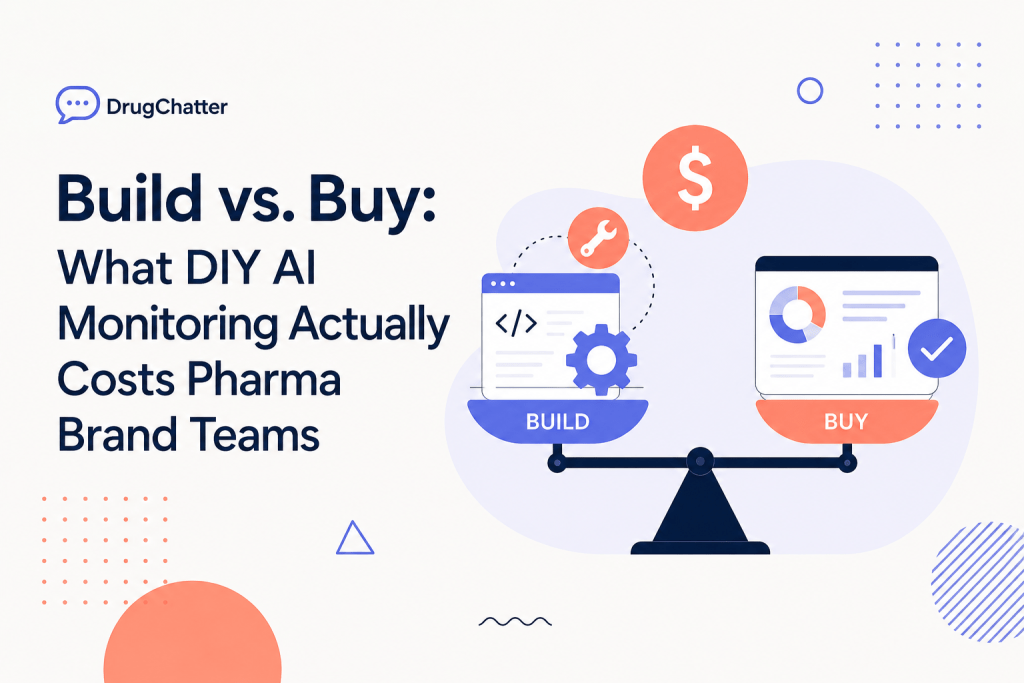
Build vs Buy: Comparing the Real Cost of Both Paths
This is the section that actually answers the question in the title, and the honest framing is that “build” and “buy” are not really two options at the same price point solving the same problem. They solve overlapping problems at very different scales.
What a DIY AI Monitoring Program Costs in Labor
Using the earlier estimate, a single-brand, single-market program at a sustainable audit cadence runs roughly 20 hours a week once scoring and reporting are included. At a loaded cost for a mid-level brand or regulatory analyst, that is a real, ongoing expense that shows up as headcount time rather than a line-item subscription, which is precisely why it is easy for a company to underestimate. Add a second brand or a second market and the hours roughly double or triple rather than scaling linearly, because prompt libraries, label references, and language coverage do not share cleanly across brands.
What Pharma-Native AI Monitoring Platforms Charge
General-purpose AI visibility platforms built for consumer and retail brands, such as Athena HQ, price self-serve plans around $295 to $595 a month for coverage across eight or more engines, with unlimited seats and competitor tracking included. That is inexpensive by pharma standards, but general-purpose platforms are not built around label-language scoring, MLR-ready audit trails, or pharmacovigilance-adjacent signal detection, which is the gap that pharma-specific platforms exist to close. DrugChatter and DrugPatentWatch build monitoring specifically around branded and generic drug data, label alignment, and the compliance documentation pharma legal and regulatory teams actually ask for. Inpharmativ, a Canadian pharma intelligence firm, offers a comparable “AI Answer Readiness” audit that specifically checks AI-generated answers for the kind of unbalanced claims, omissions, or safety gaps that a company’s medical, legal, and regulatory review process would normally catch in a traditional ad, but that AI answers bypass entirely since they are never submitted for that review.
When Building In-House Actually Makes Sense
Build makes sense for a single brand in a single market, run by a team that already has label-language expertise on staff and does not need to produce a formal audit trail for Legal beyond internal notes. That is a real and legitimate use case, and plenty of smaller specialty pharma companies operate exactly this way without issue. The moment any of three conditions appears, buy starts winning the arithmetic: a second brand or market, a compliance requirement for documented monitoring, or a launch window where accurate AI representation in the first weeks after approval materially affects how patients and physicians understand a new drug before enough independent literature exists to correct a bad first impression.
A Decision Framework for Brand Teams
Rather than treating build versus buy as a single yes-or-no decision, it helps to look for specific signals that the manual approach has reached its limit.
Signs Your Team Has Outgrown Manual AI Monitoring
Four signals tend to show up together: the weekly audit is regularly skipped or delayed because no one has the hours, a second brand or market has entered the picture, Legal has asked for a documented monitoring history that the current screenshot folder cannot produce, or a competitor’s drug has started appearing ahead of yours in AI-generated comparison answers without anyone noticing until a sales rep mentions it.
Questions to Ask Before Choosing a Vendor
Before signing with any platform, pharma or general-purpose, a brand team should ask four things: does the platform score answers against current approved label language rather than just tracking mention frequency, does it produce a dated and exportable audit trail that Legal can actually use, does it cover the specific therapeutic area and competitive set relevant to the brand, and does it support the languages and regional label variants the brand’s markets require. A platform that cannot answer all four is closer to a general brand-visibility tool than a pharma compliance solution, and the difference matters more than the price tag.
Key Takeaways
- Manual ChatGPT, Gemini, Claude, and Perplexity audits work for a single brand in a single market, but require repeated sampling per prompt since AI answers are non-deterministic.
- DrugChatter’s 2024 branded-drug audit found a 65% factual-error rate in AI answers about branded prescription drugs, a baseline any manual scoring effort should expect to see.
- Labor hours for manual monitoring do not scale linearly. A second brand or market roughly doubles or triples the workload rather than adding a fixed increment.
- FDA has not issued a rule naming AI monitoring specifically, but its April 2026 warning letter to Purolea Cosmetics Lab shows the agency will hold companies fully responsible for unreviewed AI-generated output.
- AI citation share, led by Eli Lilly and Novo Nordisk in 5W’s 2026 index, tracks what patients actually research, not television ad spend, which makes it a genuinely different metric from traditional share of voice.
- Pharma-specific platforms like DrugChatter, DrugPatentWatch, and Inpharmativ score answers against label language and produce audit trails; general-purpose platforms like Athena HQ track mentions but are not built for pharma compliance requirements.
FAQ
Can pharma brand teams monitor AI mentions manually without a platform?
Yes, for a single brand in a single market with someone on staff who knows the label well enough to score answers accurately. The method involves running a fixed prompt library across ChatGPT, Gemini, Claude, and Perplexity on a regular schedule, sampling each prompt more than once since AI answers vary between runs, and logging results against current label language.
How much does manual ChatGPT auditing cost compared to a monitoring platform?
A single-brand manual program tends to run around 20 hours of analyst time a week once scoring and reporting are included, which is a real labor cost even without a subscription fee attached. Pharma-adjacent platforms range from roughly $300 to $600 a month for general AI visibility tracking, with pharma-specific platforms priced according to the number of brands, markets, and compliance features required.
What is the biggest risk of DIY AI brand monitoring in pharma?
The two biggest risks are inconsistency and the audit trail. A manual program that gets skipped during busy weeks leaves gaps that are hard to explain later, and a folder of undated screenshots rarely satisfies what Legal or Regulatory needs to demonstrate ongoing, systematic oversight of AI-generated content about a drug.
Do FDA regulations require companies to monitor AI-generated content about their drugs?
No single FDA rule names AI monitoring as a required program. FDA has, however, shown it will hold companies fully responsible for AI-generated output associated with their products, as seen in its April 2026 warning letter regarding unreviewed AI-generated manufacturing documentation, and its broader promotional oversight already extends to any channel shaping how patients and physicians understand a drug.
How is AI brand monitoring different from traditional social listening?
Traditional social listening tracks what people say about a brand across social media, news, and forums. AI brand monitoring tracks what AI models themselves say about a brand when asked, which is a synthesized, model-generated answer rather than a human-authored post, and it requires scoring against label language rather than sentiment analysis alone.
Teams evaluating their options can review how DrugChatter and its affiliated platform DrugPatentWatch approach label-aligned AI monitoring for branded and generic drugs.