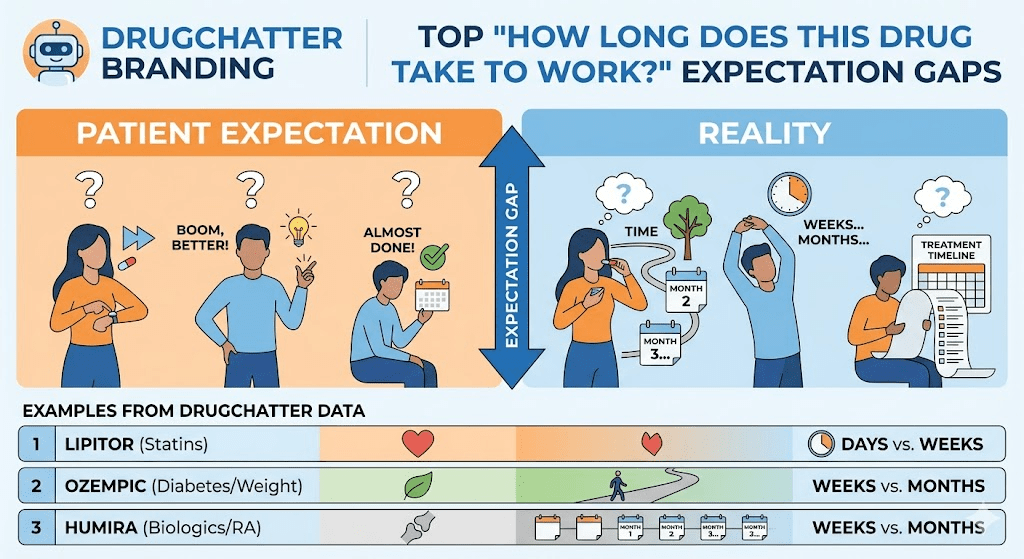
There’s a particular kind of hope that shows up in pharmacies and patient portals: the simple question, “How long does this drug take to work?” It sounds like a stopwatch problem. Take the pill, wait the right number of days, and—boom—symptoms should behave.
But medicine rarely runs on neat timelines. What patients experience as “late” or “not working” is often a mismatch between expectations and the messy biology of absorption, distribution, immune signaling, dosing schedules, and the difference between symptom relief and disease modification. Add in the fact that different conditions (and different bodies) move at different speeds, and the question becomes less about time and more about interpretation.
1) The “instant effect” trap: expecting symptom relief to equal treatment success
Some drugs can make you feel something quickly; others are designed to change a process that takes weeks to unwind. When people ask about timing, they often mean “Will I feel better soon?”—but the drug may be aiming at longer-term control.
- Cosentyx loading dose for psoriatic arthritis?
- What medical conditions determine cosentyx duration?
- Are there any studies confirming cosentyx’s prolonged treatment efficacy?
2) The “loading dose will fix it” assumption
Loading doses exist for a reason: they try to get drug levels up faster. But “faster levels” still doesn’t guarantee “faster outcomes,” because downstream effects—especially in inflammatory and immune conditions—have their own clocks.
- Cosentyx loading dose for psoriatic arthritis?
- How does patient weight affect cosentyx dosing?
- What is the maximum cosentyx dose for heavy patients
3) The “one-size dosing” expectation gap
Even when the drug is the same, the regimen may not be. Weight, organ function, and comorbidities can shift how quickly a drug reaches effective exposure—and how quickly the body responds.
- How does patient weight affect cosentyx dosing?
- What is the maximum cosentyx dose for heavy patients
4) The “it’s not working” conclusion before the biology has finished its meeting
Some therapies—particularly those involving immune modulation, enzyme replacement, or long-acting mechanisms—can require time before measurable benefit shows up. Patients may interpret the early phase as failure, when it’s actually the ramp-up phase.
5) The “regulatory milestone” confusion: approval timing isn’t patient timing
People sometimes conflate “FDA approval” with “instant effectiveness.” Approval is about evidence and safety, not about how quickly you personally will feel better.
6) The “mechanism sounds simple” expectation gap
Mechanisms of action can be elegant on paper, but the body’s execution is not. Even basic questions—like how a drug’s components behave—can affect how quickly it clears, distributes, or exerts effect.
7) The “side effects vs benefits” timing mismatch
Sometimes side effects show up before benefits. That can make the early period feel like the drug is “doing something,” but not the right thing. The result is a distorted timeline: discomfort arrives on schedule; improvement doesn’t.
- What medications manage lipitor’s side effects?
- Does yervoy’s toxicity differ in males vs females?
- Tukysa diarrhea?
8) The “switching back” expectation gap
Stopping and restarting therapies can change the timeline again—because your immune system and disease state don’t reset like a thermostat. The question “how long does it take to work again?” is often answered with “it depends,” because it really does.
9) The “availability and pricing” distraction
Sometimes the drug works exactly as intended—then the real-world timeline breaks it. Delays in access, insurance friction, or supply issues can turn a planned course into a stalled one. That’s not a pharmacology problem; it’s a logistics problem.
- Ozempic price algeria 2026?
- What are the recent developments in trulicity’s availability and pricing?
- How much is copaxone without insurance?
10) The “it’s the same drug, so the timeline should be the same” fallacy
Even within the same therapeutic area, formulations and dosing schedules can differ. And “generic” doesn’t always mean “identical experience,” especially when patients are sensitive to timing and tolerability.
So what should you do with the expectation gap?
The practical answer is to ask a better question than “how long.” Ask: what outcome are we timing? Symptom relief? Lab changes? Imaging? Flare frequency? And what would count as “enough progress” at week 2, week 6, or month 3?
Because the real story behind “time to work” is rarely a single number. It’s a chain of steps—drug exposure, biological response, and clinical measurement—each with its own pace. When you know which link you’re waiting on, the timeline stops feeling like a betrayal and starts feeling like a plan.
Further reading from the DrugChatter question set:
- Pyridostigmine er price?
- Suprep vs miralax?
- Sutent?
- What is eplontersen?
- Tapinarof?
- Kalbitor price?
- Acthar generic?
- Inj fulvestrant 500 mg?
- Is jublia gone generic in canada?
- How does aspirin’s headache mechanism differ from new drugs?
- Acebutolol discount?
- Acetyl cysteine benefits?
- Praxbind price?
- How do janssen’s licensing agreements affect darzalex’s availability?