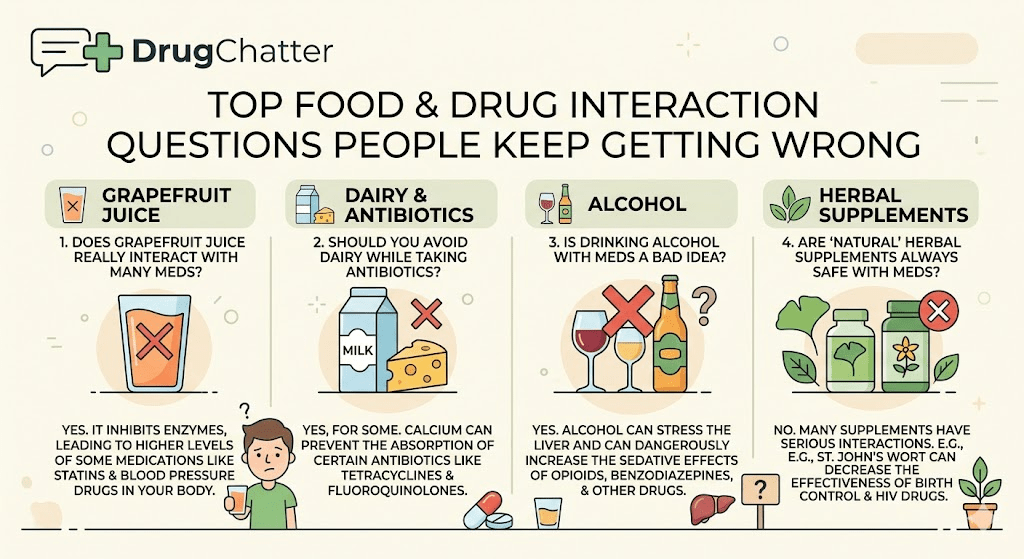
Top food and drug interaction questions people keep getting wrong
Every week, the same pattern shows up in the inbox: someone has a real concern—then asks it in a way that’s either too broad, too vague, or accidentally steers the conversation away from the actual risk. The result is predictable: confusion, unnecessary worry, and sometimes the dangerous belief that “natural” or “common” things are automatically safe.
Below are some of the most common mis-questions (and the better way to think about them), using real examples from DrugChatter.
1) “Does this food interfere with my cholesterol medicine?” (But which one, and how?)
People often ask whether a food “interferes” with a drug, as if the answer is universal. In reality, the interaction depends on the specific medication, the metabolic pathway involved, and the timing/dose. If you’re on a statin, the question isn’t just “food vs. drug”—it’s “which statin, what food, and what mechanism matters?”
- Do berries interfere with lipitor’s cholesterol lowering action?
- Can bananas interfere with lipitor’s effectiveness?
2) “Will this drug change my other drug’s dose?” (Yes—but not always the way you think)
When people hear “interaction,” they jump straight to “dose adjustment.” Sometimes that’s correct; sometimes it’s not. The right question is whether the interaction affects drug levels, bleeding risk, or therapeutic effect—and whether your clinician is already monitoring the relevant lab or clinical endpoint.
3) “How do I identify side effects?” (As if side effects are a single category)
Another recurring mistake: treating side effects like a checklist you can memorize. But side effects vary by type (common vs. rare), timing, and whether they’re dose-related or idiosyncratic. The practical question is: what symptoms should trigger urgent evaluation, and what can be watched with your prescriber?
4) “Is it the drug—or the other drug—or the underlying condition?”
People want a clean culprit. Medicine rarely offers one. Liver issues, muscle symptoms, and other adverse events can be caused by the drug, by something else you’re taking, or by the original disease process. The better question is what evidence points toward the medication versus background risk.
5) “Is the generic the same?” (Same active ingredient doesn’t always mean same experience)
For interactions, the active ingredient matters—but so do formulation, dosing, and individual response. People ask about “generic brands” as if that alone determines interaction risk. Usually, the more relevant question is whether the active ingredient is the same and whether your regimen is stable.
6) “What’s the ideal timing gap?” (Timing can matter, but the question must be specific)
Timing questions are often asked like a magic spell: “What’s the ideal gap between X and Y?” Sometimes timing is crucial (for absorption or metabolism). Sometimes it’s mostly noise. The right approach is to ask whether the interaction is absorption-related, enzyme-related, or additive in side effects.
7) “How common is this?” (Because fear needs context)
When people ask about side effects, they’re often trying to decide whether they should panic. But “common” isn’t just a number—it’s a way to calibrate monitoring and risk tolerance. The question should connect frequency to what you should do next.
8) “Does this medicine affect my daily life?” (Interaction isn’t only chemical)
Not every “interaction” is a metabolic one. Some are practical: sedation, routine changes, adherence issues, and the knock-on effects those have on safety. If a medication makes it harder to take other meds correctly, that can create real-world risk.
9) “Is this drug even the right one?” (Because the interaction question depends on the regimen)
Sometimes the real problem is that the regimen is unclear: brand vs. generic, class vs. specific agent, or “what does this even do?” Without that foundation, interaction questions become guesswork.
10) “I just want the answer—no details.” (But details are the whole point)
Food and drug interactions are rarely one-size-fits-all. The most useful questions include: the exact drug name and dose, the timing, the food/supplement amount, and any relevant labs (like INR for warfarin). Without that, you get a generic response—and sometimes the wrong reassurance.
So what should you ask instead?
If you want a safer, more accurate answer, ask in a way that forces the key variables into the light:
- Exact drug + dose (not just “my cholesterol medicine”)
- Exact food/supplement (berries are not one thing; timing matters)
- Timing (when you take each relative to meals and other meds)
- Monitoring (INR, liver enzymes, symptoms that require urgent care)
Because the truth is simple: the interaction isn’t the headline. The regimen is.