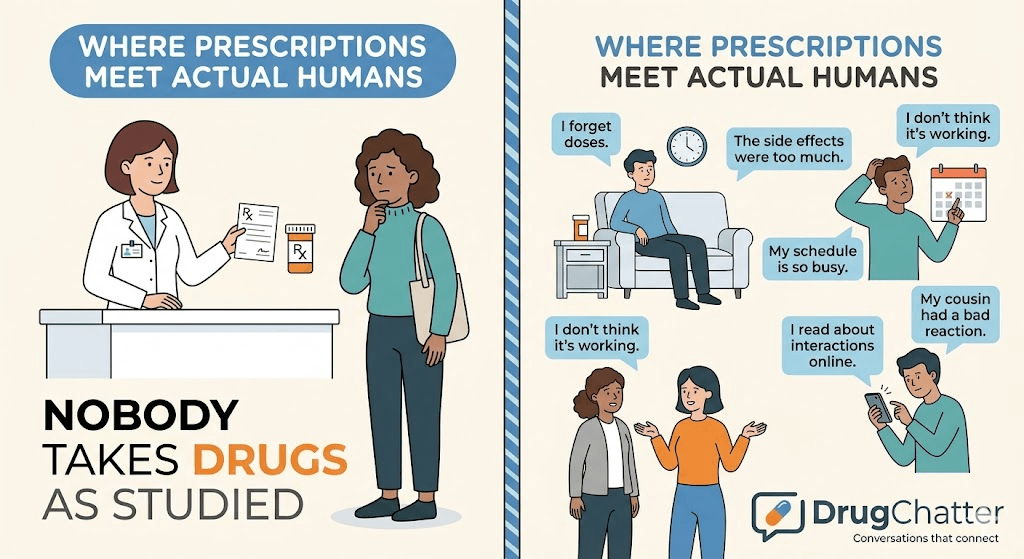
Clinical trials are tidy. Patients are not.
In papers, drugs are taken on schedule, at fixed doses, with carefully controlled exclusion criteria and enthusiastic compliance. In real life, people forget doses, drink wine, add supplements they saw on TikTok, stop early when they “feel better,” or keep going when they probably shouldn’t.
What emerges from this pile of DrugChatter questions is less a pharmacology lecture and more a quiet theme: the gap between how drugs work and how they’re actually used.
Not dramatically wrong. Just… human.
1. “Is this safe?” — the question that never goes away
Safety isn’t a binary in real-world use; it’s a spectrum shaped by comorbidities, prior therapies, and sheer randomness.
Take immunotherapies like Yervoy. In trials, adverse events are tracked with precision. In practice, patients and clinicians still ask the obvious, uncomfortable question: Are there cases where side effects caused death?
https://www.drugchatter.com/chat/45942/are-there-cases-where-yervoy’s-side-effects-caused-death
Or consider combination oncology regimens—questions about whether prior chemotherapy changes toxicity profiles:
https://www.drugchatter.com/chat/25675/how-does-prior-chemo-affect-yervoy’s-toxicity
And then there’s stacking therapies: immunotherapy plus newer agents like lurbinectedin raises the familiar real-world worry—combinations behave differently than monotherapies ever do:
https://www.drugchatter.com/chat/31885/can-immunotherapy-increase-lurbinectedin’s-side-effects
https://www.drugchatter.com/chat/53908/what-are-the-potential-risks-of-lurbinectedin-and-chemo-combinations
This is the first lesson of adherence: patients are rarely on one drug, even when the study assumes they are.
2. The interaction problem: food, alcohol, supplements, life
If pharmacology textbooks assume a clean system, reality assumes a messy kitchen.
Alcohol shows up everywhere in these questions—sometimes explicitly, sometimes as an afterthought. It’s not just “don’t mix with meds,” but “what actually happens if I do?”
https://www.drugchatter.com/chat/7100/how-does-alcohol-affect-the-effectiveness-of-certain-medications
https://www.drugchatter.com/chat/20580/what-are-common-drug-interactions-with-alcohol
https://www.drugchatter.com/chat/31878/how-does-excessive-alcohol-consumption-damage-liver-cells
Even timing becomes an obsession:
“How long after taking Lipitor can I drink lemon juice?”
https://www.drugchatter.com/chat/27786/how-long-after-taking-lipitor-can-i-drink-lemon-juice
Or wine specifically:
https://www.drugchatter.com/chat/24115/is-wine’s-taste-altered-by-regular-lipitor-use
Then come supplements—often assumed harmless, almost never inert:
- grapefruit + statins: https://www.drugchatter.com/chat/10403/what-are-the-side-effects-of-mixing-grapefruit-and-lipitor
- turmeric interactions: https://www.drugchatter.com/chat/13284/how-does-turmeric-affect-lipitor’s-cholesterol-lowering-ability
- garlic reducing potency: https://www.drugchatter.com/chat/33307/can-garlic-supplements-reduce-lipitor’s-potency
- essential oils and efficacy questions: https://www.drugchatter.com/chat/59494/which-essential-oils-interact-negatively-with-lipitor
The pattern is consistent: real-world adherence includes everything the label doesn’t control.
3. Dose is not destiny — behavior is
We like to think drugs work as long as they’re taken “correctly.” But “correctly” is doing a lot of work.
Take weight-loss and metabolic drugs like Ozempic. In real use, patients don’t just ask if it works—they ask how quickly, how strongly, and how it affects daily life:
- “How quickly does it improve sugar tolerance?”
https://www.drugchatter.com/chat/30917/how-quickly-does-ozempic-improve-sugar-tolerance - “Does it cause stomach pain?”
https://www.drugchatter.com/chat/39504/can-ozempic-cause-stomach-pain - “Does it cause hair loss?”
https://www.drugchatter.com/chat/51071/can-ozempic-cause-hair-loss - “Can it cause dehydration?”
https://www.drugchatter.com/chat/46280/can-semaglutide-cause-dehydration
And then adherence fractures in subtle ways: changing dosage time, skipping doses, or stopping due to side effects:
https://www.drugchatter.com/chat/31709/how-would-changing-ozempic’s-dosage-time-affect-blood-sugar-levels
Even something as simple as hunger suppression becomes a behavioral variable:
https://www.drugchatter.com/chat/55653/does-adderall-suppress-hunger
Drugs don’t fail in real life because they stop working. They fail because people stop taking them the way studies assume.
4. The side effect tradeoff nobody plans for
Side effects are not rare events—they are daily negotiation points.
For example:
- statin muscle pain concerns: https://www.drugchatter.com/chat/20435/is-muscle-fatigue-a-common-lipitor-side-effect
- liver enzyme concerns: https://www.drugchatter.com/chat/60372/how-does-tigecycline-impact-liver-enzyme-levels
- antihypertensive interactions with ibuprofen: https://www.drugchatter.com/chat/55435/can-i-take-ibuprofen-with-blood-pressure-medication
Even common drugs like hydroxyzine or Lyrica raise adherence issues because sedation and fatigue are not abstract risks—they’re lived experience:
https://www.drugchatter.com/chat/52886/can-hydroxyzine-cause-daytime-drowsiness
https://www.drugchatter.com/chat/27177/can-lyrica-be-safely-used-for-long-term-treatment
And when exercise, aging, or comorbid disease enters the picture, dosing becomes fluid rather than fixed:
https://www.drugchatter.com/chat/7483/how-does-exercise-impact-required-lyrica-dosage
https://www.drugchatter.com/chat/43862/how-often-should-methotrexate-dosage-be-adjusted-in-elderly-patients-with-impaired-kidney-function
Real-world pharmacology is often just dose adjustment by life circumstance.
5. Prevention vs perception: when “for” becomes unclear
Adherence also breaks when patients are unsure what a drug is for.
- “Is Adderall for ADHD?”
https://www.drugchatter.com/chat/64255/is-adderall-for-adhd - “What is Solosec for?”
https://www.drugchatter.com/chat/1886/what-is-solosec-for - “Is hydrochlorothiazide potassium-sparing?” (it isn’t)
https://www.drugchatter.com/chat/17545/is-hydrochlorothiazide-a-potassium-sparing-diuretic
Misunderstanding purpose leads to poor adherence in ways that don’t look like noncompliance—they look like confusion.
6. Access, cost, and the hidden adherence driver
Even when drugs are effective and tolerated, people still optimize around cost.
- insurance constraints on Vascepa: https://www.drugchatter.com/chat/8076/what-factors-affect-vascepa-insurance-coverage
- coupons and savings programs:
https://www.drugchatter.com/chat/39832/are-there-any-coupons-for-vascepa
https://www.drugchatter.com/chat/10795/how-long-is-your-vascepa-savings-coupon-valid - pharmacy programs and renewals:
https://www.drugchatter.com/chat/22950/is-there-a-discount-for-vascepa-renewals
This is the part clinical pharmacology rarely models well: people don’t just respond to biology—they respond to billing.
7. The quiet truth: adherence is a moving target
Across all these questions, one theme repeats:
- drugs interact with other drugs
- drugs interact with food and alcohol
- drugs interact with uncertainty
- drugs interact with misunderstanding
- drugs interact with cost
- drugs interact with daily life
Even something as basic as spacing vaccines or adjusting biologics becomes individualized:
https://www.drugchatter.com/chat/5137/do-i-need-to-space-out-cosentyx-and-vaccine-administrations
https://www.drugchatter.com/chat/39881/what’s-the-ideal-gap-between-cosentyx-and-vaccines
And biologics like Keytruda introduce another layer—immune variability that no adherence model fully captures:
https://www.drugchatter.com/chat/14056/are-skin-tests-available-for-keytruda-allergies
Closing thought
If there’s a unifying idea here, it’s not that drugs are unpredictable.
It’s that people are predictable in only one way: they will not behave like trial protocols.
They will mix alcohol with statins and then ask about timing.
They will adjust doses based on sleepiness.
They will combine supplements and medications and hope for the best.
They will stop and start based on symptoms rather than schedules.
And they will keep asking questions—because that’s how real adherence actually looks: not compliance, but continuous negotiation.
Or, put less politely: every prescription comes with a user manual that nobody follows perfectly.
Related Posts: