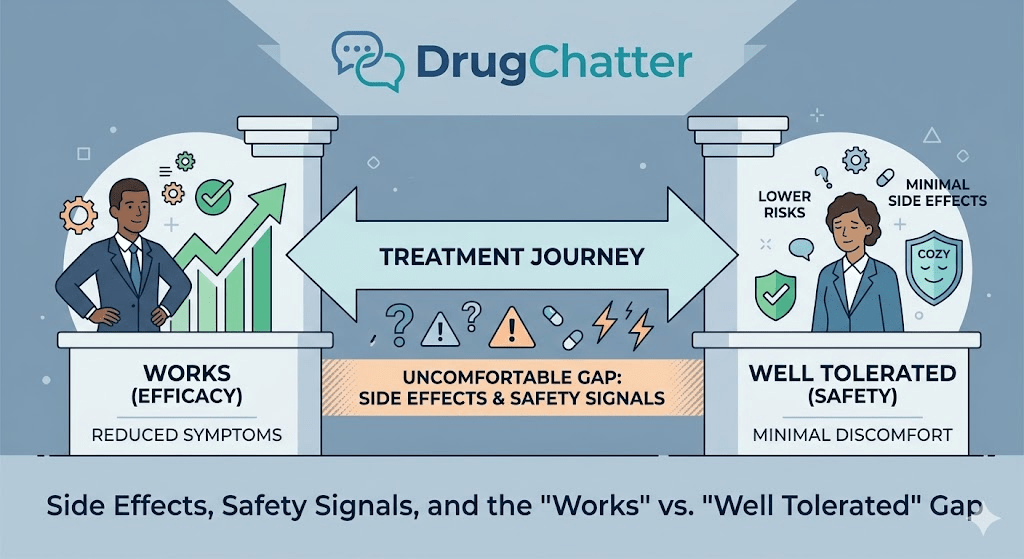
When Drugs Misbehave (and When They Don’t)

Side effects, safety signals, and the uncomfortable gap between “works” and “well tolerated”

Drug development has a habit of looking clean on paper and messy in humans. The molecule behaves. The receptor obliges. And then real patients show up—with comorbidities, combinations, alcohol, grapefruit juice, and a talent for revealing every edge case a clinical trial quietly averaged away.

What follows is a tour through DrugChatter questions that, collectively, sketch the same theme: safety signals rarely announce themselves loudly. They accumulate.


Immunotherapy: when “revving the immune system” cuts both ways

Checkpoint inhibitors are one of modern oncology’s biggest conceptual shifts: remove the brakes, let the immune system do its job. But brakes exist for a reason.

With Yervoy (ipilimumab), the question isn’t whether immune-related adverse events happen—it’s how severe and how unpredictable they can be. There are documented cases where side effects become life-threatening, reflecting the same mechanism that makes the drug effective.
Are there cases where Yervoy’s side effects caused death?

The risk calculus gets even more complicated when treatment history enters the picture. Prior chemotherapy can amplify toxicity signals, essentially priming the system for overreaction.
How does prior chemo affect Yervoy’s toxicity?

This is the recurring immunotherapy pattern: efficacy and toxicity are not separable axes. They’re the same dial.


Cardiometabolic drugs: the slow, cumulative signal problem

Statins, antihypertensives, and lipid agents tend to generate quieter safety narratives—less dramatic than immunotherapy, but more chronic.

With Lipitor (atorvastatin), the concern cluster is predictable: liver enzymes, muscle pain, drug–food interactions.

High-fat diets may worsen liver-related risk signals in susceptible patients.
Does high fat consumption increase Lipitor’s liver damage risk?

Muscle symptoms remain one of the most commonly discussed real-world complaints.
Is muscle fatigue a common Lipitor side effect?

And then there’s the interaction layer—where dietary habits quietly matter more than labeling suggests: grapefruit, turmeric, alcohol, even avocado show up repeatedly in signal discussions.
What are the side effects of mixing grapefruit and Lipitor?
Can turmeric affect Lipitor’s cholesterol lowering ability?
Can avocado consumption affect Lipitor’s efficacy?

The pattern here isn’t acute toxicity—it’s modulation. Small shifts that matter more the longer therapy continues.


Omega-3s and “benign” drugs that aren’t always benign

Vascepa (icosapent ethyl) is often treated as metabolically gentle. But even “low-risk” drugs generate safety noise once they scale.

Allergic reactions are rare but real.
Any allergic reactions reported with Vascepa?

And tolerability questions expand into food timing, alcohol interaction, and supplement stacking—less about acute danger, more about real-world variability in response.
Should Vascepa be consumed before or after meals?
Can alcohol consumption impact Vascepa’s effectiveness?
Are there any potential Vascepa interactions with ginseng supplements?

“Safe” in pharmacology rarely means “interaction-free.” It means “signal is low enough that signal-to-noise becomes your real problem.”


Painkillers and anticoagulant drift

Aspirin and ibuprofen sit in a category that feels familiar enough to underestimate.

Aspirin increases bleeding risk through a mechanism that is both expected and easy to forget in daily use.
How does aspirin affect bleeding risk?

Pregnancy introduces a different safety envelope entirely, where the same pharmacology behaves differently depending on physiological context.
What complications can aspirin cause in pregnant women?

Even “routine” combinations (antibiotics, supplements, anticoagulants) create layered uncertainty rather than binary risk.
Does combining Advil with antibiotics worsen side effects?


Antivirals, antibiotics, and the interaction problem

With antivirals like famciclovir, the narrative often drifts into expectations of certainty—“does it cure?”—when the reality is probabilistic viral suppression and host-dependent response.
Does famciclovir guarantee shingles cure?

Drug interactions complicate that further: rifampin, for instance, can reduce antiviral effectiveness through metabolic induction.
Does rifampin lower famciclovir’s effectiveness?

And antibiotics like tigecycline illustrate a different axis entirely: liver enzyme changes and dose-dependent gastrointestinal adverse events, where toxicity is often dose-shaped rather than idiosyncratic.
How does tigecycline impact liver enzyme levels?
How often do GI adverse events occur with tigecycline?


Neuropsychiatric drugs: where dose is destiny

In CNS pharmacology, side effects often look like extensions of intended effects.

Adderall suppresses appetite as part of its stimulant profile, not as an off-target surprise.
Does Adderall suppress hunger?

Sedation and daytime drowsiness appear predictably with antihistaminergic agents like hydroxyzine.
Can hydroxyzine cause daytime drowsiness?

And polypharmacy combinations—Xanax with antihypertensives or antipsychotics—turn pharmacology into a systems problem rather than a single-drug question.
Is it safe to take Xanax and risperidone?


Metabolic injectables: GI tolerance as the limiting factor

GLP-1 drugs like semaglutide and dual agonists like tirzepatide have reshaped metabolic therapy—but not without a predictable adverse event profile.

Ozempic is frequently associated with gastrointestinal effects, sleep changes, and hydration-related issues in real-world use.
Does Ozempic cause stomach pain?
How does Ozempic affect sleep quality?
Can semaglutide cause dehydration?

The safety signal here is not surprise toxicity—it’s tolerability-driven discontinuation.


The broader pattern

Across drug classes, a consistent structure emerges:

  • High-impact drugs (immunotherapy) → rare but severe immune toxicity
  • Chronic therapies (statins, omega-3s) → low-grade but persistent adverse signals
  • OTC agents (NSAIDs) → familiar risks underestimated over time
  • CNS drugs → predictable but socially disruptive side effects
  • Metabolic injectables → tolerability-limited effectiveness

The Derek Lowe-style takeaway is not that drugs are dangerous or safe, but that they are conditional systems. Every benefit is gated by context: dose, duration, combinations, and the patient’s biological variability.

Safety signals don’t usually arrive as alarms. They arrive as patterns across thousands of small questions—exactly the kind collected in places like DrugChatter.
DrugChatter - Know what AI is saying about your drugs
Scroll to Top