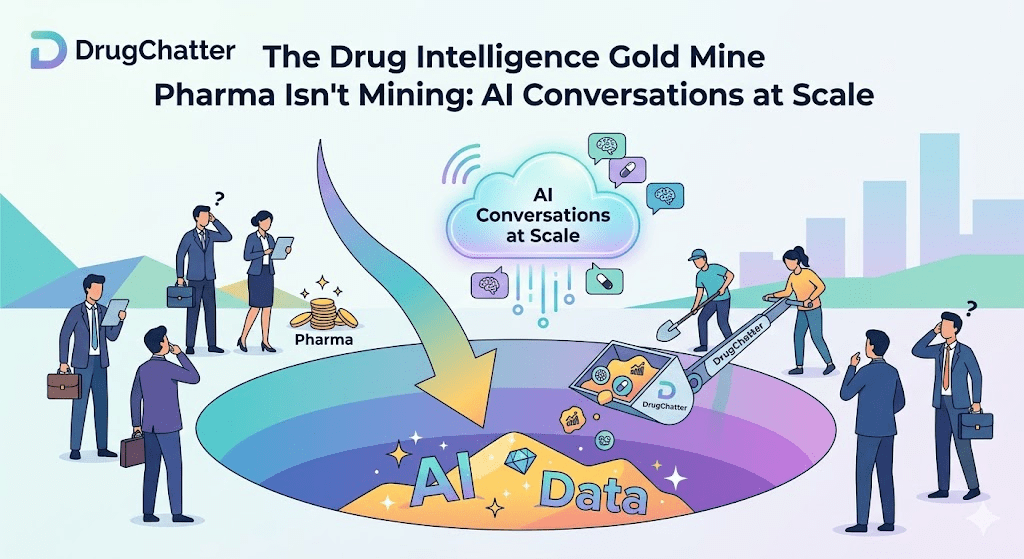
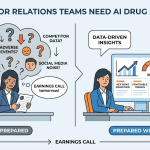
Every pharmaceutical company has a market research budget. They commission syndicated studies, run physician surveys, pay IQVIA for prescribing data, and fund focus groups. Most of them are spending very little — close to nothing — on the richest drug intelligence channel that now exists: the billions of conversations patients and physicians are having with AI systems about their drugs.
That gap is not sustainable, and the companies closing it first will have a material information advantage over those that do not.
To understand what AI conversations can actually teach a pharmaceutical brand, you need to understand what they contain. A patient asking ChatGPT whether Ozempic or Wegovy is better for weight loss reveals product confusion that no survey ever captured. A physician asking Claude about tirzepatide dosing in a patient with chronic kidney disease reveals a clinical information need that the detail representative never surfaced. An HCP forum thread that gets ingested into an LLM’s training data and then surfaces in AI-generated drug descriptions reveals how peer perception shapes what AI tells future physicians.
This is not social listening. Social listening tells you what people are saying. AI conversation monitoring tells you what the most influential information system in healthcare is telling people about your drugs, and what people are asking it. Those are different things with different intelligence value, different compliance implications, and different operational requirements.
This article covers what pharma companies can learn from monitoring AI conversations at scale, how to build that monitoring program, what the data actually reveals, and why ignoring it is becoming a regulatory and commercial liability simultaneously.
AI vs. Social Listening: What’s the Actual Difference for Pharma?
The distinction matters enough to be precise about. Social listening captures what users are saying about drugs in public forums and on social platforms. AI conversation monitoring captures what AI systems are telling users about drugs — and, separately, what users are asking AI systems about drugs.
Both are intelligence assets, but they answer different questions. Social listening answers: what do patients think about drug X right now, based on what they are posting about it? AI monitoring answers: what is the primary automated information channel telling patients about drug X when they ask, and what are they asking?
Why Social Listening Alone Is No Longer Enough
Pharma companies have long relied on social listening tools to flag adverse drug events mentioned in online conversations — tweets about unexpected side effects, Reddit threads describing off-label use, or user blog posts raising concerns. These systems are built to detect keywords like ‘rash,’ ‘headache,’ or ‘nausea’ tied to specific drug names, triggering alerts for internal safety teams.
That approach captures patient expression. It misses the new variable: AI is now filtering, interpreting, and re-presenting that patient expression to future patients who never saw the original posts. When a Reddit thread about a drug’s side effects gets ingested into an LLM’s training data, the AI does not reproduce the thread — it synthesizes it into a confident-sounding summary that may or may not reflect the original experience accurately, may or may not weight it appropriately against clinical literature, and may or may not carry the caveats the original poster included.
Social listening catches the Reddit thread. AI monitoring catches what the AI says about the Reddit thread to the next 10,000 people who ask about that drug’s side effects. The latter audience is far larger and receives the information with more apparent authority.
What Does AI Conversation Data Actually Contain?
Four categories of intelligence sit inside AI drug conversations, each with distinct value for different pharma functions.
Patient query patterns reveal what patients are concerned about, confused by, and actively seeking answers on. The specific language they use — ‘stomach pain after Ozempic,’ ‘can I take Eliquis and ibuprofen,’ ‘does Dupixent cause hair loss’ — reflects real, unfiltered information needs that structured research rarely surfaces with this specificity.
Physician query patterns reveal clinical knowledge gaps, contraindication concerns, and dosing uncertainty that detail visits do not address. A physician asking an AI system for GLP-1 dosing in renal impairment is telling you your prescribing information is not answering that question accessibly enough.
AI output content reveals how your drug is being characterized in the channel where patients and physicians go for answers — including what errors, omissions, or competitive framings are being delivered to them.
Temporal change in AI outputs reveals when model updates have shifted how your drug is described — which is a risk event, not just a data point, because those shifts happen without notice.
How IQVIA’s Social Listening Differs From LLM Output Monitoring
IQVIA has built a substantial social listening capability for pharmaceutical clients. Its social media intelligence platform analyzes conversations across patient forums, condition-specific communities, and social networks, and has processed over 15 million online mentions related to anti-obesity medications alone. That is genuine intelligence — it tells brand and medical affairs teams what patients are experiencing and expressing about GLP-1 therapies in real time.
LLM output monitoring is a layer on top of that. IQVIA’s social listening captures the source conversations. AI monitoring captures how AI systems have synthesized and are re-presenting those conversations — plus all the clinical literature, news coverage, and forum content they have ingested — to the next person who asks. For a drug like Ozempic, which carries both enormous commercial salience and significant AI-driven misinformation about its indications and dosing, both layers are necessary. Social listening without AI monitoring leaves you blind to how your information environment is being automated.
Which Drugs Get the Most AI Attention — and Why That Creates Risk
Not all drugs are equal in the AI information environment. The drugs that generate the most AI queries, the most confident AI descriptions, and the most AI-driven misinformation are the ones with high public visibility, long commercial histories, and high patient engagement online. Those characteristics correlate closely with commercial importance — which means the drugs most at risk from AI misinformation are frequently the drugs generating the most revenue.
Why GLP-1 Drugs Like Ozempic, Wegovy, and Mounjaro Are AI’s Most Dangerous Territory
No drug class illustrates the AI information problem more clearly than GLP-1 receptor agonists. Semaglutide (Ozempic, Wegovy), liraglutide (Victoza, Saxenda), and tirzepatide (Mounjaro, Zepbound) are among the most-queried drugs in AI clinical tools as of 2024 and 2025. The off-label use of diabetes-approved formulations for weight loss was widespread before Wegovy received its FDA approval in June 2021. By 2023, that off-label use had created supply shortages that forced the FDA to place both Ozempic and Wegovy on its drug shortage list.
Throughout that period, AI tools were actively contributing to prescriber and patient confusion about which formulation to use, what doses were appropriate, and whether the diabetes-approved and obesity-approved formulations were interchangeable. An AI trained on the enormous volume of media coverage, patient forum discussion, and clinical commentary about GLP-1s carries that confusion in its training data. It will produce answers that reflect the messy, off-label-heavy, dose-confused reality of how these drugs entered public consciousness — not the clean, indication-specific reality of their approved labels.
For Novo Nordisk and Eli Lilly, the competitive dynamics make this worse. Published US prescription data shows Eli Lilly overtaking Novo Nordisk in key GLP-1 segments within months of tirzepatide’s commercial launch. In a market that competitive, what an AI says when a physician asks ‘What is the best GLP-1 for weight management?’ is a commercially meaningful question. If that answer systematically favors one molecule over another based on training data composition rather than clinical evidence quality, it is competitive intelligence that neither company can afford to ignore.
How Keytruda, Dupixent, and Skyrizi Get Described in LLM Drug Comparisons
Oncology and immunology drugs face a different version of the AI characterization problem. Keytruda (pembrolizumab) generated nearly $29.5 billion in global sales in 2024, making it the world’s best-selling drug. Dupixent (dupilumab) and Skyrizi (risankizumab) are in the top tier of the immunology market. These drugs have complex approved labels — multiple indications, specific patient populations, detailed safety disclosures — and they compete against each other in categories where treatment selection is nuanced and evidence-driven.
An AI asked to compare immunology biologics for atopic dermatitis will draw on whatever clinical comparison data appears most prominently in its training corpus. The AI’s comparative description does not necessarily reflect the most recent trial data, the most relevant patient population, or the current formulary environment. If Dupixent has generated more real-world evidence publications than a competitor, the AI will tend to describe it more favorably in comparative contexts. If Skyrizi’s approval for ulcerative colitis is recent enough to be underrepresented in training data, the AI may describe its indications incompletely.
What Happens to Humira Biosimilars in AI Drug Comparisons
Biosimilar substitution adds a specific dimension to the AI monitoring problem. Humira (adalimumab) has faced biosimilar competition in the US since 2023, with multiple biosimilars entering the market. An AI asked about adalimumab treatment for rheumatoid arthritis will draw on a training corpus that includes everything ever written about Humira, plus everything written about each biosimilar, plus prescribing guidance, payer coverage discussions, and patient forum posts about switching experiences.
The AI may recommend a biosimilar, or the branded product, or a different biologic entirely — based on what the training data’s weight of evidence suggests, which is not the same as what the current formulary environment, rebate structure, or clinical guidelines recommend. For AbbVie, whose immunology portfolio generated $26.68 billion in 2024 partly by managing the Humira biosimilar transition, understanding what AI systems recommend when physicians ask about adalimumab options is not a theoretical exercise.
How to Read Patient Sentiment From AI Query Patterns
The most underused intelligence dimension in AI conversation monitoring is what patient queries reveal about sentiment, concern, and unmet need — before those concerns mature into formal adverse event reports, social media campaigns, or prescribing trend shifts.
What Do Patients Ask AI About That They Don’t Ask Doctors?
The disinhibition effect in AI queries is real and consistent. Patients ask AI systems questions they do not ask their physicians — either because of embarrassment, fear of judgment, concern about changing their treatment plan, or simple convenience. Those questions reveal the actual patient experience of a drug: the side effects they are managing silently, the doses they are adjusting without telling their prescriber, the concerns about long-term use they have never voiced in a clinical setting.
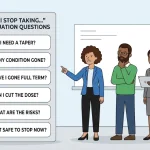
AI-powered social listening tools can sift through massive amounts of unstructured data across various platforms, identifying patterns, sentiments, and emerging trends. The patient queries that flow into AI systems follow the same pattern — they represent a massive corpus of unfiltered patient experience that pharmaceutical companies can mine for insights that structured research cannot access. A brand team that knows patients are asking ChatGPT ‘Is it safe to stop Jardiance suddenly’ in high volumes is learning something about adherence behavior, discontinuation intent, and safety concern that survey data would take months to capture.
Can AI Query Patterns Predict Adverse Event Trends Before They Hit FAERS?
Traditional pharmacovigilance systems suffer from a 94% median underreporting rate for adverse drug reactions. The vast majority of drug safety events are never formally captured. Meanwhile, patients are describing their drug experiences to AI chatbots in natural language — ‘I’ve been on Trulicity for three months and I’m having this…’ — at scale and with detail that formal adverse event reporting never approaches.
Applying NLP analysis to the patterns of patient queries about a drug creates a pharmacovigilance signal channel that currently produces no formal data. The regulatory status of AI-query-derived pharmacovigilance signals is unsettled — the FDA has not provided guidance on whether these constitute reportable data. But the intelligence value is independent of the regulatory status: knowing that patient queries about a drug’s neurological side effects are increasing three months before formal adverse event reports start arriving is advance warning with real patient safety value.
What Patient Queries About Ozempic Side Effects Reveal About Real-World Safety
The GLP-1 class demonstrates this clearly. Patient queries about Ozempic, Wegovy, and Mounjaro side effects — gastroparesis concerns, hair loss questions, muscle mass worries, injection site reactions, long-term safety anxiety — flowed through AI systems and patient forums months before formal clinical literature addressed them systematically. Manufacturers monitoring those query patterns were operating with advance signal on where patient safety concerns were heading. Those that were not were surprised when those concerns became headline issues.
The monitoring infrastructure required to capture those signals is not dramatically different from the infrastructure required to monitor AI brand outputs. It requires systematic querying of AI platforms with patient-perspective prompts — ‘What are the most common side effects of Ozempic?’ ‘Are Ozempic side effects worse at higher doses?’ — and NLP analysis of the responses to identify what concerns are being surfaced and how consistently.
The Physician Perception Problem: What AI Tells HCPs Between Detail Visits
Pharmaceutical sales forces invest billions in physician detailing. They build relationships, deliver clinical data, leave behind samples and prescribing information, and work to position their drugs favorably in a physician’s mental hierarchy of treatment options. Then the physician leaves the detail visit, sits down at their desk, and types a drug question into ChatGPT or Claude.
The AI answers with no brand team present. No medical science liaison to correct a mischaracterization. No fair balance requirement. No review by medical, legal, or regulatory. The answer the physician receives may reinforce what the detail visit communicated — or it may directly contradict it.
What Physicians Ask Claude and ChatGPT About Drug Dosing
Physician queries to AI systems cluster around four practical needs: dosing in special populations, drug interaction checking, differential diagnosis support, and comparative efficacy across therapeutic options. All four are areas where AI responses can systematically diverge from approved labeling.
A real-world evaluation of LLM medication safety reviews in NHS primary care found that LLMs produced sensible clinical reasoning structures with incorrect factual content in 25 patient scenarios. In five instances, the systems contained direct hallucinations about drug compositions. In three distinct cases, the system repeatedly misidentified the composition of Monomil XL — a brand of isosorbide mononitrate — by implying it contained clopidogrel in one case, was a calcium channel blocker in another, and was an opioid in a third. That is not a minor error. A prescribing decision made on those outputs could harm a patient.
Do LLMs Recommend Generic Drugs Over Branded Alternatives?
The generics question is one of the most commercially sensitive dimensions of AI output monitoring. LLMs trained on cost-effectiveness literature, payer publications, formulary guides, and consumer health sites carry a training-data bias toward generic alternatives in cost-related contexts. When a physician asks ‘What are the first-line options for Type 2 diabetes management?’, the AI’s answer reflects the weight of its training corpus — which includes years of cost-effectiveness research favoring generic metformin, SGLT-2 inhibitors, and GLP-1s at different price points.
That answer is not wrong. But it may omit recent label expansions, REMS program requirements, patient access program details, or formulary-specific factors that would change the recommendation in a specific clinical or payer context. A pharmaceutical company that has invested in real-world evidence, patient support programs, and favorable formulary placement cannot assume any of that work flows through to AI recommendations. It has to verify, continuously.
How AI Training Data Cutoffs Create Prescribing Information Gaps
Every major AI model has a training data cutoff — a date after which it does not know what happened. A drug with a label update, a new indication approval, a REMS modification, or a safety communication issued after that cutoff will be described by the AI with outdated information. The AI does not flag the outdatedness. It describes the drug with the same confident tone it uses for everything else.
A safety signal from 2019 that was subsequently clarified and contextualized in the literature may still dominate an AI’s characterization of a drug in 2025 if the original coverage was more widely replicated than the correction. Corrections rarely generate the same volume of coverage as initial safety signals. The AI’s training data reflects that asymmetry.
For pharmaceutical companies, label updates and new indication approvals trigger an immediate AI monitoring need. The period between a label update and when that update is sufficiently represented in AI training data is a gap during which AI systems may be describing the drug inaccurately to physicians making prescribing decisions. Monitoring that gap and responding with authoritative content is a post-regulatory-action priority, not a nice-to-have.
FDA’s Own AI Tool Has a Hallucination Problem — Here’s What Pharma Should Take From That
On June 2, 2025, the FDA launched Elsa — Electronic Language System Assistant — an agency-wide generative AI tool built using Anthropic’s Claude model and operating within AWS’s secure GovCloud environment. FDA Commissioner Marty Makary described it as a productivity breakthrough: tasks that took reviewers two to three days would now take six minutes. Elsa would help summarize adverse event reports, compare labels, review clinical trial protocols, and identify high-priority inspection targets.
It did not go entirely as described.
What FDA’s Elsa AI Tool Gets Wrong — and What It Means for Drug Submissions
FDA reviewers described Elsa as ‘clunky,’ with staff reporting the tool produced hallucinated studies and regulatory citations. ‘It confidently hallucinates,’ one reviewer told BioSpace. ‘Anything you don’t have time to double-check is unreliable.’ Another noted that early use revealed the tool was ‘making stuff up’ on drug composition and component structure questions — precisely the domain where small errors have serious patient safety consequences.
The Department of Health and Human Services’ ‘Make America Healthy Again’ report, released in May 2025, came under fire for citing studies that do not exist — an example of how AI hallucination surfaces in regulatory contexts even when the AI is being used by regulators, not companies subject to regulation.
The pharmaceutical industry implication is direct. Elsa is positioned to accelerate adverse event summarization, label comparison, and inspection targeting. If Elsa is hallucinating regulatory citations in its current form, the risk flows in both directions. A company whose drug is being reviewed by a hallucinating AI assistant needs its adverse event reports, label documentation, and regulatory submissions to be so clean, well-structured, and internally consistent that the AI cannot introduce error by misreading them. The response to a regulators’ AI tool that makes mistakes is not to complain about it — it is to make your documentation hallucination-resistant.
Will the FDA Use AI to Find Adverse Event Reporting Gaps?
Elsa’s roadmap includes linking to big data sources — social media reports of adverse events, electronic health records — to enhance signal detection. If and when that expansion happens, the FDA’s AI tool will be scanning the same patient conversation landscape that pharmaceutical AI monitoring programs track. The companies with monitoring programs already in place will know what signals the FDA’s AI is likely to find before the FDA finds them. The companies without monitoring programs will be surprised.
That asymmetry is worth taking seriously. The FDA’s September 2025 enforcement wave — 40 untitled letters followed by approximately 80 warning letters, generated partly using AI surveillance tools for drug advertising — demonstrates that the agency is willing to use AI for enforcement at scale. The Purolea April 2026 warning letter, the first to explicitly cite AI misuse in pharmaceutical manufacturing, established that the agency is paying attention to how manufacturers interact with AI tools. The direction of travel is toward more AI-assisted enforcement, not less.
Building an AI Conversation Monitoring Program for Pharma: A Practical Framework
The practical challenge is not that monitoring is technically impossible — it is that most pharmaceutical companies have not built the operational infrastructure to do it systematically. The gap between ‘we should be monitoring this’ and ‘we have a running program that produces actionable intelligence’ is an organizational and process gap, not a technology gap.
What Queries Should Pharma Run Against AI Systems?
A structured query library for pharmaceutical AI monitoring covers four functional areas: brand-specific queries, safety queries, competitive queries, and patient-perspective queries.
Brand-specific queries test how the AI describes the drug’s approved indications, dosing, route of administration, and mechanism. These are scored directly against the approved label for factual accuracy.
Safety queries test whether the AI includes black box warnings, serious adverse events, and contraindication information when describing the drug. Omission of safety information is as significant a finding as factual inaccuracy.
Competitive queries test how the AI frames the drug relative to its competitors — which drug it recommends first, what criteria it applies, and whether it characterizes clinical comparisons accurately. This is share-of-voice intelligence.
Patient-perspective queries use natural patient language — ‘What are the side effects of…’, ‘Is it safe to take… while pregnant’, ‘Can I drink alcohol on…’ — to test what patients actually receive when they ask AI the questions they ask most often.
How DrugChatter Enables Systematic Pharma AI Monitoring
Rather than building this infrastructure from scratch, pharmaceutical brand and medical affairs teams can use purpose-built platforms. DrugChatter runs structured query batteries across ChatGPT, Gemini, Claude, Copilot, and Perplexity simultaneously, logs the outputs, and scores them for accuracy against approved labeling, regulatory alignment, sentiment, and competitive framing. It then surfaces anomalies for review by medical affairs or regulatory teams.
The operational model mirrors what pharmaceutical companies already do for paid search, social media monitoring, and earned media tracking — except the channel is AI outputs rather than human-generated content. A sample audit of twenty branded drugs conducted by DrugChatter in 2024 found that 65% had at least one material factual error in AI-generated descriptions across four major platforms. Wrong dosing information, incorrect indication language, outdated contraindication lists, and mislabeled routes of administration were the most common error types.
DrugPatentWatch provides complementary intelligence on competitive pipeline positioning in AI outputs — particularly useful when monitoring reveals that AI systems are recommending a competitor’s drug for an indication where your drug holds stronger clinical evidence, or are failing to mention your drug in a therapeutic area where it has a meaningful clinical role.
How to Track Share of Voice Across ChatGPT, Gemini, Claude, and Perplexity
Share of voice in AI requires prompt-level tracking rather than keyword-level tracking. The query ‘What is the best treatment for moderate-to-severe plaque psoriasis?’ will produce a different share-of-voice result than ‘Which biologics are approved for psoriasis in the US?’ — and both differ from ‘My dermatologist mentioned a biologic injection — what are the options?’ Each query type reflects a different patient or physician intent, and share of voice across those intents provides a more complete competitive picture than any single metric.
Share of voice is calculated as: your drug’s mentions divided by total mentions of all drugs in your therapeutic category, across all tracked platforms, for all tracked query types. That number expressed as a percentage over time tells you whether your competitive position in AI is improving or deteriorating — and model updates that shift it are detectable within days if you are running weekly monitoring queries.
What Monitoring Cadence Is Right for Different Drug Types?
Four factors should determine monitoring cadence: competitive intensity, safety complexity, commercial importance, and label recency. Drugs that score high on two or more of these factors need weekly monitoring. Drugs scoring on one factor need monthly monitoring. All commercial brands need at minimum quarterly monitoring as a baseline.
Weekly monitoring is appropriate for GLP-1 drugs, major oncology immunotherapies, and drugs with active REMS programs — because competitive dynamics are fast-moving, safety information is complex, and model updates can shift outputs materially within days. Monthly monitoring is appropriate for mature brands in stable therapeutic areas with simpler label structures. Quarterly monitoring is the absolute minimum — and it is too slow to be genuinely protective for any drug where an AI output error could cause patient harm or generate regulatory scrutiny.
What AI Conversations Reveal About Competitive Intelligence That Traditional Research Misses
Traditional competitive intelligence in pharma comes from prescribing data, market research surveys, conference proceedings, clinical trial registrations, and competitive promotional monitoring. Each of those sources has lag time — prescribing data reflects decisions made weeks or months ago; survey research takes months to design, execute, and analyze; clinical trial registrations reveal intent but not real-world prescriber behavior.
AI conversation patterns reveal competitive positioning in near-real time, from the perspective of the information system that is now mediating most first-touch drug information for both patients and physicians.
How AI Reflects Real-World Competitive Positioning Between Drug Classes
In a global immunology franchise case study, Day One Strategy documented unexpected physician switching within three to four months of a competitor’s market entry — movement that traditional research infrastructure did not detect until well after it had begun. The signal was visible in AI conversation patterns before it appeared in prescribing data.
That lead time is commercially meaningful. A brand team that detects AI-driven competitive repositioning three months before it shows up in IQVIA data has three months to respond with corrective content strategy, medical affairs engagement, and real-world evidence generation. A brand team that waits for prescribing data has missed the window.
What AI Systems Say When Asked to Compare Your Drug to a Biosimilar
Biosimilar competition creates a specific AI monitoring challenge. When a physician asks an AI system to compare a branded biologic to its biosimilars, the AI’s answer reflects the weight of published evidence, cost-effectiveness analyses, payer guidance, and clinical commentary in its training data. Branded biologic manufacturers who have invested in real-world evidence studies showing clinical differentiation from biosimilars need to ensure that evidence is represented prominently enough in the AI’s training corpus to influence the comparison.
That means publishing real-world evidence in accessible, well-indexed sources. It means ensuring medical society guidelines reflect the clinical differentiation evidence. It means maintaining medical information resources in formats that AI retrieval mechanisms can access and cite. None of that happens automatically — it requires deliberate content strategy informed by knowing what AI systems currently say when asked the comparison question.
What Patient-to-AI Conversations Reveal About Treatment Switching Intent
Patient queries about switching drugs are among the highest-value intelligence signals in AI conversation monitoring. A patient asking ChatGPT ‘Is Rinvoq better than Dupixent for eczema?’ is signaling active consideration of a switch — something they may never have mentioned to their dermatologist and that would not appear in any prescribing data until after the switch occurred.
The queries themselves reveal concern, dissatisfaction, or curiosity that precedes behavioral change. Monitoring the frequency and direction of switching-related queries across major AI platforms gives brand teams advance intelligence on where competitive pressure is building in the patient population — before it shows up in adherence data, prescription abandonment rates, or market share shifts.
The Content Strategy Pharma Needs to Influence What AI Says About Its Drugs
Monitoring AI outputs is necessary. It is not sufficient. The logical follow-on to knowing what AI systems say about your drugs is doing something to improve the accuracy, completeness, and competitive positioning of those outputs. That requires a content strategy built around how AI systems source and synthesize drug information.
What Types of Content Do AI Systems Prefer When Describing Drugs?
AI systems do not cite promotional materials. They synthesize peer-reviewed literature, clinical guidelines, regulatory documents, patient education resources, and authoritative health information sites. Pharmaceutical content strategy for AI influence means ensuring those authoritative non-promotional sources accurately represent your drug’s clinical evidence, safety profile, and approved indications.
Brands in the top 25% for web mentions earn 10 times more AI Overview mentions than everyone else. The same principle applies to drug information: a drug with extensive, well-structured, authoritative third-party documentation will be described more accurately and more favorably by AI systems than one with thin or poorly indexed coverage.
How Real-World Evidence Publications Shape AI Drug Descriptions
Real-world evidence is the pharmaceutical content type with the most direct influence on AI drug characterization. RWE publications appear in PubMed, appear in clinical guidelines, get cited in prescribing information discussions, and generate secondary coverage in medical journalism — all of which flow into AI training data. A manufacturer that consistently publishes RWE showing their drug’s effectiveness and safety in real-world populations is also, over time, improving how AI systems describe that drug.
This is the mechanism by which DrugPatentWatch’s competitive analysis is directly relevant to AI monitoring: understanding the RWE publication advantage or disadvantage against competitors tells you where your AI characterization gaps are likely to be, and where you need to generate more evidence to shift the training data balance.
Should Pharma Companies Submit Drug Information Directly to AI Platforms?
Several AI platforms — including ChatGPT and Perplexity — have established medical accuracy feedback channels. These allow pharmaceutical manufacturers to submit corrections when AI outputs about their drugs are materially inaccurate. The responsiveness varies, and the changes are not guaranteed or rapid, but the practice of submitting documented corrections creates a paper trail of manufacturer engagement that has both practical and regulatory value.
If a manufacturer has a licensed data relationship with an AI platform and knows the platform is using that data inaccurately, documenting correction attempts matters — because the regulatory question of whether a manufacturer is complicit in drug misinformation it knows about and does nothing to address is not entirely settled.
AI Monitoring as a Pharmacovigilance Tool: What the Regulators Are Watching
Pharmacovigilance is evolving toward broader signal capture. The traditional FAERS-centric model captures a fraction of adverse events. Electronic health record mining adds more. Social media monitoring adds more still. AI conversation monitoring is the next layer — not as a replacement for any of these, but as an additional signal source that operates in a channel where patients are increasingly going to describe their drug experiences.
How NLP Can Extract Adverse Event Signals From AI Drug Queries
NLP achieves 70 to 82% accuracy in extracting adverse drug reactions from unstructured data. Applying that accuracy to patient queries submitted to AI systems — which are unstructured text describing drug experiences — extends pharmacovigilance reach into a channel that currently produces no formal signal. The 2024 CIOMS Working Group XIV Consensus Report on AI in Pharmacovigilance explicitly addresses AI use cases and risk management, signaling that regulators expect this channel to be incorporated into PV programs as the infrastructure matures.
Can AI-Generated Patient Conversations Be Used as ICSRs?
Not directly. An Individual Case Safety Report requires specific data fields — patient identifiers, drug details, event description, reporter information — that a patient query to an AI system does not provide. But the pattern of queries can support signal detection even without generating ICSRs directly. If a pattern of queries about a specific adverse event type is detected and cross-referenced with FAERS data showing an emerging signal, the combination creates stronger evidence than either source alone.
The practical approach is to use AI query pattern analysis as a signal prioritization tool — flagging areas that warrant deeper investigation through formal pharmacovigilance channels — rather than treating AI query data as primary evidence for regulatory reporting.
What REMS Programs Mean for AI Monitoring Obligations
Risk Evaluation and Mitigation Strategies impose specific manufacturer obligations around safety communication. Drugs with REMS programs — including drugs with elements to assure safe use (ETASU), such as isotretinoin (iPLEDGE), clozapine, and thalidomide analogs — require manufacturers to ensure that safe use conditions are communicated effectively to prescribers and patients.
When an AI system describes an ETASU drug without mentioning the REMS requirements, it is not violating the manufacturer’s REMS obligations directly — the AI is a third party. But if a patient receives incorrect information about an ETASU drug from an AI system and experiences harm, the question of whether the manufacturer maintained adequate monitoring of how its REMS-constrained drug was being described in major information channels is one that regulators will eventually ask. Building that monitoring into REMS maintenance programs is a forward-looking but defensible approach.
How to Present AI Monitoring Intelligence Internally — and Who Needs to See It
The organizational challenge is as real as the technical one. AI monitoring generates intelligence that is relevant to at least four separate pharmaceutical functions — brand marketing, medical affairs, regulatory, and pharmacovigilance — and none of those functions has historically owned this channel. Getting the intelligence to the right audience requires both organizational design and internal communication infrastructure.
Which Pharma Functions Own AI Monitoring?
The answer varies by company, but the most effective models treat AI monitoring as a medical affairs function with inputs from brand and regulatory. Medical affairs owns it because the core intelligence is about drug characterization in clinical contexts — the accuracy of safety and efficacy information that physicians and patients receive. Brand marketing is a stakeholder because share-of-voice and competitive framing are commercial intelligence. Regulatory is a stakeholder because material inaccuracies in AI outputs about approved drugs are a compliance concern. Pharmacovigilance is a stakeholder because patient query patterns are a safety signal source.
Giving any single function exclusive ownership of AI monitoring creates blind spots. Medical affairs that does not share competitive framing intelligence with brand fails to act on it commercially. Brand that does not loop in regulatory misses the compliance dimension. The cross-functional model — medical affairs leads, regulatory and brand have defined input and output relationships — works best in practice.
How Often Should AI Monitoring Reports Go to Senior Leadership?
For priority brands, monthly intelligence summaries to brand leadership and quarterly reviews with medical, legal, and regulatory leadership is the appropriate cadence. The monthly summary should cover material changes in AI outputs since the last review, competitive share-of-voice trends, identified safety information omissions, and any platform-specific anomalies. The quarterly review should cover whether identified inaccuracies have been addressed through content strategy and platform feedback submissions, and what regulatory exposure has been identified or mitigated.
The existence of that reporting cadence — and the documentation of senior leadership visibility into AI monitoring intelligence — matters if the company ever faces a regulatory question about what it knew and when.
Key Takeaways
AI conversations between patients, physicians, and AI systems contain four categories of intelligence that traditional market research does not capture: patient query patterns revealing unfiltered information needs, physician query patterns revealing clinical knowledge gaps, AI output content revealing how your drug is being characterized, and temporal changes in AI outputs revealing when model updates have shifted how your drug is described.
Social listening and AI conversation monitoring are distinct capabilities that answer different questions. Social listening captures what patients are saying. AI monitoring captures what the primary automated information channel is telling patients — and what it is being asked. Both are necessary; neither substitutes for the other.
GLP-1 drugs, major oncology immunotherapies, and drugs facing biosimilar competition are at the highest risk from AI misinformation because they combine commercial importance, clinical complexity, and high AI query volume. Semaglutide and tirzepatide are among the most-queried drugs in AI clinical tools, and AI confusion between on-label and off-label uses of these molecules has been documented across major platforms.
The FDA’s own Elsa AI tool — launched June 2025, built on Anthropic’s Claude, used for adverse event summarization and label comparison — has hallucination problems that the agency’s own reviewers have documented publicly. The implication for pharmaceutical companies is not reassurance; it is a mandate to make regulatory submissions and documentation so clean and well-structured that AI-assisted review cannot introduce error.
Pharmaceutical content strategy directly shapes what AI systems say about drugs, because AI systems draw on the same authoritative sources that good content strategy produces: peer-reviewed literature, clinical guidelines, real-world evidence publications, and authoritative patient education resources. AI monitoring tells you where the gaps are; content strategy fills them.
AI query pattern monitoring is an emerging pharmacovigilance signal source. Patients describe drug experiences to AI chatbots in natural language, and NLP analysis of those patterns can surface adverse event signals weeks or months before formal FAERS reports arrive. With a 94% adverse event underreporting rate in traditional pharmacovigilance, that additional signal source has genuine patient safety value.
Building a documented AI monitoring program — with defined query libraries, scoring methodologies, anomaly routing workflows, and senior leadership reporting — creates regulatory defensibility. It establishes what the manufacturer knew, when they knew it, and what they did about it. Monitoring programs that produce no records provide no defense.
Frequently Asked Questions
What is pharmaceutical AI conversation monitoring and how does it differ from traditional social listening?
Pharmaceutical AI conversation monitoring tracks what AI systems — ChatGPT, Gemini, Claude, Perplexity, Copilot — say about drugs when queried, and what patients and physicians are asking those systems about drugs. Traditional social listening tracks what people post on social media, forums, and patient communities. The distinction matters because AI outputs reach more people, carry more perceived authority, and may contain material errors that neither social media users nor pharmaceutical companies have detected. Social listening captures the source conversation; AI monitoring captures how that conversation has been synthesized and automated into answers that millions receive.
How can pharmaceutical companies use AI query patterns for pharmacovigilance?
AI query patterns reveal what drug experiences patients are describing and seeking information about, in natural language and in real time. NLP analysis of those patterns can detect clusters of adverse event descriptions — ‘I’ve been on Ozempic and I’m having…’ — that precede formal FAERS reporting by weeks or months. The approach works best as a signal prioritization tool: AI-query-derived signals flag areas for deeper investigation through formal pharmacovigilance channels. Because traditional pharmacovigilance systems capture only about 6% of actual adverse events, adding AI query analysis as a signal source expands detection coverage in a channel that currently generates no formal data.
What should pharmaceutical companies do when AI systems describe their drugs inaccurately?
Four responses are available, and they work best in combination. First, publish corrective information through authoritative sources that AI retrieval mechanisms can access — peer-reviewed literature, clinical guidelines, well-indexed patient education resources. Second, submit documented correction requests to AI platforms through their medical accuracy feedback channels. Third, ensure the company’s own medical information resources are structured for AI indexing. Fourth, document the inaccuracy identified, the correction submitted, and the platform response — because that documentation has regulatory value as evidence that the manufacturer actively monitors and addresses AI misrepresentation of its products. Tools like DrugChatter support all four by providing the monitoring infrastructure that makes inaccuracies detectable in the first place.
Which pharmaceutical companies are leading in AI conversation monitoring?
A small number of large pharmaceutical companies — primarily those with high-value brands in competitive therapeutic areas — have built systematic AI monitoring programs. These companies treat AI monitoring as a medical affairs function rather than a digital marketing experiment, with defined query libraries, weekly monitoring cadence, regulatory scoring against approved labeling, and documented anomaly reporting to senior leadership. Publicly, Sanofi, Novo Nordisk, and Eli Lilly have made major investments in AI across their operations, though the specifics of external AI monitoring programs are not publicly disclosed. The most sophisticated programs combine purpose-built pharmaceutical AI monitoring tools with complementary competitive intelligence platforms.
How does an AI model’s training data cutoff affect what it says about a drug?
AI models stop learning at a training cutoff date — after that point, the model has no knowledge of new developments. For pharmaceutical companies, this creates a specific risk window every time a label is updated, a new indication is approved, a safety communication is issued, or a REMS program is modified. During the period between a regulatory event and when that event is sufficiently represented in AI training data, AI systems will describe the drug with outdated information — confidently, with no flag that the information is outdated. Monitoring for this gap requires running specific queries designed to elicit regulatory-event-relevant information immediately following any label or indication change, and tracking whether AI outputs reflect the update. For drugs with recent approvals or label modifications, this is among the highest-priority monitoring activities.
Pharmaceutical companies building AI monitoring programs can explore DrugChatter for purpose-built infrastructure to track AI drug mentions, score outputs against approved labeling, and generate competitive share-of-voice analysis across major AI platforms.