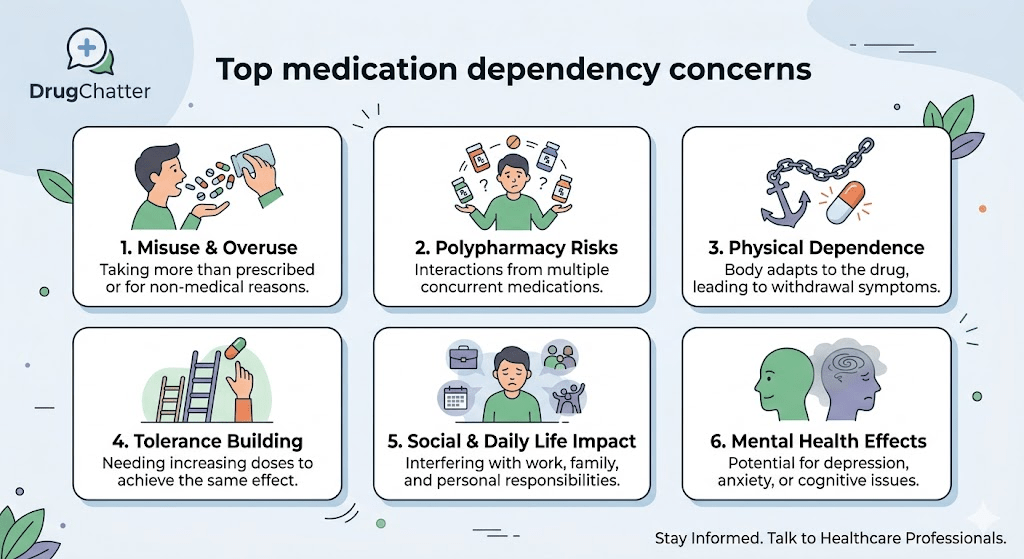
There are two kinds of medication problems: the ones that announce themselves in big, dramatic side effects—and the ones that creep in through routine. Dependency is the second kind. It doesn’t always look like “addiction.” Sometimes it looks like “I can’t function without it,” or “I tried stopping and everything fell apart,” or “my symptoms came roaring back.”
Below are the dependency concerns that show up again and again across common drug categories—plus a set of DrugChatter Q&A links you can use to dig into specific examples.
1) The “I’ll just taper later” trap
Many medications are safe when used as prescribed, but dependency can still form when the body adapts to regular exposure. The danger isn’t only withdrawal; it’s the way people keep escalating dose or frequency because stopping feels impossible.
2) Sedatives and anxiolytics: dependency can masquerade as “stress control”
Drugs used for anxiety and sleep are among the most common sources of dependency risk. People often start them for short-term relief and then discover—sometimes months later—that their baseline anxiety or insomnia is worse without them.
3) Pain and muscle-relaxation regimens that quietly become “daily scaffolding”
When pain or spasm medications become part of everyday life, dependency risk rises—not necessarily because the drug is “bad,” but because the nervous system learns a new normal. That’s when dose changes, missed doses, or abrupt discontinuation can become destabilizing.
4) Antidepressant-adjacent and neurologic therapies: stopping can feel like relapse
Some therapies don’t cause classic withdrawal, but discontinuation can still trigger a rebound of the underlying condition. Patients may interpret that rebound as proof they “need” the medication indefinitely—when the real issue is that the stop was too fast, too abrupt, or unsupported.
To see how neurologic medication questions can be framed around practical use, see: How to make methylphenidate?
5) Cardiovascular and metabolic drugs: dependency isn’t always the drug—it’s the routine
Not every dependency concern is about withdrawal. Sometimes it’s about the way people tie their sense of safety to a pill. Miss a dose and you feel “unsafe,” even if the medication isn’t the only factor at play.
Dependency risk isn’t only pharmacology. It’s also logistics. When medication is expensive or hard to access, people may stretch doses, delay refills, or stop and restart—conditions that can worsen side effects and make the medication feel even more “necessary.”
7) “Generic soon” and “biosimilar timeline” uncertainty
When patients don’t know whether the next version will be available, they may cling to the current one longer than they otherwise would—or they may face abrupt changes if supply or coverage shifts. That can create a psychological and clinical dependency on stability.
8) Immunology and biologics: dependency through long-term disease control
Biologics and other long-term therapies can create a different kind of dependency: not withdrawal, but dependence on ongoing treatment to keep disease activity controlled. Stopping can lead to flare-ups that feel like “withdrawal,” even when the mechanism is simply the return of the underlying condition.
Ask about discontinuation plans before you start long-term therapy: taper schedules, monitoring, and what rebound symptoms to expect.
Don’t treat missed doses as “no big deal.” If you miss, ask your clinician what to do next time.
Bring up cost and access early. If refills are uncertain, dependency risk rises through instability.
Use the right language with your prescriber. “I’m worried about dependency” is a legitimate clinical concern, not a moral failing.
Dependency is rarely a single moment of “becoming addicted.” It’s usually a slow negotiation between your body, your symptoms, and your life. The best time to address it is before the medication becomes the only thing holding the day together.