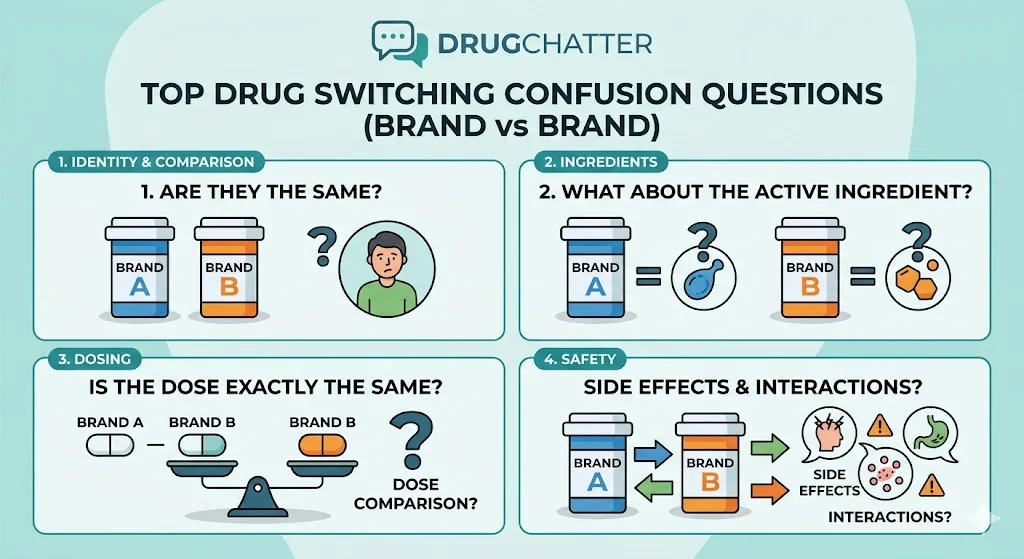
Drug switching is supposed to be simple: same active ingredient, same job, different label. In practice, patients and even clinicians run into a familiar fog—brand vs brand, generic vs “not quite,” and biosimilar vs “close enough.” The result is a steady stream of questions that all sound different but rhyme: Is this really the same medicine? Is it safe? Will it work?
Here are some of the most common “brand-versus-brand” confusion questions—along with the DrugChatter answers that try to cut through the noise.
1) “Is this gel generic?” (and what that actually means)
When a product changes from one branded presentation to another “generic,” people understandably worry they’re getting a different drug—or a weaker one. Start here if you’re trying to map the label to the active ingredient.
2) “Is it safe for someone older?” (brand changes can trigger extra caution)
Even when the active ingredient is the same, switching can raise anxiety in older adults—because side effects, dosing tolerance, and comorbidities are already in play.
3) “What even is this drug?” (before you can switch, you need the identity)
Confusion often begins with naming. If you don’t know what a medication is, you can’t reliably judge whether a “different name” is truly a switch or just a different product.
4) “Kit” vs “not a kit” (same therapy, different packaging and expectations)
Some therapies come as kits—devices, components, instructions. People may interpret packaging differences as clinical differences, when sometimes it’s just logistics.
5) “Who makes it?” (manufacturer questions are really about consistency)
Patients often ask about the manufacturer because they’re trying to predict consistency: formulation, supply stability, and sometimes insurance behavior.
6) “How long can I stay on it?” (switching can change the plan)
Switching isn’t just about whether the drug is “the same.” It can also affect how long clinicians expect you to use it—especially for biologics and specialty therapies.
- What’s the maximum cosentyx treatment duration?
- What medical conditions determine cosentyx duration?
7) “Does it change immune effects?” (brand changes can feel like biological changes)
For drugs that interact with immune responses, patients worry that switching could alter vaccine timing, protection, or risk.
8) “Is there a generic/biosimilar?” (and if not, why not?)
When people can’t find the “same” product under a generic name, they often assume it’s a different drug. Sometimes it’s a timing issue; sometimes it’s exclusivity; sometimes it’s a formulation/device issue.
- Is jublia gone generic in canada?
- Generic vanrafia available?
- Zerviate generic?
- Generic sensipar?
- Biosimilar kadcyla?
9) “Alternatives” (when the pharmacy says ‘we can’t get that’)
Sometimes the switch is driven by availability or coverage, not by preference. That’s when “alternative” becomes a loaded word.
10) “Is it the same drug if it’s a different name?” (the classic brand-vs-brand trap)
Even when two products share a therapeutic goal, the details matter: dosing form, active ingredient, and how the drug behaves in the body. These questions are where people try to confirm the identity before they commit.
11) “Will switching affect side effects?” (especially with drugs people already feel)
For medications with noticeable side effects, any change—brand, formulation, or timing—can feel like a new problem. The question is whether the side effect profile should be expected to change.
- Hpw long does it take for the side effects to subside on lipitor?
- Can lipitor’s side effects worsen with severe low sodium?
12) “Interactions and timing” (because switching rarely happens in a vacuum)
Switching can coincide with changes in diet, supplements, pain meds, or meal timing. People then wonder whether the new product is the culprit—or whether it’s the context around it.
- Can lipitor interact with common painkillers?
- Will taking fish oil affect lipitor’s effectiveness?
- Do fiber supplements affect lipitor’s efficacy?
- How does regular consumption of fatty foods affect lipitor’s efficacy?
- What’s the impact of meal timing on ozempic?
What to do when the label changes
If you’re facing a brand-to-brand switch, the safest move is to confirm the active ingredient and the dosing form (tablet vs injection vs device kit), then ask whether your clinician expects any monitoring or dose adjustment. If you’re unsure, the questions above are a good map of the exact issues people run into—before the switch becomes a mystery.
Note: This post is a curated reading list of common confusion questions and their answers. For personal medical decisions, rely on your prescriber and pharmacist.