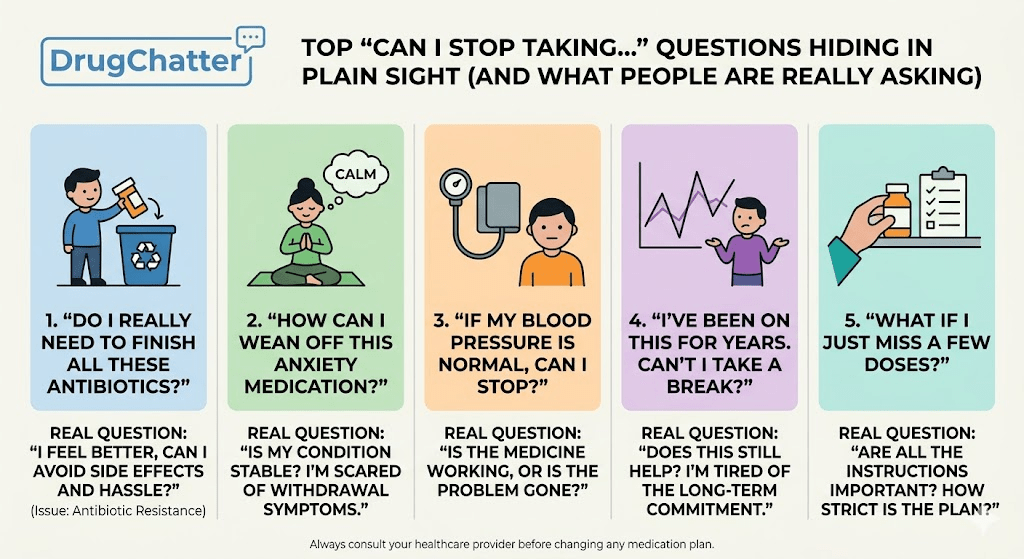
There’s a particular moment in modern pharmacology that doesn’t show up in clinical trials or prescribing inserts. It happens at 11:43 p.m., phone in hand, when someone types: “can I stop taking…”
Not “is it working?” Not “what are the risks?” But the exit question. The quiet search for a trapdoor.
And while not every question below literally asks about discontinuation, they orbit the same gravitational center: What happens if I change this? Reduce it? Combine it? Or quietly walk away?
Let’s look at the recurring themes.
1. The statin hesitation: “Do I really need to stay on this?”
Few drug classes generate more low-grade exit anxiety than statins. Take Lipitor. It shows up in questions that are really about long-term commitment disguised as side quests.
People don’t just ask about side effects—they test the edges of persistence:
- Exercise and recovery concerns:
https://www.drugchatter.com/chat/16669/is-exercise-healing-impacted-by-lipitor-use - Alcohol interactions and downstream effects:
https://www.drugchatter.com/chat/56206/how-long-after-taking-lipitor-can-i-drink-wine - Grapefruit and dietary interference:
https://www.drugchatter.com/chat/20584/can-grapefruit-oil-reduce-lipitor’s-cholesterol-benefits - Muscle, endurance, and perception changes:
https://www.drugchatter.com/chat/59665/did-you-notice-endurance-change-early-in-lipitor-use
Even “benign” questions—dairy, avocado, breathing exercises—become proxies for a deeper one: Is this drug quietly reshaping my baseline?
And once that question appears, discontinuation is never far behind.
2. The antidepressant fork in the road: switching feels like stopping (but isn’t)
With SSRIs, “can I stop?” often mutates into “can I switch without chaos?”
For example, the familiar comparison:
- Prozac vs Zoloft
https://www.drugchatter.com/chat/7739/what-is-the-difference-between-prozac-and-zoloft
On paper, this is pharmacology. In practice, it’s risk management of identity, sleep, appetite, and emotional baseline.
And nearby sits Trintellix:
These aren’t discontinuation questions outright. But they are rehearsals for it: What if I leave this drug—gradually or otherwise—and what replaces it?
3. Painkillers: the illusion of harmless forever
Few drugs feel more “stoppable” than NSAIDs—until you zoom in.
Advil appears in an almost comical number of long-term boundary tests:
- Can long-term use worsen headaches?
https://www.drugchatter.com/chat/38334/can-long-term-advil-use-worsen-headaches - Interactions with blood pressure and antidepressants:
https://www.drugchatter.com/chat/59857/can-i-take-advil-with-my-heart-medicine
https://www.drugchatter.com/chat/53988/is-it-safe-to-take-advil-with-antidepressants - Bleeding and anticoagulant stacking concerns:
https://www.drugchatter.com/chat/44078/can-advil-intensify-warfarin’s-impact-on-blood-thinning
Here, “can I stop?” often becomes “should I stop before this becomes a long-term problem?”
And unlike many chronic medications, NSAIDs blur the line between treatment and habit.
4. Metabolic drugs: success creates its own exit anxiety
Weight-loss and lipid drugs introduce a paradox: if they work, people worry about what happens next.
With Ozempic:
- https://www.drugchatter.com/chat/34007/why-do-some-people-regain-weight-after-ozempic
- https://www.drugchatter.com/chat/9296/can-ozempic-cause-fatigue
- https://www.drugchatter.com/chat/49741/what-benefits-have-you-noticed-in-controlling-sugar-cravings-with-ozempic
And its close cousin Wegovy:
The discontinuation question here is almost inverted:
If stopping makes weight return likely, is it really a “stop,” or just a relapse with better branding?
5. Antibiotics and short-course drugs: the “can I stop early?” temptation
With drugs like Tigecycline, the question is more procedural than philosophical—but still critical:
- Liver enzyme risk and monitoring:
https://www.drugchatter.com/chat/10812/does-tigecycline-use-frequently-cause-liver-enzyme-elevation - Dosing adjustments in liver dysfunction:
https://www.drugchatter.com/chat/10800/how-does-liver-dysfunction-affect-tigecycline-dosing - Monitoring frequency and precautions:
https://www.drugchatter.com/chat/44702/what-factors-increase-liver-test-frequency-during-tigecycline-use
Here, stopping early isn’t philosophical—it’s microbial selection pressure.
Still, the instinct is familiar: if I feel better, can I stop now?
History says: usually no.
6. Immunotherapy and “how long is forever?”
Cancer drugs add a different dimension entirely.
With Keytruda:
- https://www.drugchatter.com/chat/48685/how-long-do-keytruda’s-benefits-last-for-most-patients
- https://www.drugchatter.com/chat/56258/is-pembrolizumab-effective-for-msi-high-tumors
- https://www.drugchatter.com/chat/46091/can-you-tell-me-the-year-keytruda-received-initial-fda-approval
The discontinuation question here is rarely “can I stop?” and more:
“When do we stop calling this a treatment and start calling it a history?”
7. The supplement gray zone: where stopping is assumed, not discussed
Even “harmless” additions complicate exit logic:
- L-theanine with sleep meds:
https://www.drugchatter.com/chat/19539/is-it-safe-to-take-l-theanine-with-my-sleep-medication - Ginkgo and cognition supplements:
https://www.drugchatter.com/chat/61369/is-it-safe-to-take-a-ginkgo-biloba-supplement-for-my-memory - Multivitamins with cardiovascular regimens:
https://www.drugchatter.com/chat/38608/can-vascepa-and-multivitamins-be-taken-at-the-same-time
Supplements rarely come with structured discontinuation plans. Which is exactly why they linger.
The pattern underneath all of it
Across all these questions, the surface topic changes—cholesterol, mood, pain, weight, immunity.
But the underlying structure stays the same:
- uncertainty about duration
- fear of dependency
- confusion between improvement and cure
- and the persistent belief that “stopping” is a simple action rather than a physiological event
Pharmacology, unfortunately, does not recognize simple actions.
It recognizes kinetics, receptors, adaptation, and time.
A final thought
The phrase “can I stop taking this?” sounds like a question about permission.
But most of the time, it’s really a question about control.
And drugs—especially the useful ones—tend to answer with a quiet, chemical “it depends.”
Related Posts: