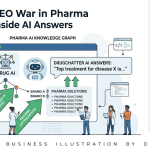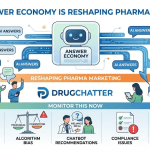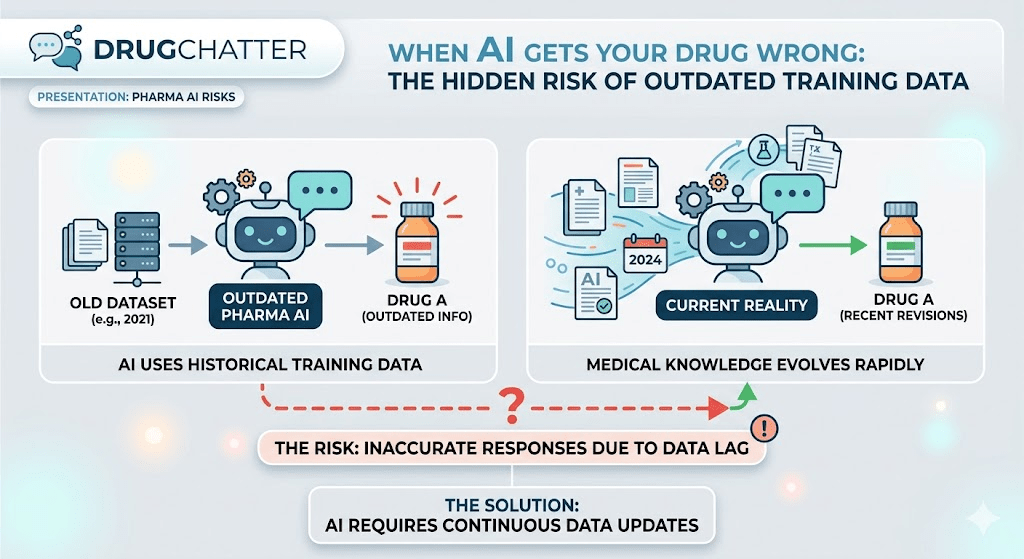
In March 2023, the FDA updated the prescribing information for Dupixent (dupilumab) to include new warnings around eosinophilic conditions. Physicians knew. Pharmacists updated their records. But ChatGPT, Gemini, and most other large language models kept describing Dupixent’s safety profile using information frozen at their training cutoff — sometimes 12 to 18 months behind the regulatory update.
Patients asked AI chatbots about Dupixent’s side effects. The chatbots answered with confidence. The answers were wrong.
This is not a hypothetical risk. It is happening right now, across every major AI platform, for hundreds of branded and generic drugs. And most pharmaceutical companies have no system in place to detect it.
The pharmaceutical industry spends billions on pharmacovigilance, adverse event monitoring, and regulatory compliance. Yet the fastest-growing channel for patient drug information — AI chatbots and AI-powered search — remains almost entirely unmonitored by brand teams, safety officers, and regulatory affairs departments.
That gap is where lawsuits, FDA inquiries, and reputational damage grow.
What Is an LLM Training Cutoff and Why Does It Matter for Drug Safety?
Every large language model — GPT-4o, Gemini 1.5, Claude Sonnet, Llama 3, Mistral — is trained on a static snapshot of text data collected up to a specific date. After that date, the model knows nothing about the world unless it is retrained, fine-tuned, or given access to live retrieval tools.
OpenAI’s GPT-4 had a training cutoff of April 2023. Many deployments of Claude have cutoffs ranging from early 2024 into 2025, depending on the version. Gemini’s cutoffs vary by model variant. Perplexity and some Microsoft Copilot deployments use retrieval-augmented generation (RAG) to supplement static training with live web search — but this is inconsistent and not universal.
For most consumer queries about weather, pop culture, or general science, a 12-month lag in training data is a minor inconvenience. For pharmaceutical information, it can be clinically significant.
How Drug Information Changes After an LLM Is Trained
Drug information is among the most dynamic categories of regulated content in the world. Between a model’s training cutoff and the moment a patient queries it, any of the following can change:
- FDA label updates, including new boxed warnings, contraindications, and dosing changes
- New drug approvals and new indications for existing drugs
- Post-market safety communications and Risk Evaluation and Mitigation Strategies (REMS) updates
- Drug withdrawals and market discontinuations
- Generic entry and biosimilar approvals that shift prescribing patterns
- New clinical trial results that alter standard of care
- Litigation settlements that implicitly validate safety concerns
- EMA decisions that precede or diverge from FDA action
None of these changes reach an LLM unless the model is retrained or augmented with live data. A patient asking ChatGPT whether a drug is safe for use during pregnancy may receive an answer based on a label that has since been revised. A physician using AI-assisted clinical decision support may see dosing guidance that was updated in a Dear Healthcare Provider letter the model never ingested.
Which Drug Categories Face the Highest Outdated-Data Risk?
Not all therapeutic areas carry equal risk. The categories where label changes, safety updates, and new evidence move fastest include:
- Oncology (frequent label expansions, new indications, evolving NCCN guidelines)
- GLP-1 receptor agonists (Ozempic, Wegovy, Mounjaro — regulatory updates moving at speed of commercial demand)
- Immunology (Dupixent, Skyrizi, Rinvoq — expanding indications creating coverage confusion)
- Anticoagulants (Eliquis, Xarelto — dosing complexity and interaction updates)
- Psychiatric medications (black box warning revisions, evolving FDA risk communications)
These are also, not coincidentally, the drug categories patients ask AI about most frequently.
Why ChatGPT, Gemini, and Claude Get Drug Side Effects Wrong
The mechanism behind AI drug misinformation is not mysterious. LLMs are trained to predict statistically likely text completions based on patterns in their training data. When asked about a drug’s side effects, the model retrieves patterns from whatever content existed at training time — package inserts, clinical trial summaries, patient forums, news articles, and medical databases.
If the training data is stale, the model’s output will be stale. The model will not flag this. It will not say “my information may be outdated.” In most consumer deployments, it will answer with the same confident tone it uses for everything else.
Real Cases Where LLM Drug Information Was Wrong or Outdated
In 2023, researchers at the University of California San Francisco tested GPT-4’s responses to drug interaction queries and found that the model produced incorrect or incomplete interaction warnings in a meaningful subset of cases — particularly for newer drug combinations not well represented in pre-2023 literature. The study, published in JAMA Internal Medicine, found that GPT-4 answered drug interaction questions accurately about 90% of the time but failed on complex or novel pairings.
A 90% accuracy rate sounds reassuring until you consider the scale. ChatGPT alone receives an estimated 100 million queries per day. If even 0.1% involve drug-related safety questions — a conservative estimate — that’s 100,000 drug queries daily, with a meaningful error rate on novel or recently updated information.
A 2024 analysis by researchers at Stanford Medicine found that AI chatbots, including ChatGPT and Bard (now Gemini), frequently omitted or mischaracterized FDA black box warnings for high-risk medications including antipsychotics, anticoagulants, and opioids. The models tended to understate risk, not overstate it — a pattern consistent with training data drawn heavily from pharmaceutical company materials and clinical trial publications rather than post-market safety communications.
Do LLMs Underreport Drug Risks Because of Training Data Bias?
The composition of LLM training data skews toward optimistic drug information. Clinical trial publications, which dominate medical literature, report drugs in the context of controlled populations where adverse events are monitored and managed. Post-market real-world adverse event reports — the kind filed to the FDA’s MedWatch system — are less represented in the training corpus of most models.
This creates a structural bias: LLMs are more likely to describe a drug’s benefits and less likely to accurately characterize the full scope of real-world adverse events, particularly those that emerged after approval. For drug companies monitoring their AI footprint, this bias cuts both ways. A model that undersells your competitor’s side effects is a competitive disadvantage. A model that undersells your own drug’s risks is a regulatory liability.
How Often Does Claude Mention Ozempic vs. Wegovy — and Does It Know the Difference?
Ozempic (semaglutide, 0.5–2 mg injection) and Wegovy (semaglutide, 2.4 mg injection) are the same molecule at different doses, approved for different indications — Ozempic for type 2 diabetes, Wegovy for chronic weight management. Novo Nordisk has invested heavily in distinguishing the two brands, but AI chatbots frequently conflate them.
When a patient asks an LLM “Can I take Ozempic for weight loss?”, the model often describes Wegovy’s indication without clearly distinguishing between the two products, their dosing regimens, or their respective coverage and reimbursement profiles. This is not just a brand confusion issue. It affects patient conversations with physicians, out-of-pocket cost decisions, and insurance authorization language.
Novo Nordisk’s brand team has a direct commercial interest in understanding how AI systems represent Ozempic and Wegovy — and whether AI is accurately reflecting the approved indication boundary between them. When AI systems train on 2022-era data, they may reflect a period before Wegovy achieved full market penetration, producing responses that default to Ozempic for all semaglutide queries regardless of use case.
How GLP-1 Drugs Are Misrepresented in AI Search Results
Mounjaro (tirzepatide), approved by the FDA in May 2022 for type 2 diabetes, received its obesity indication as Zepbound in November 2023. LLMs trained before late 2023 may not know Zepbound exists, or may describe tirzepatide only in its diabetes context. A patient asking “What’s better for weight loss, Mounjaro or Wegovy?” may receive a comparison that treats Mounjaro as an off-label option rather than an approved obesity treatment — because for the AI’s training data, it was.
Eli Lilly has a significant commercial interest in correcting this AI knowledge gap. So does any competitor trying to understand how its products are being positioned relative to tirzepatide in AI-generated responses.
Can AI Hallucinations About Drugs Trigger FDA Regulatory Risk?
This is the question pharmaceutical regulatory teams are beginning to take seriously — and it is more complex than it first appears.
The FDA’s framework for drug promotion and adverse event reporting was built around manufacturer-controlled communications: advertisements, sales force materials, sponsored content, and direct-to-consumer campaigns. AI-generated responses from third-party platforms like ChatGPT do not fit neatly into this framework. The manufacturer did not produce the content. The manufacturer did not sponsor it. The manufacturer may not even know it exists.
What FDA Guidance Exists on AI-Generated Drug Information?
As of 2024, the FDA had not issued comprehensive guidance specifically addressing AI-generated drug information from third-party LLM platforms. The agency has issued guidance on digital health technologies, prescription drug promotion via social media, and the use of AI in drug development — but the specific question of what happens when an independent AI chatbot makes a false or outdated claim about a regulated drug remains in a regulatory gray zone.
However, several existing frameworks are relevant. The FDA’s draft guidance on prescription drug promotion on the internet and social media (originally issued in 2014 and still operative) establishes that manufacturers have an obligation to monitor the digital landscape for misinformation about their products — including user-generated content on platforms they do not control — and to take corrective action where feasible.
Legal counsel at major pharmaceutical companies are beginning to argue that this monitoring obligation extends to AI-generated content. If a drug company knows that ChatGPT is consistently misrepresenting its drug’s contraindications and takes no corrective action, that passive knowledge may eventually create liability exposure.
Could an AI Hallucination About a Drug Be Treated as Misbranding?
Misbranding under the Federal Food, Drug, and Cosmetic Act applies to false or misleading labeling. The act’s reach extends beyond the physical package insert to promotional materials and representations made “in connection with” the drug. Courts and the FDA have historically interpreted this broadly.
A drug company that actively seeds incorrect information into AI training data — or that pays for sponsored content that ends up in AI training sets — could face misbranding scrutiny. The more exotic question is whether a manufacturer’s failure to correct a pervasive, known AI hallucination about its product could eventually be characterized as a form of constructive misrepresentation.
No enforcement action has yet tested this theory. But pharmaceutical legal teams are not waiting for a test case to decide whether to monitor AI outputs about their products.
Real FDA Warning Letters That Reveal What Regulators Watch
The FDA’s Office of Prescription Drug Promotion (OPDP) has issued warning letters addressing digital drug misinformation for years. Notable recent examples include warning letters to companies for off-label promotion on social media, for minimizing risk information in digital advertisements, and for failing to include required safety information in sponsored search results.
In 2020, the FDA issued a warning letter to Pacira Pharmaceuticals regarding online promotional materials that omitted risk information. In 2021, letters went to multiple manufacturers regarding social media content that made efficacy claims without balancing risk disclosure. In each case, the FDA held manufacturers responsible for content appearing on digital platforms — including platforms where the manufacturer’s degree of control was indirect.
The trajectory of these letters points toward increased scrutiny of AI-generated drug content, even when the manufacturer is not the publisher.
Tracking AI Share of Voice: How Pharma Brand Teams Can Monitor Drug Mentions Across ChatGPT, Gemini, and Claude
Share of voice (SOV) is a metric pharmaceutical brand teams have tracked across print, broadcast, and digital media for decades. The concept is straightforward: what percentage of total category mentions does your brand capture versus competitors?
AI search is now a significant and growing slice of the media landscape — and most pharma brand teams are measuring their SOV across every channel except this one.
What Is AI Share of Voice for Drug Brands?
AI share of voice measures how frequently a specific drug brand is mentioned, recommended, or cited in AI-generated responses to relevant queries. It can be measured at several levels:
- Mention frequency: How often does the AI mention your drug when asked about a condition it treats?
- First-mention position: Is your drug named first, second, or not at all in AI responses listing treatment options?
- Sentiment: When your drug is mentioned, is the framing positive, neutral, or negative?
- Accuracy: Does the AI correctly describe your drug’s indication, dosing, and safety profile?
- Competitive framing: How does your drug’s AI representation compare to your main competitors?
Tools designed specifically for pharmaceutical AI monitoring — including DrugChatter — allow brand teams to run systematic queries across multiple LLM platforms, track responses over time, and identify where AI representations of their products deviate from approved label language.
Do LLMs Recommend Generic Drugs More Often Than Brand-Name Drugs?
This is one of the most commercially consequential questions in pharmaceutical AI monitoring — and the preliminary evidence suggests the answer is yes, with significant nuance.
LLMs trained on consumer health content tend to reflect the editorial slant of that content. Consumer health publications, patient advocacy resources, and payer-adjacent content consistently recommend generic equivalents over brand-name drugs when they are available. This editorial posture becomes encoded in the model’s training weights.
When a patient asks ChatGPT “Should I take Eliquis or a generic blood thinner?”, the model’s response may reflect a cost-conscious consumer health framing that favors generics — even though apixaban (Eliquis) has no generic equivalent in the US market as of mid-2024, and the comparison involves drugs with genuinely different mechanisms and clinical profiles.
Bristol-Myers Squibb and Pfizer, as Eliquis co-promoters, have a direct interest in whether AI systems accurately represent the generic landscape for anticoagulants. When an LLM trained on 2022 data tells a patient that cheaper warfarin is “just as good” as Eliquis without accurately representing the clinical trial data comparing the two, that AI response is doing competitive damage that no brand team’s advertising budget is countering.
How to Run a Competitive AI SOV Analysis Across LLM Platforms
A basic competitive AI share-of-voice study involves systematically querying each major LLM platform with condition-specific prompts and documenting the responses. Example prompt structures include:
- “What are the most effective treatments for [condition]?”
- “What are the side effects of [drug name]?”
- “Is [drug name] safe for [patient population]?”
- “What’s the difference between [brand A] and [brand B]?”
- “My doctor recommended [drug name]. What should I know?”
Running these prompts across ChatGPT, Gemini, Claude, Perplexity, and Copilot on a weekly or monthly basis, then analyzing the results for mention frequency, accuracy, and sentiment, produces a competitive intelligence dataset that no other monitoring channel currently provides.
Platforms like DrugChatter automate this process at scale, enabling pharmaceutical companies to monitor AI responses across dozens of drugs and dozens of platforms simultaneously.
What Pharma Brand Teams Can Learn From How Patients Ask AI About Drug Interactions
Patient query patterns in AI systems reveal a layer of drug concern that traditional market research misses. Patients do not ask AI questions the way they answer market research surveys. They ask the questions they are actually afraid to ask their physician.
The Patient Questions That AI Gets Most Wrong
Based on published research and publicly available analyses of AI chatbot behavior, the drug-related query categories with the highest error rates in AI responses include:
- Drug-drug interaction queries involving recently approved medications
- Pregnancy and lactation safety queries for drugs with post-market label updates
- Off-label use queries where physician practice has evolved ahead of regulatory approval
- Comparative efficacy queries where new clinical data has shifted clinical opinion
- Dosing queries for drugs with recently revised titration schedules
Each of these query types is a signal. If patients are asking AI about a drug’s safety in pregnancy at high volume, that is a voice-of-the-customer insight that should inform patient education materials, physician outreach, and label communication strategy. If the AI is answering incorrectly, that is a compounding problem.
Off-Label AI Discussions: What Pharma Companies Must Track
Off-label use discussions are among the most legally sensitive areas of pharmaceutical AI monitoring. Manufacturers are prohibited from promoting off-label use. But AI platforms are not subject to the same restrictions — and they routinely discuss off-label applications of drugs based on published clinical literature, physician commentary, and patient forum content in their training sets.
When a patient asks Perplexity about using low-dose naltrexone for fibromyalgia — an off-label use with emerging but not FDA-approved evidence — the AI may describe it favorably based on published case reports and small trials. The manufacturer of naltrexone (Revia, generic) did not create that content and cannot control it. But monitoring that AI-generated off-label content is valuable intelligence for understanding how physicians and patients are using the drug in practice.
The same logic applies to branded drugs. If an AI system is recommending Humira (adalimumab) for a condition for which it does not have an approved indication — based on off-label physician practice reflected in medical literature — AbbVie’s brand and regulatory teams need to know. Not because they can or should intervene in every AI conversation, but because understanding the off-label AI narrative helps them anticipate regulatory questions, plan label expansion strategies, and detect adverse event signals that may be emerging in an off-label population.
AI Pharmacovigilance: Can AI Outputs Be Used for Adverse Event Detection?
Pharmacovigilance — the science of detecting, assessing, and preventing drug adverse effects — has traditionally relied on spontaneous reporting systems (FDA MedWatch, EMA EudraVigilance), clinical trial data, and epidemiological studies. Social listening on platforms like Twitter/X, Reddit, and patient forums has become a recognized supplementary source.
AI-generated content is the next frontier — and it works in two directions.
Using AI Query Patterns to Detect Emerging Safety Signals
When patients begin asking AI chatbots about a specific combination of symptoms alongside a drug name, that query pattern is a weak signal that may precede a formal adverse event report. If 10,000 patients independently ask ChatGPT “I’ve been taking [drug] and I’m experiencing [symptom] — is that normal?”, that collective query behavior may surface a safety signal weeks or months before it appears in post-market surveillance data.
Pharmaceutical companies that can access and analyze these query patterns — either through direct platform partnerships or through monitoring tools — gain an early warning system that complements traditional pharmacovigilance. The FDA’s Sentinel System, which monitors real-world healthcare data for safety signals, is the gold standard for post-market surveillance. AI query monitoring is not a replacement for Sentinel. It is an earlier, weaker signal that can prompt proactive investigation.
When AI Generates Its Own Adverse Event Reports
A more direct pharmacovigilance application involves AI systems that are explicitly designed to collect and process adverse event reports. Chatbots deployed on pharmaceutical company websites and patient support platforms can collect structured adverse event information from patients in conversational formats and route it to pharmacovigilance teams.
This application is distinct from the outdated-training-data problem — it involves AI as a collection tool rather than an information source. But the two interact. If a patient first queries an AI chatbot and receives inaccurate safety information, they may be less likely to report a genuine adverse event to the manufacturer’s pharmacovigilance channel. Misinformation in AI responses creates noise in the adverse event detection system.
“AI search tools now influence drug information-seeking behavior for an estimated 40% of patients who go online before or after a physician visit — yet fewer than 5% of pharmaceutical companies have any systematic monitoring program for AI-generated content about their products.”
— Pharmaceutical Executive, 2024 Digital Health Survey
How Eli Lilly and Novo Nordisk Are Approaching AI Brand Monitoring
Eli Lilly and Novo Nordisk are the two pharmaceutical companies with the most commercially urgent reason to monitor AI-generated content about their drugs. The GLP-1 market — Wegovy, Ozempic, Mounjaro, Zepbound — is the fastest-growing drug category in the world and the subject of more AI queries than any other therapeutic area.
Neither company has publicly disclosed a comprehensive AI monitoring program. What is publicly known comes from conference presentations, job postings, and industry analyst reports.
How Novo Nordisk Is Handling AI Misinformation About Ozempic
Novo Nordisk has publicly addressed misinformation about Ozempic and Wegovy in the context of social media — particularly TikTok content around “Ozempic face” (facial volume loss associated with rapid weight loss) and off-label prescribing patterns. The company has issued public statements clarifying label information and worked with patient organizations to provide accurate information.
However, the AI platform problem is structurally different from social media misinformation. On TikTok or Instagram, a specific piece of misinformation can be identified, flagged, and potentially removed. On ChatGPT, the misinformation is embedded in the model’s parameters — it cannot be “removed” in the same way. The only remediation pathway involves retraining the model (which Novo Nordisk cannot compel), using retrieval-augmented systems that pull current information (which some platforms do and some do not), or providing accurate content at sufficient scale that future model training incorporates corrected information.
Eli Lilly’s Digital Intelligence Infrastructure
Eli Lilly has invested significantly in digital health intelligence over the past five years, including through its Lilly Digital Health business unit and strategic partnerships with data analytics firms. Publicly available job postings from Lilly’s digital team through 2023 and 2024 reference capabilities in “AI-generated content monitoring,” “social listening across emerging platforms,” and “competitive digital intelligence.”
Whether these capabilities extend to systematic LLM query monitoring is not publicly confirmed. Given the scale of Lilly’s GLP-1 portfolio and the volume of AI queries about Mounjaro and Zepbound, the commercial logic for such a program is clear.
Which Drugs Are Most Frequently Mentioned by AI — and Are Those Mentions Accurate?
Certain drug categories dominate AI-generated health content by sheer volume of patient and consumer interest. The most frequently AI-queried drug categories include:
- GLP-1 receptor agonists (Ozempic, Wegovy, Mounjaro, Zepbound, Victoza, Saxenda)
- Oncology immunotherapies (Keytruda, Opdivo, Tecentriq)
- Immunology biologics (Humira, Dupixent, Skyrizi, Rinvoq)
- Anticoagulants (Eliquis, Xarelto, Pradaxa)
- ADHD medications (Adderall, Vyvanse, Strattera, Concerta)
- Antidepressants and anxiolytics (Lexapro, Zoloft, Effexor, Wellbutrin)
- HIV treatments (Biktarvy, Descovy, Cabenuva)
Accuracy Audit: What AI Gets Right and Wrong About Keytruda
Keytruda (pembrolizumab, Merck) is the top-selling drug in the world by revenue and one of the most complex drugs to describe accurately. It has more than 40 FDA-approved indications across multiple tumor types and biomarker combinations. Its label has been updated dozens of times since initial approval in 2014.
LLMs trained on data through 2022 or early 2023 may accurately describe Keytruda’s earliest approved indications — melanoma, non-small cell lung cancer — but fail to represent its more recent approvals in cervical cancer, biliary tract cancer, colorectal cancer with specific biomarkers, and others. A patient or caregiver asking whether Keytruda is relevant to their diagnosis may receive an answer that is technically accurate for an earlier version of Keytruda’s indication landscape but incomplete for the current one.
Merck’s commercial team has an obvious interest in ensuring AI platforms accurately reflect Keytruda’s full indication portfolio. Competitors have an equally obvious interest in identifying any AI representations that incorrectly attribute Keytruda’s efficacy to conditions where their own drugs may have a stronger evidence base.
Biosimilar and Generic Substitution in AI Responses: The Humira Case
Humira (adalimumab) faced its first US biosimilar competition in 2023, when Amjevita (adalimumab-atto, Amgen) launched at a significant discount. Since then, more than a dozen adalimumab biosimilars have entered the US market, creating a complex commercial landscape.
LLMs trained on pre-2023 data describe a world where Humira has no US biosimilar competition. Models trained in 2023 may know about the first biosimilar entrants but not the subsequent wave. Models trained in 2024 may accurately represent the current biosimilar landscape — or may not, depending on how well medical and pharmacy content about biosimilar interchangeability is represented in their training data.
When a patient asks an AI chatbot whether they can switch from Humira to a cheaper biosimilar, the answer depends critically on the model’s training vintage. An incorrect answer — whether it understates or overstates biosimilar interchangeability — affects patient-physician conversations about switching, formulary decisions, and AbbVie’s defense of Humira revenue against biosimilar erosion.
What Reddit and Patient Forums Teach Us About AI Drug Citations
Reddit is one of the most heavily scraped sources of consumer health content for LLM training. Subreddits including r/diabetes, r/loseit, r/SkincareAddiction, r/ChronicPain, r/pharmacy, and dozens of condition-specific communities contain millions of posts discussing drug experiences, side effects, cost concerns, and physician interactions.
This content shapes LLM responses about drugs in ways that pharmaceutical brand teams rarely consider. When patients on r/diabetes discuss switching from Ozempic to Mounjaro, that discussion — its language, its concerns, its reported outcomes — ends up encoded in the model’s understanding of both drugs.
How Patient Forum Language Shapes AI Drug Descriptions
Patient forum language is more emotionally charged, more anecdote-driven, and more focused on adverse experiences than clinical literature. Patients who have a bad experience with a drug are more likely to post about it than patients for whom a drug worked as expected. This negativity bias in patient-generated content gets reflected in LLM training data.
A pharmaceutical company monitoring AI responses about its drug may discover that the model’s description of side effects reflects the most commonly discussed adverse events on Reddit — which may differ meaningfully from the FDA-approved label’s risk summary. If patients on patient forums disproportionately discuss a specific side effect that the label lists as uncommon, the AI may overstate that side effect’s frequency relative to the label’s characterization.
This is not misinformation in the traditional sense. It may be real patient experience that diverges from clinical trial data. But it creates a complex situation for brand teams and medical affairs teams trying to ensure accurate drug representation.
The Emerging Role of DrugPatentWatch in AI Drug Intelligence
DrugPatentWatch, which tracks pharmaceutical patent expiration dates, exclusivity periods, and generic entry timelines, is an example of structured pharmaceutical intelligence that AI systems can access and represent. When an LLM is asked about a drug’s patent status or generic availability timeline, responses may draw on DrugPatentWatch data — but only if that data was in the training set and only up to the training cutoff.
Patent expirations and generic launch timelines change frequently, particularly when manufacturers pursue patent litigation strategies or regulatory exclusivity extensions. An AI response about when a drug’s generic equivalent will be available may be significantly out of date — and for patients making cost decisions or physicians counseling patients about treatment costs, that outdated information has real consequences.
Building a Pharmaceutical AI Monitoring Program: A Practical Framework
Most pharmaceutical companies currently monitor AI-generated drug content either not at all or in an ad hoc fashion. Building a systematic monitoring program requires addressing several distinct operational questions.
What Should a Drug AI Monitoring Program Actually Track?
A comprehensive pharmaceutical AI monitoring program should track the following dimensions for each priority drug in the portfolio:
- Accuracy vs. label: Does the AI’s description of indication, dosing, and safety match current approved prescribing information?
- Training data vintage signals: Are there specific claims in AI responses that suggest the model is drawing on pre-update information?
- Competitive positioning: How is your drug described relative to competitors in responses to category queries?
- Off-label representation: What off-label uses does the AI describe, and how does it frame evidence quality?
- Patient sentiment signals: What concerns, complaints, and questions does the AI surface about your drug?
- Generic/biosimilar framing: How does the AI represent generic availability and biosimilar interchangeability for your products?
How to Structure an AI Monitoring Workflow for a Pharmaceutical Brand Team
A functional AI monitoring workflow for a pharmaceutical brand team involves four operational layers:
Layer 1 — Query design: Develop a standardized battery of queries that a patient, caregiver, or physician might ask about your drug and your therapeutic category. Include both branded (using the drug’s trade name) and generic (using the INN or condition name) query variants.
Layer 2 — Platform coverage: Run queries systematically across ChatGPT, Gemini, Claude, Perplexity, Microsoft Copilot, and any AI-powered search tool relevant to your target audience. Different platforms produce meaningfully different responses for the same query due to differences in training data, retrieval augmentation, and model architecture.
Layer 3 — Response analysis: Compare AI responses against the current approved prescribing information for each drug. Flag discrepancies in indication description, dosing information, contraindications, drug interactions, and safety warnings. Identify language that suggests outdated training data (e.g., references to approval timelines or clinical trials that predate known label updates).
Layer 4 — Action and escalation: Establish clear protocols for responding to detected inaccuracies. Actions may include corrective content publication (creating accurate, accessible web content that may enter future model training data), regulatory notification (if the AI misinformation creates material compliance risk), platform outreach (contacting AI developers through their feedback and enterprise channels), and internal briefing (alerting medical affairs, legal, and regulatory affairs teams to identified AI misrepresentations).
Platforms built for this workflow — including DrugChatter’s pharmaceutical AI monitoring tools — automate layers 1 through 3 and provide structured reporting to support layer 4 decision-making.
The ROI Case for Pharmaceutical AI Monitoring
The business case for pharmaceutical AI monitoring does not rest on a single benefit. It draws from multiple risk and opportunity categories:
- Regulatory risk mitigation: Identifying and addressing AI misinformation before it attracts FDA attention or generates adverse event reports that could trigger a safety review
- Competitive intelligence: Understanding how AI platforms position your drugs versus competitors across the query landscape your physicians and patients actually use
- Brand equity protection: Detecting and correcting AI representations that undermine your drug’s value proposition or overstate its risks relative to label language
- Patient education optimization: Learning from AI query patterns what questions patients are actually asking, then building patient education resources that answer those questions accurately
- Early signal detection: Using AI query patterns as a weak but early signal for emerging adverse event patterns or off-label use trends
Against these benefits, the cost of an AI monitoring program — whether built internally or through a purpose-built platform — is modest relative to a pharmaceutical brand’s total marketing and pharmacovigilance budget.
The Future of AI Drug Information: Where Retrieval-Augmented Generation Changes the Calculus
Retrieval-augmented generation (RAG) systems supplement LLM outputs with real-time retrieval from current data sources — databases, websites, news feeds, and structured knowledge bases. When a RAG-enabled AI is asked about a drug, it can pull current information from sources like FDA.gov, PubMed, or drug information databases rather than relying solely on frozen training data.
Perplexity AI is the most prominent consumer-facing AI platform currently using RAG as its primary architecture. Microsoft Copilot uses a combination of GPT-4 and Bing search retrieval. Some ChatGPT deployments can access current web content through a browsing tool.
Does Retrieval-Augmented Generation Solve the Outdated Drug Data Problem?
RAG reduces the outdated-data problem but does not eliminate it. The quality of a RAG system’s drug information depends entirely on which sources it retrieves from and how it synthesizes them. If a RAG system retrieves from FDA.gov, it may produce accurate, current label information. If it retrieves from a patient forum post from 2021 because that page ranks highly in its retrieval index, it may produce outdated or inaccurate information.
RAG systems also introduce new failure modes. A RAG system can retrieve current but contextually inappropriate information — for example, pulling a drug’s EU label from the EMA rather than its US label from the FDA, or retrieving a news article about a clinical trial that has not yet resulted in a label change. These retrieval errors can produce responses that are current but misleading.
For pharmaceutical AI monitoring purposes, the RAG architecture means that different platforms require different monitoring strategies. A purely static LLM produces consistent responses until it is retrained. A RAG-enabled platform produces responses that can vary day-to-day as its retrieval sources are updated. Both require monitoring, but the monitoring cadence and methodology differ.
What Pharmaceutical Companies Should Push AI Developers to Implement
Pharmaceutical industry associations — including PhRMA and EFPIA — have begun engaging with AI developers about standards for drug information accuracy. The conversation is early and the regulatory framework is underdeveloped. But several concrete asks are emerging:
- Mandatory disclosure of training data cutoffs when AI systems respond to health-related queries
- Direct integration with FDA-maintained drug information databases (DailyMed, FDA Drug Database) as authoritative sources in RAG architectures
- Clear labeling of AI-generated health content as “AI-generated” with links to authoritative sources
- Structured channels for pharmaceutical manufacturers to report detected inaccuracies and request correction
- Integration of FDA MedWatch adverse event data into AI training pipelines with appropriate weighting
None of these changes will happen quickly. In the meantime, pharmaceutical companies need monitoring programs that work within the current landscape — not the landscape they would prefer.
Physician Perception of AI Drug Recommendations: What the Research Says
Physicians are using AI tools at increasing rates for clinical decision support. A 2023 survey by the American Medical Association found that 38% of physicians reported using AI tools at least occasionally for patient care tasks, with drug information queries among the most common use cases.
The quality of physician experience with AI drug information varies significantly by specialty and by the specific AI tool used. Physicians in primary care — who face the broadest range of drug queries and have the least specialist knowledge in any given therapeutic area — are both the highest volume users of AI drug information tools and the most vulnerable to being misled by outdated or inaccurate AI responses.
Do Physicians Know When AI Drug Information Is Outdated?
Research suggests that most physicians do not reliably detect when AI-generated drug information is based on outdated training data. A 2024 study published in The Lancet Digital Health tested physician ability to identify inaccuracies in AI-generated clinical recommendations. Physicians correctly identified AI errors approximately 60% of the time — but that figure dropped significantly for errors involving recently updated clinical guidelines or newly approved drugs, categories where the physician’s own knowledge may not be current enough to serve as a check on the AI’s.
This creates a compounding problem. The AI is wrong because its training data is stale. The physician may not catch the error because their own knowledge of recent updates is also imperfect. The patient receives a clinical decision influenced by outdated information, with no reliable point of correction in the chain.
Key Takeaways
- LLM training cutoffs create a structural lag between current drug information and what AI platforms tell patients and physicians. This lag ranges from months to years depending on the platform and model version.
- Drug categories with the highest outdated-data risk include GLP-1 receptor agonists, oncology biologics, immunology biologics, anticoagulants, and psychiatric medications — all high-volume AI query categories.
- AI platforms systematically underreport drug risks relative to post-market safety communications because clinical trial literature is better represented in training data than MedWatch reports and post-approval safety updates.
- The FDA’s existing digital promotion framework implies a manufacturer monitoring obligation that likely extends to AI-generated drug content, even when the manufacturer is not the publisher.
- AI share of voice — how frequently and how accurately your drug is mentioned in AI responses — is a competitive intelligence metric that most pharmaceutical brand teams do not yet track.
- Retrieval-augmented generation reduces but does not eliminate the outdated-data problem, and introduces new failure modes related to source quality and retrieval relevance.
- Systematic pharmaceutical AI monitoring programs — using tools like DrugChatter — provide measurable ROI through regulatory risk mitigation, competitive intelligence, brand equity protection, and early adverse event signal detection.
- The most commercially significant AI monitoring gap is in GLP-1 drugs, where the speed of regulatory updates and biosimilar developments has outpaced the training data of most major LLMs.
Frequently Asked Questions
1. How far out of date is AI drug information typically?
It depends on the platform. Most major LLMs have training cutoffs between 12 and 24 months before the date a user queries them. GPT-4’s original training cutoff was April 2023; many deployments of Claude have more recent cutoffs. Retrieval-augmented platforms like Perplexity pull current web content but are only as accurate as the sources they retrieve. For a drug that received an FDA label update in the past 18 months, there is a meaningful probability that any given LLM platform does not reflect that update — unless the platform actively retrieves from FDA.gov in real time.
2. Can pharmaceutical companies legally require AI platforms to correct inaccurate drug information?
Currently, no. AI platforms like OpenAI, Google, and Anthropic are not subject to FDA drug promotion regulations because they are not drug manufacturers or their agents. There is no legal mechanism that allows a pharmaceutical company to compel an AI platform to update or retract specific content about a drug. The available remediation pathways are indirect: publishing accurate content that may enter future training data, contacting AI developers through enterprise or research channels, working through industry associations to advocate for better standards, and ensuring that authoritative sources (FDA.gov, DailyMed) rank highly in web search so retrieval-augmented systems pull accurate information.
3. What is the difference between AI pharmacovigilance and traditional pharmacovigilance?
Traditional pharmacovigilance relies on structured adverse event reporting through channels like FDA MedWatch, clinical trial safety monitoring, and epidemiological study. AI pharmacovigilance — in its emerging form — uses AI tools to monitor unstructured data sources (social media, patient forums, AI chatbot queries) for weak signals that may indicate emerging safety issues. AI pharmacovigilance is supplementary to traditional pharmacovigilance, not a replacement. The FDA does not currently accept AI-generated social listening as a substitute for formal adverse event reporting, but the agency has shown interest in real-world data sources as early signal detection tools through the Sentinel System and related initiatives.
4. How does AI share of voice differ from traditional share of voice metrics?
Traditional share of voice measures brand mentions and advertising presence across paid and earned media channels — print, broadcast, digital advertising, social media. AI share of voice measures how frequently and how favorably a brand appears in AI-generated responses to relevant queries. It is a measure of organic AI presence rather than paid presence. Unlike traditional SOV, AI SOV is not directly purchasable — you cannot buy advertising in a ChatGPT response. AI SOV is shaped by training data composition, model architecture, and retrieval source quality. Improving your drug’s AI SOV requires a content strategy focused on authoritative, accurate, accessible web content that enters future training data and retrieval indexes.
5. Should pharmaceutical companies be worried about AI hallucinations creating FDA enforcement risk?
Pharmaceutical legal teams should be aware of the risk without overstating it. The FDA has not yet taken enforcement action against a manufacturer based solely on AI-generated misinformation about the manufacturer’s product on a third-party platform. However, the regulatory trajectory is clear: the FDA increasingly holds manufacturers responsible for the digital information environment around their products, even where the manufacturer is not the direct publisher. If a manufacturer knows that AI platforms are consistently misrepresenting its drug’s safety profile and takes no corrective action, that passive knowledge may eventually create exposure. Proactive monitoring, documentation of detected inaccuracies, and good-faith corrective actions are the appropriate response — not waiting to see whether enforcement materializes.