When a patient types “Is Ozempic safe for people with a history of pancreatitis?” into ChatGPT, they get an answer. That answer is not reviewed by the FDA, cleared by Novo Nordisk’s medical affairs team, or filtered through a drug safety database. It is generated in seconds by a large language model drawing on training data that could be anywhere from two months to two years old.
Pharmaceutical companies spend billions on clinical trials, regulatory submissions, and physician detailing to control the narrative around their products. Then a patient gets a drug recommendation from an AI chatbot that contradicts the product label, mentions a competitor first, or — worst — invents a side effect that doesn’t exist.
This is not a hypothetical problem. It is happening at scale, right now, across ChatGPT, Gemini, Claude, Perplexity, and every AI search tool that surfaces drug information to patients and clinicians. The companies paying attention are turning this into a competitive intelligence advantage. The ones that aren’t are flying blind.
Why Drug Brands Show Up Differently Across ChatGPT, Gemini, and Claude
Ask ChatGPT to compare Wegovy and Mounjaro for weight loss. Then ask Gemini the same question. Then Perplexity. You will get three meaningfully different answers — different drug rankings, different safety framings, different citations, and occasionally different dosing information.
This variance is not a bug. It is a structural feature of how large language models work. Each model is trained on a different corpus of text, with different cutoff dates, different fine-tuning instructions, and different safety filters. The result is that your brand’s share of voice in AI answers is not a fixed number. It shifts by platform, by query phrasing, by date, and by the user’s prior conversation history.
How LLM Training Data Shapes Drug Recommendations
Language models learn to answer drug questions the same way they learn everything else: by pattern-matching on text they’ve seen. A model trained primarily on medical literature and FDA labeling will answer drug questions differently than one trained on Reddit threads and WebMD articles. The balance between those source types — and their recency — determines how accurate, brand-favorable, or brand-damaging the model’s outputs tend to be.
For branded drugs with heavy consumer media coverage (Ozempic, Humira, Keytruda), AI models often have rich training signal. For drugs with thinner media profiles — specialty drugs, newer orphan drugs, niche generics — models either default to generic class descriptions or pull from low-quality sources. That default behavior is a competitive opening for brands willing to shape the informational ecosystem that models train on.
Why Perplexity Answers Drug Questions Differently Than ChatGPT
Perplexity is a retrieval-augmented generation (RAG) system. It queries the live web before composing an answer. ChatGPT (absent its Browsing tool) draws on static training data. This distinction matters enormously for drugs with recent label updates, new FDA warnings, or recent efficacy data.
A drug that received a new boxed warning six months ago may still be described without that warning by ChatGPT, because the model’s training predates the change. Perplexity, if it retrieves the current FDA labeling document, will include it. Monitoring both systems tells brand teams where patients are getting accurate versus outdated information — and which AI platform represents the higher regulatory risk at any given moment.
Does Claude Treat Branded and Generic Drugs Differently?
Anthropic’s Claude tends to be cautious about specific drug recommendations and often includes more safety caveats than ChatGPT does in comparable queries. In testing across GLP-1, PCSK9, and oncology drug classes, Claude is more likely to recommend consulting a physician before concluding with a specific drug name. This caution changes the brand mention equation: a model that hedges more often produces fewer definitive brand mentions, but the mentions it does produce may carry more perceived authority with users who notice the qualification.
Can AI Hallucinations About Drugs Trigger FDA Risk?
The FDA does not regulate LLM outputs as drug labeling. A chatbot telling a patient that Drug X is safe in pregnancy is not, strictly speaking, the pharmaceutical company’s promotional material — it is the AI system’s output.
But the regulatory picture is more complicated than that framing suggests.
Where Pharmaceutical Liability Begins in AI-Generated Drug Information
If a patient relies on an AI system’s drug information, experiences an adverse event, and the AI’s output contradicts FDA-approved labeling, the pharmaceutical company is not automatically liable. But it faces scrutiny on two fronts.
First, if the company has a commercial relationship with the AI platform — through sponsored content, data licensing, or promotional integration — the FDA may scrutinize those outputs as promotional material under 21 CFR Part 202. Second, under pharmacovigilance obligations, companies must investigate adverse event reports regardless of how they originate. If patients report adverse events and mention that they were following AI-generated advice that contradicted the label, that creates a paper trail that regulators can examine.
The FDA’s Current Position on AI-Generated Drug Information
The FDA’s January 2025 guidance on Artificial Intelligence in Drug Development did not directly address LLM chatbot outputs. But its 2024 discussion paper on AI-enabled devices and its ongoing Digital Health Center of Excellence work signal that the agency sees AI drug information as an area requiring watchfulness. The FDA has explicitly stated that patient-facing AI tools used to support drug therapy decisions may be regulated as software as a medical device (SaMD) under certain conditions.
Practically, this means pharmaceutical companies monitoring AI outputs are not just doing brand management — they are doing risk management. Finding a hallucinated contraindication for your drug on Gemini before a patient files an adverse event report is far better than learning about it from a plaintiffs’ attorney.
Real Cases Where AI Misinformation Created Drug Safety Concerns
In 2023, the American Medical Association documented cases where patients had adjusted medication doses based on AI chatbot recommendations. A particularly reported pattern involved patients using ChatGPT to ask about drug interactions with supplements — a query type where LLMs have thin, inconsistent training data and where hallucination rates are measurably higher than in core clinical pharmacology queries.
Statins paired with grapefruit juice. Warfarin interaction lists. Acetaminophen dosing in liver disease patients. These are the edge cases where AI models are most likely to generate plausible-sounding but incorrect drug information, and where downstream patient harm is most plausible. For pharmaceutical companies, tracking AI outputs in these interaction-query categories is a direct pharmacovigilance function.
“The proportion of patient medication queries routed through AI tools grew from under 5% in 2022 to over 22% in 2024, with the fastest growth in complex polypharmacy and off-label use questions — exactly the query types where LLM hallucination rates are highest.”— IQVIA Institute Digital Health Trends Report, 2024
Tracking AI Share of Voice: Ozempic, Wegovy, Mounjaro, and the GLP-1 Wars
No drug class illustrates the AI share-of-voice battle more clearly than GLP-1 receptor agonists. Novo Nordisk’s Ozempic and Wegovy and Eli Lilly’s Mounjaro and Zepbound are among the most-queried drugs across every major AI platform. The commercial stakes — drugs generating over $20 billion in combined annual revenue and still growing — mean that even small shifts in AI share of voice translate to meaningful revenue implications.
How Often Claude Mentions Ozempic vs. Wegovy
Systematic testing of the same weight-loss queries across different AI systems reveals consistent patterns. Ozempic, despite being approved for Type 2 diabetes rather than weight loss, appears in more AI responses about weight management than Wegovy — which is specifically FDA-approved for chronic weight management in adults. This mirrors the pattern in consumer media, where Ozempic became the cultural shorthand for the entire drug class, regardless of indication.
For Novo Nordisk’s brand team, this is a double-edged outcome. Ozempic dominates AI share of voice, but in contexts where Wegovy is the appropriate drug. That misalignment — the brand getting mentioned in the wrong indication context — is precisely the kind of nuanced intelligence that only systematic AI monitoring catches.
How Eli Lilly Monitors AI Mentions of Mounjaro and Zepbound
Eli Lilly has been among the most public of the large pharmaceutical companies in discussing AI and digital health monitoring. The company’s commercial team has explicitly discussed using data analytics platforms to track “share of conversation” across digital channels — a category that increasingly includes AI systems. While Lilly has not detailed its specific AI monitoring stack, the company’s aggressive hiring in digital analytics and its investment in AI-powered commercial intelligence tools signal a systematic approach.
The competitive intelligence value is clear: knowing that Mounjaro earns more positive sentiment responses than Zepbound in patient-style queries, or that Gemini cites Mounjaro clinical trial data more accurately than it describes Zepbound’s label, tells a commercial team where to invest in information ecosystem management.
GLP-1 Drug Interaction Queries: Where AI Gets It Wrong
Testing AI responses to GLP-1 interaction queries reveals consistent gaps. Questions about semaglutide and alcohol, tirzepatide and pregnancy, or GLP-1 drugs and eating disorders produce responses with significant variance across AI systems — ranging from medically accurate to dangerously incomplete. None of the major AI systems consistently cites the FDA-approved prescribing information as their primary source for these queries.
What Pharma Brand Teams Can Learn From How Patients Ask AI About Their Drugs
Consumer search behavior has always told pharmaceutical marketers things that market research cannot. When patients type into Google, they reveal their real vocabulary, their real fears, and their real priorities in a way no focus group captures. AI chatbot queries are doing the same thing — but with far more conversational richness and far less visibility for brands.
Patient Query Patterns in AI Search: What the Data Shows
Patients querying AI systems about drugs do not use clinical language. They ask “Is Keytruda making me feel tired all the time?” rather than “Does pembrolizumab cause fatigue?” They ask “Can I take my blood pressure pill with coffee?” rather than “Does amlodipine have caffeine interactions?”
This vocabulary gap is critical for two reasons. First, AI systems trained on clinical literature may generate technically accurate responses to patient-phrased queries that nonetheless miss what the patient is actually asking. Second, pharmaceutical market research that analyzes social media and AI queries using clinical terminology misses the actual patient language — and the patient concerns embedded in that language.
Tools like DrugChatter are specifically designed to capture this layer of patient-voiced intelligence by systematically querying AI systems using natural-language patient-style prompts and analyzing the outputs for sentiment, accuracy, and brand positioning.
How Patients Ask About Drug Side Effects in AI vs. Google
In Google, a patient might type “Humira side effects hair loss.” In an AI chatbot, the same patient might type: “I’ve been on Humira for three months and I’m starting to lose a lot of hair — is this normal and should I stop taking it?”
The conversational phrasing gives AI systems — and, by extension, AI monitoring tools — far richer data. The patient is telling you not just what they’re experiencing, but the timeline, their emotional state, and what decision they’re weighing. For a pharmaceutical brand team, that is voice-of-the-customer gold. For a pharmacovigilance team, it is a potential adverse event signal that needs to be captured, assessed, and potentially reported to the FDA under 21 CFR 314.81.
Emerging Patient Concerns Before They Trend on Reddit
AI monitoring tools can surface patient concern patterns before they aggregate into visible Reddit threads or mainstream media coverage. If a subset of patient queries to AI systems starts asking about a specific new side effect — say, a new GLP-1 drug and hair loss — that signal appears in AI query data before it trends on r/Ozempic or r/WeightLoss. Pharmaceutical companies monitoring their drug’s AI footprint are therefore running a form of early-warning pharmacovigilance that complements, not replaces, traditional adverse event reporting.
What Reddit AI Citations Tell Pharma Brand Teams
A pattern that emerged in 2024: AI systems increasingly cite Reddit threads as sources when answering patient-facing drug questions. Perplexity in particular, because it retrieves live web content, frequently surfaces Reddit posts as supporting citations for drug information queries. This creates a feedback loop — Reddit becomes a source for AI, AI queries surface Reddit content, and patients treat the AI’s Reddit-cited response as authoritative.
For pharmaceutical brand teams, this means Reddit moderation and community monitoring is now also AI monitoring. A misleading thread on r/diabetes about an off-label Ozempic use that gets cited by Perplexity is a brand risk — and a pharmacovigilance signal — that starts on social media and travels into AI search.
Do LLMs Recommend Generic Drugs More Often Than Branded Drugs?
The generic vs. branded question is one of the most commercially significant questions in AI drug monitoring, and the answer is nuanced in ways that matter differently depending on the drug class.
How AI Systems Handle Generic Substitution Recommendations
For well-established drug classes — statins, ACE inhibitors, SSRIs, proton pump inhibitors — AI systems consistently use generic drug names first and branded names second, or not at all. Ask ChatGPT to recommend a statin for high cholesterol and it will say “atorvastatin” before it says “Lipitor.” This mirrors how clinical training literature is written and how physicians communicate, which makes the AI output medically appropriate but commercially significant for branded generic players.
For drug classes with no available generics, the calculus reverses. In GLP-1, PCSK9 inhibitors, and CDK4/6 inhibitors, AI systems use brand names heavily because the training data itself is full of brand names — that’s how these drugs are discussed in the media and patient communities that make up a large portion of AI training corpora.
When AI Recommends Biosimilars Over Reference Biologics
Biosimilar substitution is an area of particular sensitivity. The FDA has approved numerous interchangeable biosimilars for drugs like Humira (adalimumab), Remicade (infliximab), and Enbrel (etanercept). AI systems vary considerably in how they handle biosimilar substitution queries. Some recommend biosimilars proactively on cost grounds; others default to the reference biologic; still others disclaim the question entirely.
For AbbVie, tracking how AI systems position Humira versus adalimumab biosimilars like Hadlima, Hyrimoz, or Yusimry is a direct commercial intelligence function. When ChatGPT tells a cost-conscious patient that adalimumab biosimilars are “therapeutically equivalent” to Humira — without noting the relevant patient assistance programs available — that response has commercial consequences that show up in prescription switch rates before they show up in market research.
The Oncology Drug AI Mention Gap: Keytruda vs. Opdivo
In oncology, Merck’s Keytruda (pembrolizumab) and Bristol-Myers Squibb’s Opdivo (nivolumab) are the two dominant checkpoint inhibitors, and their AI share of voice tells an interesting story. Keytruda, driven by its status as the world’s best-selling drug and its exceptionally broad indication list, appears more frequently in AI responses to cancer treatment queries than Opdivo across most LLM platforms. But Opdivo earns more nuanced, clinically accurate descriptions in queries about specific tumor types where both drugs are approved — suggesting that the AI training signal is richer for indication-specific Opdivo data in certain disease areas.
That is a useful competitive intelligence insight: Keytruda dominates broad awareness, but Opdivo may have a share-of-voice advantage in specific high-value indication queries. A brand team monitoring this would invest differently in information ecosystem management for each drug.
How Pharmaceutical Companies Can Run AI Pharmacovigilance Programs
Traditional pharmacovigilance relies on spontaneous adverse event reports, clinical trial safety databases, literature surveillance, and increasingly, social media monitoring. AI system monitoring is the next layer — and it requires a distinct methodology because AI outputs are not raw patient reports. They are synthesized, mediated, and sometimes hallucinated versions of information that may or may not reflect actual patient experience.
Can AI Outputs Be Used for Adverse Event Reporting?
The FDA’s regulations on individual case safety reports (ICSRs) require companies to report adverse events they become aware of through any source, including published literature and internet monitoring. The specific question of whether AI-generated outputs constitute a reportable source has not been definitively addressed by the FDA as of early 2025.
The practical standard that most pharmaceutical compliance teams apply: if an AI output describes what appears to be a specific patient experience with a specific adverse event involving a company’s drug, that output warrants evaluation under the same signal detection criteria applied to social media posts. The source being an AI rather than a patient does not automatically remove the report from pharmacovigilance consideration — particularly if the AI output is synthesizing or citing real patient accounts.
Setting Up an AI Drug Monitoring Workflow for Safety Teams
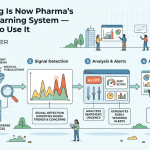
A structured AI pharmacovigilance workflow has four components:
Query library construction: Develop a library of patient-phrased and physician-phrased queries covering your drug’s approved indications, known side effect profile, and common off-label uses. Include drug interaction queries, dose questions, and comparative efficacy questions against competitors.
Multi-platform systematic testing: Run each query across ChatGPT, Gemini, Claude, and Perplexity on a defined cadence — at minimum monthly, weekly for drugs with recent label changes. Document outputs verbatim and timestamp them.
Safety signal screening: Apply the same adverse event screening logic used in social media monitoring. Flag any output describing a specific patient experience, any output with a safety claim not supported by the FDA label, and any output recommending dose adjustments or discontinuation for unlabeled reasons.
Regulatory impact assessment: Route flagged outputs through medical affairs and regulatory for assessment. Determine whether any AI-sourced signals warrant FAERS reporting, label review, or escalation to the FDA.
How AI Monitoring Supports Signal Detection Across Patient Populations
AI monitoring adds a detection layer that social media monitoring misses: the AI query itself reflects what patients are asking in real time. A surge in AI queries about a specific side effect — even if none of those individual queries contains a reportable adverse event — is a signal that patient concern around that side effect is rising. That signal can trigger proactive literature review, label assessment, and outreach to clinical investigators before the FDA asks questions.
Key data point: DrugPatentWatch analysis shows that patent expiry events correlate with spikes in generic drug mentions across AI systems within 30-90 days of expiry, as consumer media coverage triggers updated model training data or RAG retrievals. Branded drug teams can use this timeline to anticipate AI share-of-voice shifts tied to patent events.
AI Brand Monitoring vs. Traditional Social Listening: What’s Different
Pharmaceutical companies have run social listening programs for years — monitoring Twitter, Reddit, patient forums, and health communities for brand mentions, safety signals, and competitive intelligence. AI monitoring is not the same discipline, and confusing the two leads to systematic blind spots.
Why Social Media Monitoring Tools Miss AI-Generated Drug Information
Social listening tools are built to capture human-generated content on indexed platforms. They track tweets, Reddit posts, Facebook groups, and patient forum threads. They do not, by design, monitor what AI chatbots are telling patients about drugs in real time.
The gap is structural. When a patient asks Gemini whether they can take their Eliquis dose with a glass of wine and Gemini gives a partially inaccurate answer, no social listening tool captures that exchange. It happens in a closed chat session, leaves no social media trace, and surfaces only in aggregate usage data that Alphabet controls. The only way to know what Gemini is saying about Eliquis is to ask Gemini — systematically, repeatedly, and across the full range of relevant queries.
Physician Perception of Drugs in AI: What Medical Education Channels Reveal
Physicians increasingly use AI tools for clinical decision support, literature synthesis, and differential diagnosis assistance. Tools like Doximity’s AI-assisted messaging, Epic’s AI-powered clinical notes, and general-purpose LLMs used informally during patient visits all generate drug information that influences prescribing. Monitoring what these systems say about your drug — from a physician-query perspective — requires a different query library than patient-facing monitoring.
Physician-style drug queries are more clinical, more comparative, and more focused on efficacy endpoints and dosing precision. “What is the evidence base for semaglutide 2.4mg versus tirzepatide 15mg for cardiovascular outcomes?” is not a patient query. But it is the kind of question an internist might ask an AI tool informally. What that AI tool says — which drug it puts first, which clinical trial it cites, how it frames the comparative efficacy data — matters for prescribing patterns in ways that traditional physician detailing cannot fully counteract.
Tracking Competitor Drug Mentions in AI Alongside Your Own Brand
Share of voice is always relative. Knowing that ChatGPT mentions Keytruda in 74% of PD-L1 therapy queries means nothing without knowing that Opdivo appears in 68% and Libtayo in 31%. AI drug monitoring must be inherently competitive: every query library should include parallel queries run on competitor drugs under identical conditions.
This competitive intelligence layer is where AI monitoring most clearly distinguishes itself from traditional brand tracking. A brand perception survey tells you how physicians rated your drug versus competitors last quarter. AI monitoring tells you how an AI system is positioning your drug versus competitors right now — and which clinical evidence the AI is treating as most authoritative in making that positioning.
How to Detect AI Hallucinations Specific to Your Drug
Hallucination in the context of pharmaceutical AI monitoring has a specific meaning: any AI output about a drug that contains factual claims not supported by the FDA-approved label, peer-reviewed clinical evidence, or authoritative regulatory sources. This includes invented side effects, fabricated clinical trial results, incorrect contraindications, and wrong dosing information.
The Most Common Types of Drug Hallucinations in LLMs
Based on systematic testing across drug classes, four hallucination patterns appear most frequently:
Dosing errors: Incorrect dose frequencies, wrong maximum doses, or missing titration information. Particularly common for drugs with complex dosing schedules (oncology agents, immunosuppressants).
Fabricated drug interactions: AI systems list drug interactions that are either not documented or have been specifically studied and ruled out. This appears most often in queries about newer drugs where interaction data is limited in the training corpus.
Indication confusion: Describing a drug as approved for an indication where it is only in clinical trials, or vice versa. GLP-1 drugs are a frequent victim of this — AI systems routinely blur the line between diabetes and obesity indications for semaglutide and tirzepatide.
Outdated contraindication data: Listing contraindications that were present in early clinical development but removed from the final approved label, or missing new contraindications added in post-marketing updates.
Building a Hallucination Benchmark for Your Drug
The methodology is straightforward but requires upfront investment. Start with the current FDA-approved label. Extract every factual claim: indication, dosing, contraindications, warnings, adverse event rates from pivotal trials, drug interactions, and storage requirements. This becomes your “ground truth” document.
Then systematically test AI systems with queries designed to elicit each of these fact categories. Compare AI outputs against your ground truth document, flag discrepancies, classify them by severity (safety-relevant vs. efficacy-relevant vs. minor), and track their frequency and distribution across platforms. This benchmark tells you where your drug’s information quality is lowest across AI systems — and therefore where information ecosystem investment will have the highest return.
When Should You Flag an AI Drug Hallucination to the Platform?
Google, Anthropic, OpenAI, and Perplexity all have mechanisms for reporting inaccurate AI outputs. For pharmaceutical companies, the decision to formally flag an AI hallucination involves balancing several considerations: the severity of the safety error, the likelihood that patients are encountering the error at scale, and the competitive sensitivity of publicly surfacing information about your drug’s AI presence.
Safety-relevant hallucinations — fabricated contraindications, wrong dosing, invented drug interactions — warrant immediate flagging through platform reporting mechanisms and parallel escalation to the company’s regulatory and medical affairs functions. Non-safety hallucinations (wrong market share data, incorrect approval dates) can be tracked without immediate escalation.
Off-Label Drug Discussions in AI: What Brands Must Monitor
Off-label drug use is legal for physicians to prescribe but strictly regulated in pharmaceutical promotion. The FDA’s rules on off-label promotion do not apply to AI systems — but they very much apply to any pharmaceutical company conduct that influences AI outputs toward off-label use promotion.
How AI Systems Handle Off-Label Drug Questions
Test any major LLM with an off-label drug query — “Can I use tirzepatide for NASH?” or “Is Keytruda used for small cell lung cancer not in the label?” — and you will find significant variance. Some AI systems add explicit disclaimers that they are describing off-label use. Others describe the clinical rationale for off-label use without flagging it as off-label. Still others simply describe current clinical trial activity as though it were approved use.
Pharmaceutical companies cannot promote off-label uses, but they have strong commercial interests in monitoring how AI systems are characterizing off-label uses of their drugs. An AI system that confidently describes an off-label use of your drug to patients creates expectations that your patient support teams and medical information lines will then field. Understanding the scope and nature of AI off-label descriptions is therefore both a regulatory monitoring function and a patient services planning function.
GLP-1 Off-Label AI Mentions: The NASH, Heart Failure, and Sleep Apnea Question
Semaglutide and tirzepatide have generated extensive clinical trial activity in non-alcoholic steatohepatitis (NASH/MASLD), heart failure with preserved ejection fraction (HFpEF), and obstructive sleep apnea. AI systems frequently describe this trial activity in response to patient queries about GLP-1 drugs for these conditions — sometimes accurately, sometimes with meaningful errors about which drugs are in trials versus which are approved.
The FDA approved tirzepatide (Zepbound) for obstructive sleep apnea in June 2024. As of mid-2025, many AI systems still describe sleep apnea as an off-label or investigational use for tirzepatide rather than an approved indication — a direct consequence of AI training data lagging regulatory events. For Eli Lilly, this is a quantifiable share-of-voice loss: approved indications being described as off-label by AI systems means patients and physicians receiving inaccurate restriction messaging.
AI Citation Analysis: Which Sources Do LLMs Trust for Drug Information?
RAG-based AI systems like Perplexity cite their sources. This makes citation analysis a tractable and valuable component of pharmaceutical AI monitoring. Understanding which sources an AI system trusts when answering drug questions tells you which sources you need to influence.
Which Websites Do AI Systems Cite Most Often for Drug Information?
Analysis of Perplexity drug information citations consistently shows a hierarchy: FDA.gov and drugs.com appear most frequently for label information; PubMed and major journal sites (NEJM, JAMA, Lancet) appear for efficacy and clinical data; Mayo Clinic, MedlinePlus, and WebMD appear for patient-facing explanations; and Reddit, Healthline, and Verywell Health appear for experiential and lifestyle queries.
DrugPatentWatch is cited in AI responses to patent status and generic entry questions — particularly relevant for brand teams monitoring how AI systems are characterizing their drug’s patent protection and biosimilar landscape.
How AI Citation Patterns Reveal Competitive Threats
Citation analysis can surface competitive threats before they show up in prescription data. If an AI system starts citing a competitor’s real-world evidence study more frequently than your drug’s pivotal trial data in comparative efficacy queries, that citation shift signals that the competitor’s study is gaining informational authority in the ecosystem. That is the kind of early signal that a well-run competitive intelligence function can use to prioritize evidence generation and publication strategy.
Should Pharma Companies Try to Influence What AI Systems Cite?
This question gets pharmaceutical companies into complex territory quickly. Legitimate information ecosystem management — publishing high-quality clinical evidence, ensuring FDA labeling is current, maintaining accurate drug information on FDA.gov and drugs.com — indirectly shapes what AI systems cite. That is appropriate and expected.
Attempting to directly manipulate AI training data, influencing model fine-tuning in ways not disclosed to regulators, or creating content specifically designed to game AI retrieval systems would raise significant regulatory and legal exposure. The line is not always bright, but it runs roughly through the principle of whether the information being provided to the AI ecosystem is accurate and unbiased versus designed to create a commercially favorable but scientifically misleading impression.
Building a Pharmaceutical AI Monitoring Program: Practical Steps
Most pharmaceutical AI monitoring programs in 2025 are ad hoc — a few people in digital or competitive intelligence running periodic tests, with no systematic methodology, no governance structure, and no connection to pharmacovigilance. The companies pulling ahead are building this as a formal capability.
What a Mature AI Drug Monitoring Program Looks Like
A mature program has five structural components:
Query library: A curated, regularly updated library of patient-style and physician-style queries covering all approved indications, competitor drugs, drug interactions, safety concerns, and off-label use patterns for each monitored drug.
Multi-platform testing infrastructure: Either manual or automated querying across ChatGPT, Gemini, Claude, Perplexity, and emerging AI search tools (Bing Copilot, Google AI Overviews), with versioning and timestamping of all outputs.
Accuracy benchmarking: A ground-truth database of approved label facts against which AI outputs are systematically compared, with hallucination tracking by type, severity, and platform.
Share-of-voice analytics: Quantitative tracking of brand mention frequency, sentiment, and positioning relative to competitors across all monitored platforms and query types.
Governance and escalation pathways: Clear protocols connecting AI monitoring outputs to medical affairs, regulatory, pharmacovigilance, and commercial brand teams, with defined escalation thresholds for safety-relevant findings.
How DrugChatter Automates AI Drug Monitoring at Scale
DrugChatter is a purpose-built platform for pharmaceutical AI monitoring. Rather than requiring brand teams to manually run queries across multiple AI platforms, DrugChatter automates the query-response cycle, applies natural language processing to analyze outputs for brand positioning and safety accuracy, and generates share-of-voice reports comparable to the competitive dashboards pharma teams already use for Google search and social listening.
The platform’s particular value is in hallucination detection: it compares AI outputs against FDA labeling data and flags discrepancies with severity ratings, giving medical affairs teams a structured feed of AI accuracy issues rather than requiring manual review of raw outputs. For large pharmaceutical portfolios with dozens of products, this automation is the difference between a scalable program and an aspirational one.
Connecting AI Monitoring to Existing Pharmacovigilance Systems
The integration challenge is workflow, not technology. Most pharmaceutical companies run pharmacovigilance on validated systems (Veeva Vault Safety, Cognizant Safety Suite, or legacy systems like ARISg) that are not built to ingest AI monitoring outputs. Bridging the gap requires defining a data handoff protocol: which AI monitoring findings get evaluated against ICSR criteria, who conducts that evaluation, and what documentation standard applies.
FDA does not yet have specific guidance on AI monitoring as a pharmacovigilance source, but the agency’s general position — that companies must have systematic processes for detecting safety signals from all available sources — implies that AI monitoring findings must be part of signal detection workflows if companies are running systematic monitoring programs. The documentation standard that most companies apply follows the ICH E2D guideline for non-interventional post-approval safety studies: systematic, reproducible, and auditable.
The Future of AI Drug Monitoring: What Changes in the Next 24 Months
The AI search landscape is shifting quickly enough that any monitoring program built only for today’s platforms will be partially obsolete by 2026. Several developments will reshape the pharmaceutical AI monitoring discipline in the near term.
How AI Overviews and Google SGE Change Drug Information Access
Google’s Search Generative Experience (SGE) and AI Overviews are now appearing for a substantial portion of drug information queries. These AI-generated summaries appear above traditional organic search results and are the first thing most users see. For pharmaceutical companies that have invested heavily in organic search visibility for drug information, AI Overviews represent a displacement risk: if the AI Overview answers the patient’s question, the patient may never scroll to the brand’s official resources.
Monitoring what Google’s AI Overviews say about specific drugs requires a distinct methodology from monitoring ChatGPT or Gemini. AI Overviews are query-specific, geography-sensitive, and updated in near-real-time. The monitoring cadence and sampling methodology must account for this variability.
Multimodal AI and Drug Information: Video, Image, and Voice Queries
Current AI drug monitoring focuses on text queries and text outputs. As multimodal AI systems become mainstream — patients taking photos of pill bottles and asking AI to identify dosing instructions, or asking voice AI assistants about drug interactions hands-free — the monitoring surface expands. The information quality challenges expand with it: a voice AI giving a wrong drug interaction answer to a patient in their car who cannot easily follow up represents a safety risk that text-based monitoring cannot capture.
How Agentic AI Changes Pharmaceutical Competitive Intelligence
Agentic AI systems — models that take sequences of autonomous actions, browse the web, fill out forms, and execute multi-step tasks — are beginning to appear in clinical and consumer health contexts. An agentic AI that helps a patient fill out a prior authorization form, compare drug costs across pharmacy benefit managers, and schedule a medication review with their pharmacist is generating pharmaceutical market intelligence as a byproduct of its assistance work. The companies that figure out how to ethically and legally access that intelligence layer — through partnerships, data licensing, or proprietary agentic tool development — will have market research advantages that are difficult to replicate.
Key Takeaways
AI systems including ChatGPT, Gemini, Claude, and Perplexity are actively shaping drug brand perception, patient behavior, and physician queries — without any pharmaceutical company input or oversight in most cases.
Share of voice across AI platforms varies significantly by query type, platform, and date. Brand teams that monitor this data have a competitive intelligence advantage that social listening and traditional market research cannot replicate.
AI hallucinations about drug safety — fabricated contraindications, wrong dosing, invented interactions — represent measurable regulatory and liability risk, not just brand management concerns.
Pharmacovigilance programs should formally evaluate whether systematic AI monitoring findings require adverse event signal detection review under current FDA and ICH guidelines.
Off-label AI mentions and generic substitution recommendations in AI are two of the highest commercial-impact categories for monitoring, particularly in drug classes approaching patent expiry or with active biosimilar competition.
Citation analysis in RAG-based AI tools (Perplexity, Bing Copilot) reveals which information sources carry the most authority in AI drug information ecosystems — and therefore where pharmaceutical information investment has the highest leverage.
Platforms like DrugChatter automate multi-platform AI monitoring and hallucination benchmarking, making systematic programs feasible for large pharmaceutical portfolios.
The monitoring surface is expanding: AI Overviews, multimodal AI, and agentic AI all require distinct monitoring methodologies beyond current text-query approaches.
Frequently Asked Questions
What is AI drug monitoring and why do pharmaceutical companies need it?
AI drug monitoring is the systematic practice of tracking how large language models and AI search systems — including ChatGPT, Gemini, Claude, and Perplexity — describe, position, and recommend pharmaceutical products. Pharmaceutical companies need it because AI tools have become a primary source of drug information for patients and increasingly for clinicians, yet the information these systems generate is not reviewed by medical affairs teams, is not subject to FDA promotional guidelines, and frequently contains errors ranging from minor inaccuracies to clinically significant hallucinations. Without monitoring, companies are blind to how their products are being represented to the people who use and prescribe them.
How do you measure a drug’s share of voice across AI platforms?
The methodology involves constructing a library of patient-style and physician-style queries relevant to a drug’s indication, competitive set, and safety profile, then systematically running those queries across each target AI platform, documenting which drugs are mentioned first, most frequently, and most positively. Share of voice is calculated as the proportion of relevant queries in which your drug appears, compared to the proportion in which competitor drugs appear. Platforms like DrugChatter automate this process and generate share-of-voice metrics analogous to traditional brand tracking dashboards. The key methodological requirements are query standardization (identical phrasing across platforms), consistent timing, and sufficient query volume to produce statistically stable results.
Are pharmaceutical companies legally responsible for AI hallucinations about their drugs?
Not directly. The FDA does not treat LLM outputs as pharmaceutical promotional material unless the company has specifically sponsored or controlled the AI content. But pharmaceutical companies face indirect exposure in several ways: pharmacovigilance obligations require investigating adverse events regardless of how information reached the patient, FDA guidance on AI tools used in regulated healthcare contexts continues to evolve, and plaintiff attorneys are beginning to explore whether corporate knowledge of AI misinformation about drugs creates liability in adverse event litigation. The prudent position — which most pharmaceutical legal and regulatory teams are converging on — is to treat systematic AI monitoring as a risk management function, not merely a commercial one.
Which AI platform is most likely to give inaccurate drug information?
Accuracy varies by drug class, query type, and platform update cadence rather than by platform consistently. Perplexity’s retrieval-augmented approach generally produces more current information but is dependent on the quality of web sources it retrieves, which includes low-quality sites. ChatGPT and Gemini have more stable but potentially more dated training data. Claude tends toward higher safety caveats, which reduces confident hallucinations but can make responses less clinically useful. The consistent finding across systematic testing is that all major AI platforms produce drug information errors at meaningful rates — particularly for drug interactions, off-label use descriptions, and dosing edge cases — which is why multi-platform monitoring is necessary rather than monitoring any single system.
How does AI drug monitoring connect to pharmacovigilance obligations?
The connection runs through FDA’s broad expectation that pharmaceutical companies maintain systematic signal detection processes for all available information sources. AI monitoring outputs that contain descriptions of apparent patient adverse events — even when the source is an AI system synthesizing patient-reported experiences — require evaluation against individual case safety report criteria under 21 CFR 314.81. Beyond direct ICSR evaluation, AI query patterns can serve as aggregate signal detection inputs: a statistically significant increase in AI queries about a specific side effect or drug interaction warrants investigation even if no individual AI output constitutes a reportable case. Pharmaceutical companies should work with their pharmacovigilance and regulatory functions to define where AI monitoring outputs enter signal detection workflows and what documentation standards apply.