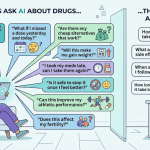
There’s a revealing pattern buried inside patient drug searches. People rarely begin with mechanism-of-action questions. They don’t open with receptor affinity or progression-free survival curves. They start somewhere much more practical:
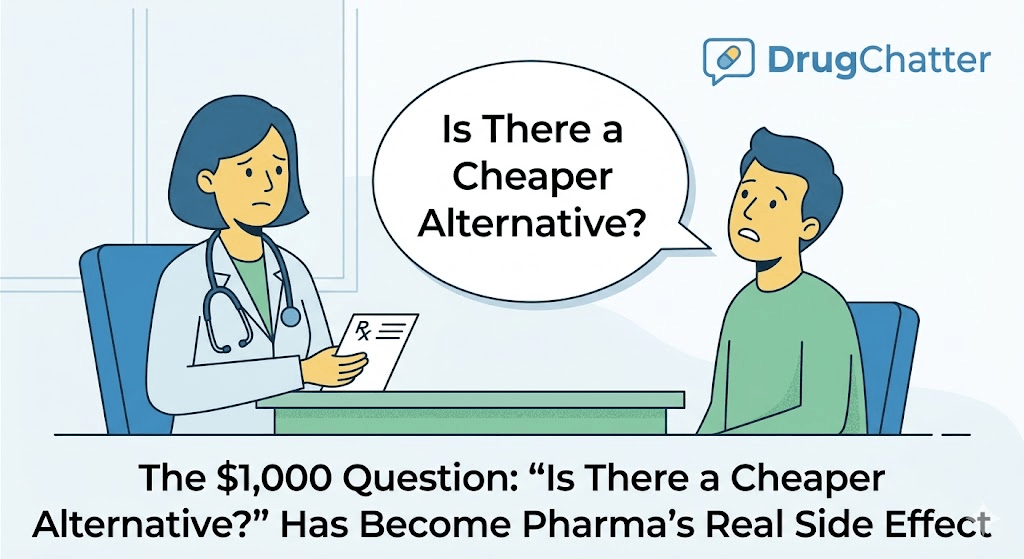
Can I afford this? Is there a generic? Can I substitute something cheaper? Can I combine this with what I already have?
Reading through hundreds of questions on DrugChatter feels less like browsing a medical FAQ and more like listening in on America’s pharmaceutical coping strategies.
And increasingly, the subtext is obvious: patients are trying to engineer around cost.
The interesting part is that they rarely ask directly. Instead, the “cheaper alternative” question mutates into several recognizable forms.
1. The Direct Generic Hunt
These are the cleanest examples — users explicitly trying to escape branded pricing gravity.
“Is there a generic version of entresto available?” — Answer here
“Is there a generic for ozempic expected soon?” — Answer here
“Are there generic alternatives available for uninsured individuals needing vascepa?” — Answer here
These questions appear constantly because the modern blockbuster drug market has created a strange split-screen reality. Patients know the drugs work. They just don’t know whether the monthly payment resembles a utility bill or a used Honda Civic.
The GLP-1 category may be the purest example. The clinical demand for Ozempic and related agents has outrun both supply chains and household budgets simultaneously.
Which leads to the second category.
2. The “Can Food or Supplements Do This Instead?” Economy
This is where pharmaceutical economics starts colliding with internet wellness culture.
Patients aren’t always looking for exact substitutes. Sometimes they’re looking for close enough.
“Can chia seeds match vascepa’s triglyceride lowering potency?” — Answer here
“Can i find yogurts with similar cholesterol lowering compounds to lipitor?” — Answer here
“Can natural remedies replace advil for pain relief?” — Answer here
“Can i take red yeast rice with my statin?” — Answer here
“What alternatives exist to advil for ulcer pain?” — Answer here
This is the consumer health market trying to reverse-engineer pharmacology with pantry ingredients.
Sometimes there’s partial logic to it. Red yeast rice, for example, genuinely contains statin-like compounds. Omega-3 foods do affect triglycerides. But what patients often discover is the same thing medicinal chemists learned decades ago: biology rewards potency, consistency, and dose control. Yogurt cultures are not a substitute for Lipitor.
Still, the search behavior matters because it signals something larger: people are actively building informal therapeutic ladders based on affordability.
3. The Coupon-and-Rebate Underground
Another major cluster revolves around gaming the reimbursement maze.
“How can i apply for vascepa copay assistance?” — Answer here
“Do i qualify for a vascepa patient assistance rebate?” — Answer here
“Are refills eligible for vascepa discount coupons?” — Answer here
“How much can insurance lower vascepa’s cost?” — Answer here
“How does insurance affect vascepa’s list price?” — Answer here
This is one of the odder realities of modern pharma: many patients now spend as much cognitive energy understanding copay infrastructure as they do understanding disease biology.
Entire therapeutic journeys now depend on whether a manufacturer savings card stacks with commercial insurance, whether a pharmacy benefit manager rejects a refill, or whether a deductible reset hits in January.
That’s no longer edge-case behavior. It’s mainstream navigation.
4. The “Can I Buy This Somewhere Else?” Migration
Some questions are essentially gray-market economics wearing a healthcare disguise.
“Are canadian pharmacies stocking vascepa?” — Answer here
This category tells you something important: patients increasingly think geographically about pricing.
Not therapeutically. Geographically.
The same molecule can move from “unaffordable specialty medicine” to “reasonable monthly expense” simply by crossing a border or routing through a different distribution channel.
That’s a remarkable state of affairs for an industry built on standardized chemistry.
5. The Side-Effect Substitution Market
Another huge category involves people trying to trade efficacy for tolerability.
“Are there stomach friendly aspirin alternatives?” — Answer here
“What new aspirin forms are gentler on the stomach?” — Answer here
“Are there safer alternatives to advil for asthmatic kids?” — Answer here
“Which prescription medications mimic aspirin’s anti clotting property?” — Answer here
This is classic medicine: every pharmacologic benefit arrives attached to a liabilities package.
Patients understand this intuitively. They may not know the cyclooxygenase pathway, but they absolutely understand stomach pain.
And so they search for compromise molecules.
6. The Biologic Comparison Olympics
Some of the most fascinating questions are really comparative-value analyses disguised as treatment questions.
“Is kesimpta better than ocrevus for ms?” — Answer here
“Is enbrel or humira better for rheumatoid arthritis?” — Answer here
“How does eliquis compare to warfarin?” — Answer here
“Is aristada more effective than oral risperidone?” — Answer here
This is where healthcare starts resembling consumer electronics. Patients are comparing feature sets, side-effect profiles, convenience, and cost simultaneously.
And honestly, that’s rational behavior.
A patient facing a four-figure biologic copay is effectively making a capital allocation decision.
What These Searches Really Reveal
The obvious interpretation is that drug prices are high. True, but incomplete.
The deeper point is that patients increasingly behave like procurement departments.
They compare vendors. They seek arbitrage. They optimize rebates. They substitute ingredients. They analyze insurance pathways. They search for near-equivalents.
That’s not how healthcare systems are supposed to function. But it is how high-friction markets behave.
And if you want a real-time picture of where pharmaceutical pressure points are emerging, don’t start with analyst calls or earnings decks.
Start with the search box.
Because somewhere between “Is there a generic for ozempic expected soon?” and “Can chia seeds match vascepa’s triglyceride lowering potency?” you can see patients trying to solve the economics of modern medicine in public.