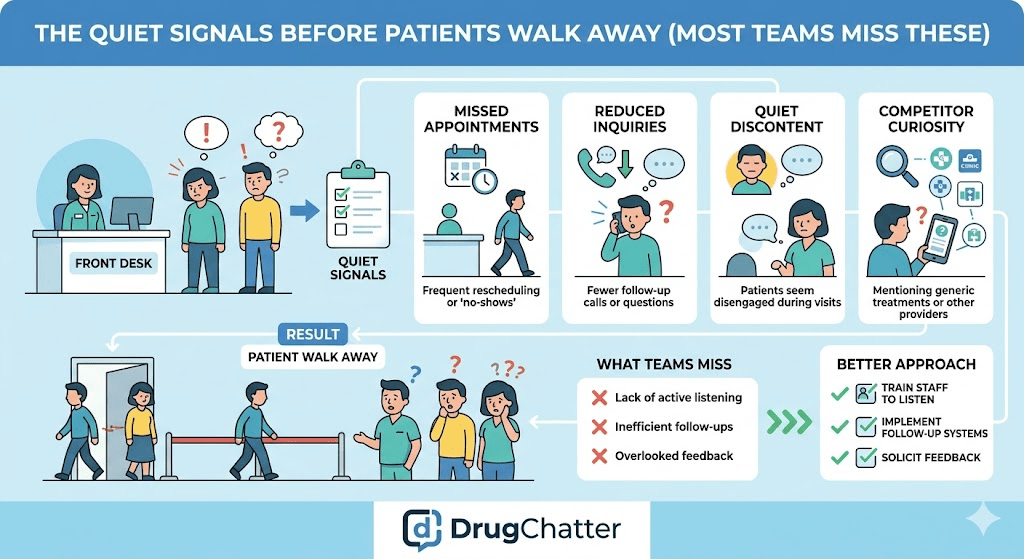
If you want to know when adherence breaks, don’t look at refill data. That’s the autopsy. The early signals show up weeks earlier—in the questions patients ask when something starts to feel “off.”
Read enough of them, and a pattern emerges. Not dramatic. Not explicit. But consistent.
1) “Can I mix this with…” → the interaction anxiety phase
It often starts here:
what are the risks of combining vascepa and probiotics: https://www.drugchatter.com/chat/13977/what-are-the-risks-of-combining-vascepa-and-probiotics
does vascepa affect other cholesterol lowering medications: https://www.drugchatter.com/chat/33016/does-vascepa-affect-other-cholesterol-lowering-medications
can i mix advil and aspirin: https://www.drugchatter.com/chat/5458/can-i-mix-advil-and-aspirin
This isn’t curiosity. It’s risk calibration. Patients are probing for hidden dangers—and when answers feel uncertain, discontinuation becomes the simplest “safe” option.
2) “Are these side effects normal?” → the doubt phase
Then come the symptoms:
does regular tylenol use lead to stomach problems: https://www.drugchatter.com/chat/57439/does-regular-tylenol-use-lead-to-stomach-problems
are there similar side effects between cosentyx and the flu shot: https://www.drugchatter.com/chat/52788/are-there-similar-side-effects-between-cosentyx-and-the-flu-shot
what are cosentyx s side effects with repeated use: https://www.drugchatter.com/chat/15350/what-are-cosentyx-s-side-effects-with-repeated-use
Notice the framing: not “I’m stopping,” but “is this expected?”
They’re looking for reassurance. If they don’t get it, they start experimenting—skipping doses, spacing them out.
3) “Do I need to adjust?” → self-management creep
Next, patients begin modifying therapy themselves:
how does cosentyx dosage change with increased side effects: https://www.drugchatter.com/chat/20972/how-does-cosentyx-dosage-change-with-increased-side-effects
does increased cosentyx dosage increase severity of side effects: https://www.drugchatter.com/chat/48124/does-increased-cosentyx-dosage-increase-severity-of-side-effects
do i need to adjust vascepa dosage with antidepressants: https://www.drugchatter.com/chat/23045/do-i-need-to-adjust-vascepa-dosage-with-antidepressants
This is a critical inflection point. Adherence hasn’t failed yet—but control has shifted from prescriber to patient.
4) “Is it worth it?” → value erosion
Now the tone changes:
how has vascepa impacted your overall well being: https://www.drugchatter.com/chat/15205/how-has-vascepa-impacted-your-overall-well-being
how effective is cosentyx for allergy treatment: https://www.drugchatter.com/chat/63237/how-effective-is-cosentyx-for-allergy-treatment
How effective is Lurbinectedin: https://www.drugchatter.com/chat/26776/how-effective-is-lurbinectedin
This is the quietest—and most dangerous—stage.
Patients are no longer asking “how to take it,” but “why take it at all?”
5) Cost and friction questions → the final nudge
Finally, the practical barriers surface:
How does insurance affect wegovy and ozempic copays?: https://www.drugchatter.com/chat/46795/how-does-insurance-affect-wegovy-and-ozempic-copays
any restrictions on vascepa savings program: https://www.drugchatter.com/chat/15548/any-restrictions-on-vascepa-savings-program
is there a notification system for advil purchases: https://www.drugchatter.com/chat/51438/is-there-a-notification-system-for-advil-purchases
At this point, adherence is hanging by a thread. Any friction—price, access, complexity—tips it.
What this means (and what most teams miss)
No one wakes up and decides to stop therapy.
They drift there—through uncertainty, unmanaged side effects, self-adjustment, and fading belief in benefit.
The key insight:
Adherence drop-off is not a single event. It’s a sequence of questions.
And those questions are visible—early—if you’re looking in the right place.
Ignore them, and you measure churn after it happens.
Track them, and you can intervene before the patient ever leaves.