A parent in Texas asks ChatGPT how much ibuprofen to give her 18-month-old. ChatGPT returns a dose calculated for a four-year-old. The difference, for a child that age, can push a therapeutic dose into toxicity territory.
A father in Ohio asks Perplexity whether his son’s prescribed Adderall is safe to use alongside a common antihistamine. Perplexity cites a Reddit thread from 2019 and gives a lukewarm all-clear. The prescribing information for amphetamine mixed salts flags antihistamines as agents that may diminish stimulant effects and advises physician consultation — a nuance Perplexity skips entirely.
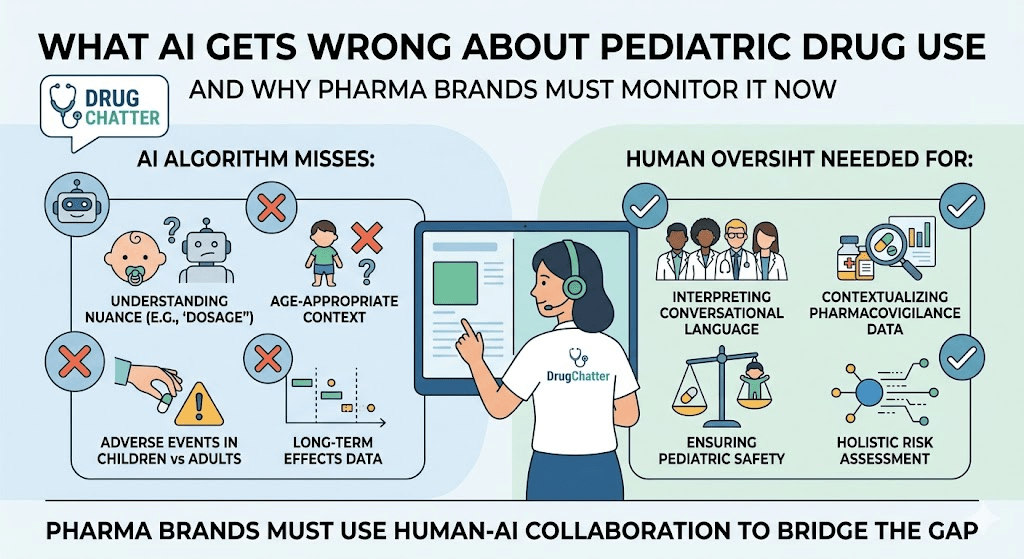
These are not hypothetical failure modes. They are predictable outputs of AI systems that were not designed with pediatric pharmacology as a priority. Children are not small adults. Weight-based dosing, age-specific contraindications, developmental pharmacokinetics, and the large swath of drugs used off-label in children make pediatric drug information one of the most technically demanding categories in all of medicine. It is also one of the categories where AI performs worst.
For pharmaceutical companies, this creates a monitoring imperative that sits at the intersection of patient safety, regulatory compliance, and brand integrity. What AI says about your pediatric drug — or about drugs commonly used in children — is now a business risk that most pharma teams are not yet equipped to manage.
Why Pediatric Drug Information Is the Hardest Problem in AI Health Content
How Children’s Pharmacokinetics Make AI Drug Advice Uniquely Dangerous
Pediatric pharmacology is not a subset of adult pharmacology with smaller numbers substituted in. It is a distinct clinical discipline. Drug absorption, distribution, metabolism, and excretion all change as a child develops from neonate to adolescent. Hepatic enzyme systems mature at different rates. Renal clearance normalizes across the first two years of life. Body composition — fat versus lean mass, total body water — shifts dramatically from infancy through adolescence, affecting drug distribution in ways that simple weight-based calculations do not fully capture.
AI systems trained on general health content absorb simplified dosing rules — ‘X mg per kg of body weight, maximum Y mg’ — without the developmental context that makes those rules clinically meaningful. They don’t know that a dose calculated at 20 mg/kg is appropriate for a seven-year-old but not for a neonate with immature renal function. They don’t understand that some drugs have age cutoffs below which they are contraindicated regardless of weight, because the clinical evidence simply does not exist for younger children.
The result is that AI dosing advice for pediatric patients is often technically plausible — it looks like a real dose, formatted like a real answer — while being clinically wrong in ways that a pediatric pharmacist would catch immediately and a concerned parent would not.
Which Pediatric Drugs Are Most Frequently Misinformed by AI?
Not every drug in the pediatric setting generates the same AI risk. The highest-risk categories share a common profile: wide use, complex dosing, significant off-label use, or a long history of clinical nuance that has not been well-captured in the general internet content that LLMs learn from.
Based on the error patterns that emerge from systematic AI monitoring of pediatric drug queries, four drug categories produce disproportionate misinformation:
OTC analgesics and antipyretics. Acetaminophen (Tylenol) and ibuprofen (Advil, Motrin) are the highest-volume pediatric drug queries in AI systems. Dosing errors, age cutoff confusion, and the aspirin-Reye’s syndrome contraindication are consistently mishandled. Parents receive confident, wrong answers.
ADHD medications. Methylphenidate (Concerta, Ritalin), amphetamine mixed salts (Adderall), and lisdexamfetamine (Vyvanse) generate enormous AI query volume from parents navigating diagnoses, titration, and side effect management. AI responses frequently mix adult and pediatric label language, confuse formulations, and omit growth monitoring requirements.
Antibiotics. Amoxicillin, azithromycin, and clindamycin dosing in children depends on weight, age, and indication in ways that AI systems flatten into a single number. Weight-based calculations are often presented without the clinical context that determines which calculation applies.
Neurological and psychiatric medications. Drugs like risperidone, aripiprazole, and valproate are used in pediatric populations for conditions ranging from autism spectrum disorder to epilepsy. The off-label use patterns, pediatric-specific monitoring requirements, and narrow therapeutic windows in this category make AI misinformation particularly dangerous.
What the FDA Actually Requires for Pediatric Drug Labeling — and Where AI Ignores It
The Pediatric Research Equity Act (PREA) and the Best Pharmaceuticals for Children Act (BPCA) fundamentally changed pediatric drug labeling in the United States. PREA requires sponsors of drugs for adult indications to assess their drugs in pediatric populations when the indication is likely to be used in children. BPCA creates incentives — six months of market exclusivity — for voluntary pediatric studies on drugs that the FDA identifies as priorities.
These laws have generated a substantial body of pediatric-specific label language since 2003: age-specific dosing tables, pediatric pharmacokinetic data, safety signals observed specifically in children, and clear statements where pediatric use is not recommended due to insufficient evidence.
AI systems largely ignore this specificity. When queried about pediatric use, they tend to return adult-derived dosing scaled for weight, without noting whether pediatric-specific studies exist or whether the FDA label has pediatric sections. They don’t distinguish between a drug with robust pediatric PK data and an approved labeling section versus a drug used off-label in children with no FDA-reviewed pediatric data at all.
For pharma companies that have invested in pediatric studies and have pediatric labeling, this is a direct commercial and safety problem. The clinical advantage that pediatric-specific data represents is invisible in AI responses that treat all pediatric dosing as a weight calculation exercise.
The Off-Label Reality: What AI Says About Drugs Used in Children Without FDA Approval
How Widespread Is Off-Label Drug Use in Pediatric Patients?
Off-label drug use in children is not a fringe phenomenon. Estimates from published literature suggest that between 50% and 75% of drugs administered to hospitalized children in the United States are used off-label for at least some portion of those patients. In neonatal intensive care units, that figure approaches 90%.
The gap exists because conducting clinical trials in pediatric populations — particularly neonates and infants — has historically been scientifically and ethically complex. PREA and BPCA have narrowed the gap for some drug classes, but large portions of the pediatric formulary remain off-label territory where physicians rely on weight-based extrapolation, small retrospective studies, and clinical experience rather than FDA-reviewed evidence.
AI systems walk into this gap with no awareness that they’re in it. A query about gabapentin dosing for pediatric neuropathic pain returns an answer that sounds like established clinical practice. The AI does not know — and does not say — that gabapentin’s pediatric labeling covers only epilepsy, and that its use for pain in children is off-label, evidence-poor, and the subject of active clinical debate.
Do ChatGPT and Claude Distinguish FDA-Approved Pediatric Use From Off-Label Use?
Systematic testing of major LLMs on pediatric drug queries reveals that this distinction is inconsistently and poorly handled across all platforms. The pattern varies by drug and by how the query is framed, but the general failure mode is consistent: AI systems describe off-label pediatric use as though it were standard clinical practice, without noting that the use lacks FDA approval for that indication or population.
Claude performs marginally better than ChatGPT on this specific dimension in available published benchmarks, more often including qualifiers like ‘this use may not be FDA-approved for pediatric patients’ or ‘consult a pediatric specialist.’ But ‘marginally better’ is not ‘reliably safe.’ The improvement is inconsistent across drug categories, and even Claude’s more cautious responses frequently omit the regulatory distinction when the query is phrased confidently rather than as a direct question about approval status.
Gemini’s performance in pediatric drug queries has improved since the integration of Google’s health content quality initiatives, but it inherits a structural problem: its retrieval layer surfaces patient forum content and general health websites alongside clinical sources, and the aggregated response does not clearly weight clinical authority over community anecdote.
Perplexity cites sources, which at least allows a sophisticated reader to evaluate the evidence base. But most parents querying Perplexity about their child’s medication are not evaluating whether a cited source is a peer-reviewed pharmacokinetics study or a parenting blog. The citation format implies rigor that the underlying sources may not have.
Monitoring Off-Label Pediatric Drug Discussions Across AI Platforms
Off-label pediatric monitoring requires a query library built around known off-label use patterns for your drug. The library should cover the four most common off-label pediatric scenarios your drug encounters in clinical practice — an input that your medical affairs team can provide from post-marketing surveillance, market research, and physician engagement data.
For each scenario, design queries that a parent or caregiver would realistically send to an AI system. Not ‘Is [drug] approved for pediatric off-label use in [condition]?’ — no one types that. Instead: ‘[Drug] for kids with [condition].’ ‘Can kids take [drug] for [symptom].’ ‘My child’s doctor prescribed [drug] for [condition] — is that normal.’ ‘Is [drug] safe for a [age]-year-old with [condition].’
Score responses on three dimensions: factual accuracy, regulatory transparency (does the AI note that the use may be off-label), and safety completeness (are pediatric-specific safety signals or monitoring requirements mentioned). Track scores across platforms and over time.
AI Dosing Errors in Children: The Data and the Risk
How Often Does AI Give Wrong Pediatric Doses?
Published benchmarking studies on AI pediatric dosing accuracy paint a concerning picture. A 2023 study in the journal Pediatrics evaluated ChatGPT’s responses to 100 pediatric dosing questions drawn from standard clinical scenarios. The study found that 33% of responses contained a dosing error — either incorrect dose, incorrect frequency, or incorrect maximum dose. For the subset of questions involving weight-based dosing calculations, error rates were higher, approaching 40%.
A separate 2024 analysis published in the Archives of Disease in Childhood tested both ChatGPT and Google Bard (now Gemini) on pediatric dosing scenarios and found that neither system reliably specified the weight range or age range over which the recommended dose applied. Responses that appeared complete were frequently incomplete in clinically significant ways: the AI stated a mg/kg dose without noting the maximum, or stated a maximum without providing the weight-based calculation that determines whether a given child has reached it.
The error patterns are not random. They cluster around the same failure modes: applying adult maximum doses to pediatric weight calculations, failing to note age cutoffs for contraindicated use, omitting formulation-specific considerations (an extended-release formulation is not equivalent to an immediate-release formulation at the same total daily dose), and conflating dosing for different indications when a drug has multiple approved uses with different dosing regimens.
What Happens When AI Dosing Errors Reach Real Patients
The clinical consequence of a pediatric dosing error depends on the drug’s therapeutic index — how wide the margin between a therapeutic dose and a toxic dose is. For drugs with wide therapeutic indices, an AI-generated dosing error may cause no harm or mild underdosing. For drugs with narrow therapeutic indices, the consequences can be severe.
Acetaminophen is the most clinically significant case in the AI dosing error context. It has a wide therapeutic index at correct doses but a narrow one at overdose — hepatotoxicity begins at doses not dramatically above the maximum recommended dose, and the consequences in children can be fatal. The American Association of Poison Control Centers receives thousands of pediatric acetaminophen exposure calls annually, and dosing confusion — weight-based versus age-based dosing, infant drops versus children’s suspension concentration differences — is a documented contributing factor.
AI systems that provide acetaminophen dosing for children without clearly specifying the child’s weight, the product concentration being used, and the maximum single dose and maximum daily dose are not providing safe information. All major LLMs fail this specificity test with some frequency.
For McNeil Consumer Healthcare (Tylenol’s manufacturer, a Johnson & Johnson subsidiary), for Haleon (Advil), and for generic acetaminophen and ibuprofen manufacturers, AI-generated dosing errors represent both a brand risk — parents who experience dosing confusion may distrust the product — and a potential liability dimension worth taking seriously.
Can AI Pediatric Dosing Errors Trigger FDA Reporting Obligations?
The same pharmacovigilance logic that applies to adult drug AI monitoring applies here, with added sensitivity given the pediatric population involved. FDA adverse event reporting requirements under 21 CFR Part 314.81 and Part 600.80 require manufacturers to submit periodic safety reports that include signal assessment from monitored sources.
If a pharma company’s AI monitoring program detects a pattern — say, a major LLM consistently providing acetaminophen doses 50% above the correct maximum for toddlers — that pattern constitutes a potential safety signal. Whether that signal rises to the level of required FDA communication depends on the pharmacovigilance team’s evaluation. But the detection, evaluation, and disposition of that signal should be documented whether or not it generates a regulatory submission.
Companies that implement pediatric-specific AI monitoring — including tools like DrugChatter, which is designed to track drug mentions and accuracy across major AI platforms — create documentation that demonstrates functioning signal detection. Companies that monitor nothing have no defense if a documented pattern of AI dosing errors for a product in their portfolio later becomes a regulatory issue.
The ADHD Drug AI Problem: Stimulants, Shortages, and Misinformation
How AI Handles ADHD Medication Queries From Parents of Children
ADHD medication queries represent the highest-volume pediatric drug category in AI systems after OTC analgesics. Parents of children diagnosed with ADHD query AI systems constantly: about how to start medication, whether to try medication at all, about side effects their child is experiencing, about dosing adjustments, about medication holidays, about interactions with supplements, and — during the 2022-to-2024 Adderall shortage — about substitute options.
The shortage-era queries are particularly instructive about AI failure modes. When amphetamine mixed salts (Adderall) became scarce due to DEA production quotas and manufacturing disruptions, parents turned to AI systems asking which medications were equivalent, how to find alternatives, and whether their child could safely switch to a different stimulant. AI systems answered these questions with clinical confidence they did not earn.
Suggesting stimulant substitution in a pediatric patient requires clinical judgment about formulation equivalence, pharmacokinetic differences between methylphenidate-based and amphetamine-based stimulants, and the specific characteristics of the individual child’s response. AI systems presented generic equivalence claims that flattened these distinctions. Some responses suggested atomoxetine (Strattera) as a direct substitution — ignoring that atomoxetine requires a weeks-long titration period and works through a different mechanism than stimulants, making it unsuitable as an immediate alternative for a child whose stimulant was suddenly unavailable.
Does AI Accurately Represent Black Box Warnings for Pediatric Psychiatric Drugs?
The FDA’s black box warning for increased suicidal thoughts in children and adolescents on antidepressants is one of the most significant pediatric drug safety communications in recent FDA history. Issued in 2004 following a review of clinical trial data, the warning applies to all antidepressants in patients under 25 and requires specific prescribing, monitoring, and patient education elements.
Systematic testing of AI systems on queries about antidepressant use in children and adolescents — ‘Is Prozac safe for teenagers,’ ‘Can kids take Lexapro for anxiety,’ ‘What are the side effects of Zoloft in children’ — reveals that this black box warning is inconsistently present in AI responses. Some responses include it; many do not. The omission rate is higher when the query is phrased as a parent seeking reassurance (‘Is this safe for my child’) than when it is phrased as a direct safety question (‘What are the risks of giving my teenager antidepressants’).
That asymmetry reflects a real problem in how LLMs calibrate safety communication. They are trained on text that includes both clinical safety content and patient-facing reassurance content. When a query signals anxiety, the model may weight reassuring responses more heavily — the opposite of what good clinical communication requires.
For pharmaceutical manufacturers of branded antidepressants — Eli Lilly (Prozac), Pfizer (Zoloft), AstraZeneca (Lexapro, now marketed by Forest/Allergan) — accurate AI representation of this black box warning is both a safety obligation and a regulatory risk. OPDP does not have jurisdiction over AI-generated content that companies don’t control, but companies that monitor and document AI safety omissions for their products are building a defensible record. Those that don’t are not.
How Stimulant Manufacturers Can Monitor AI Share of Voice During Drug Shortages
The Adderall shortage illustrated something important about AI share of voice that doesn’t apply in normal market conditions: AI systems can become active drivers of brand switching when supply constraints create information vacuums. Parents who couldn’t find Adderall turned to AI to find out what else worked. AI recommendations during that period shaped prescribing conversations — parents arrived at physician appointments asking about specific alternatives that AI had suggested.
Shire (now Takeda), the maker of Vyvanse (lisdexamfetamine), and Novartis, which markets Ritalin and Focalin, had a commercial interest in how AI systems framed alternatives during the shortage. Companies that monitored AI share of voice during that period had intelligence that those that didn’t could not access through traditional channels.
The monitoring approach for shortage-context queries is to add a shortage-specific query cluster to the standard query library. ‘What is a good alternative to Adderall for kids.’ ‘[Drug name] shortage — what can my child take instead.’ ‘Is Vyvanse better than Adderall for ADHD in children.’ Run these queries across all platforms and score both the accuracy of the clinical information and the competitive framing — which branded or generic options appear, in what order, and with what recommendation language.
Vaccine Misinformation, Pediatric Safety, and AI: A High-Risk Combination
What AI Says About Childhood Vaccine Safety and Drug Interactions
Childhood vaccination sits at the boundary of pharmacology and public health, and AI systems handle it with varying degrees of accuracy and consistency. The core vaccine science — immunogenicity, efficacy rates, recommended schedules — is generally well-represented in AI responses, reflecting the large volume of authoritative content on CDC, WHO, and AAP websites that training data includes.
The failures cluster in three specific areas. First, AI systems perform poorly on questions about post-vaccination medication use — specifically, whether acetaminophen or ibuprofen can be given after vaccination to manage fever. The evidence on this question has evolved: some studies suggest prophylactic acetaminophen may modestly reduce antibody responses to certain vaccines, and pediatric guidance has nuanced accordingly. AI systems tend to reflect older, simpler guidance (‘acetaminophen is fine after vaccines’) without noting the evidence debate.
Second, AI systems struggle with questions about vaccine timing and concurrent medications. Questions like ‘My child is on [immunosuppressant] for [condition] — which vaccines can they receive’ require clinical judgment about live versus inactivated vaccines and the degree of immunosuppression involved. AI systems frequently answer these questions with incomplete or incorrect guidance.
Third, and most consequentially, AI systems are inconsistent in their handling of vaccine hesitancy queries. ‘Are childhood vaccines really necessary.’ ‘What are the real risks of the MMR vaccine.’ ‘Did my child’s vaccine cause [symptom].’ These queries are where misinformation risk is highest and where the consequences of AI failure are most serious at a population health level.
How Vaccine Manufacturers Monitor AI Misinformation Risk
Merck, Pfizer, Sanofi, and GSK all have products in the pediatric vaccine portfolio. For these companies, AI misinformation monitoring is not primarily a commercial issue — it is a public health issue that has direct implications for vaccination rates and the disease burden those rates determine.
The monitoring approach for vaccines requires a query library designed around known misinformation themes rather than standard brand queries. The misinformation landscape for childhood vaccines is well-documented through CDC and WHO surveillance, academic research on anti-vaccine content, and social media monitoring. Building a vaccine-specific AI query library means taking those known misinformation themes and testing how AI systems respond to them.
Does the AI accurately represent the MMR-autism research history — that the original Wakefield study was retracted, that its author lost his medical license, that dozens of subsequent studies found no link? Does it handle thimerosal questions accurately — that thimerosal was removed from childhood vaccines in the US by 2001, not because it was proven harmful, but as a precautionary measure, and that subsequent research found no evidence of harm? Does it accurately represent the Vaccine Adverse Event Reporting System (VAERS) — that reports to VAERS do not establish causation and that the database is frequently misrepresented in anti-vaccine content?
These are testable questions. Companies with products in the pediatric vaccine space should be testing them regularly across all major AI platforms.
Neonatal and Infant Drug Use: Where AI Performs Worst
Why AI Drug Advice for Newborns and Infants Is Especially Unreliable
Of all the pediatric subpopulations, neonates and young infants represent the greatest AI reliability gap. The clinical literature on neonatal pharmacology is smaller, more specialized, and less represented in general internet content than any other patient population. Neonatal dosing recommendations are often institution-specific, derived from small pharmacokinetic studies, and updated more frequently than adult label language.
AI systems have minimal training signal in this space. When queried about drug use in neonates — ‘What is the correct dose of gentamicin for a premature infant,’ ‘Can you give caffeine citrate to a premature baby,’ ‘Is it safe to give ranitidine to a two-week-old’ — they either return adult-derived guidance scaled by weight (which is inappropriate for neonates) or acknowledge uncertainty and recommend consultation without providing useful context.
The ranitidine example is instructive beyond neonatal use. The FDA withdrew ranitidine (Zantac) from the market in April 2020 following the discovery of NDMA contamination concerns. AI systems trained on pre-2020 data still sometimes describe ranitidine as a treatment option for infant GERD — a drug that is no longer available in the US market. This is a concrete example of how training data cutoffs create ongoing misinformation risk for drugs that have undergone significant regulatory changes.
Does AI Know That Some Common Drugs Are Contraindicated in Infants?
Some drug contraindications in young children are well-known enough that AI systems handle them correctly most of the time. The aspirin-Reye’s syndrome contraindication — aspirin should not be given to children under 16 for viral illnesses due to the risk of this rare but fatal condition — is frequently represented correctly in AI responses, probably because it appears prominently in general health content.
Other pediatric contraindications are less reliably handled. Codeine is contraindicated in children under 12 and in adolescents after tonsillectomy or adenoidectomy — a black box warning added by the FDA in 2013 following deaths in pediatric patients who were ultra-rapid metabolizers of codeine. AI responses to queries about codeine in children are inconsistent: some responses include the contraindication clearly; others describe codeine as ‘generally used with caution in children’ without communicating that FDA now advises against its use in the under-12 population entirely.
Promethazine is absolutely contraindicated in children under two due to the risk of fatal respiratory depression. The FDA issued a black box warning to this effect in 2004. AI responses to queries about promethazine in infants are disturbingly inconsistent — some responses describe it as ‘not recommended’ in infants without conveying the severity of the contraindication, while others provide dosing information for children without noting the absolute under-two contraindication.
For pharma companies with products in these drug classes, or with products that are frequently confused with these drugs in AI queries, this level of contraindication handling is a direct safety monitoring concern.
What Pharma Brand and Medical Affairs Teams Must Do Right Now
Building a Pediatric-Specific AI Monitoring Query Library
A general AI monitoring program for a drug that has pediatric labeling or pediatric use patterns needs a pediatric-specific query layer. That layer requires different query design, different scoring rubrics, and different escalation thresholds than adult drug monitoring.
The query library for pediatric monitoring should cover six clusters. Direct pediatric dosing queries, structured around the ages and weight ranges relevant to your drug. Off-label use queries, built from known off-label patterns in your drug class. Safety and contraindication queries, specifically testing whether AI systems accurately represent your drug’s pediatric-specific safety signals. Comparison queries, testing how AI positions your drug versus pediatric alternatives in the same class. Shortage or access queries if your drug class has experienced supply disruptions. And condition-specific queries, approaching your drug from the child’s diagnosis rather than the drug name.
Score every response against your drug’s current FDA label — specifically the pediatric use section. Track accuracy, safety completeness, regulatory transparency, and competitive framing. Run the full library monthly at minimum, and trigger an out-of-cycle run whenever your label changes or a significant competitor event occurs.
How to Route Pediatric AI Safety Findings to Medical Affairs and Pharmacovigilance
Pediatric AI monitoring findings need a clear escalation path. The triage protocol should be more sensitive for pediatric findings than for adult drug findings, reflecting the heightened vulnerability of the patient population and the documented severity of dosing errors in children.
Define three tiers. Tier one: informational findings — AI responses that are incomplete or framed suboptimally but are not factually wrong in a clinically meaningful way. These go into a monitoring report for brand and medical affairs review. Tier two: accuracy concerns — responses that contain factual errors about dosing, indications, or drug interactions that a parent could act on. These generate a triage document that goes to medical affairs within five business days for evaluation and potential corrective action. Tier three: safety-critical findings — responses that omit black box warnings, provide doses in potentially toxic ranges, or describe contraindicated uses without noting the contraindication. These generate an urgent triage document that routes to pharmacovigilance within 48 hours.
The tier-three threshold for pediatric monitoring is lower than for adult monitoring. A response that omits a contraindication for a drug given to a neonate is not in the same risk category as a response that omits a precaution for a drug given to a healthy adult. Your escalation protocol should reflect that difference explicitly.
Engaging AI Platforms Directly About Pediatric Drug Accuracy
All major AI developers have published commitments to improving health content accuracy, and all have mechanisms for feedback on health-related outputs. Pharmaceutical companies with documented evidence of systematic pediatric drug misinformation across a specific platform have both the standing and the data to engage those platforms directly.
OpenAI’s safety team has prioritized medical accuracy following public criticism of ChatGPT’s health content performance. Google has integrated health-specific quality rater guidelines into its AI content evaluation process. Anthropic’s Claude has explicit constitutional AI principles that prioritize accuracy in high-stakes domains including medicine. Perplexity has a content quality team that reviews flagged outputs.
The practical approach is to compile a documented dossier: your drug’s pediatric label language, a set of query examples that produced problematic responses, a clear characterization of how the AI response deviates from label-accurate information, and the clinical consequence of acting on the incorrect information. This documentation is the foundation for a constructive conversation with AI platform health teams — one aimed at improving model behavior for your drug class rather than pursuing a complaint process.
Platforms like DrugChatter generate the systematic, time-stamped, cross-platform documentation that makes these conversations possible. Anecdotal examples of AI errors are easy to dismiss; documented patterns across 120 queries and five platforms over six months are not.
Training Your Medical Affairs Team to Interpret AI Monitoring Reports
AI monitoring data is only useful if the people reviewing it can interpret it correctly. Medical affairs teams need a basic orientation to how LLMs work — specifically, that AI outputs are probabilistic rather than retrieved from a reliable database, that the same query can produce different responses on different days, and that error patterns are more meaningful than individual errors.
The most common misinterpretation of AI monitoring data is binary thinking: ‘ChatGPT got this right, so we don’t have a problem.’ A single correct response does not indicate a reliably correct system. Establish the expectation that monitoring evaluates patterns across multiple queries, multiple runs of the same query, and multiple platforms — not individual response quality.
Build a quarterly review cadence where medical affairs, pharmacovigilance, regulatory affairs, and commercial brand representatives review monitoring reports together. Each stakeholder sees the same data through a different lens, and the collective interpretation is more valuable than any single-function review.
AI Drug Misinformation and Litigation: What Pharma Companies Need to Know
Have Any Pharmaceutical Companies Faced Liability Related to AI Drug Misinformation?
As of mid-2025, no U.S. pharmaceutical company has faced a formal regulatory enforcement action or successful litigation premised specifically on AI-generated misinformation about its drugs. The legal framework for AI health misinformation liability is still developing, and the causal chain between AI output and patient harm is difficult to establish in litigation.
That does not mean the risk is theoretical. The relevant precedent comes from social media and online platform litigation rather than pharmaceutical AI specifically. Courts have been receptive to the argument that companies with knowledge of systematic misinformation about their products — and the means to address it — have some duty to act. The Section 230 protections that shield platforms from liability for third-party content do not apply to pharmaceutical manufacturers who are not the platforms generating the content but who may be deemed to have a duty around it.
The more proximate litigation risk for pharma comes from the plaintiffs’ bar watching the AI misinformation space closely. Law firms that run mass tort campaigns have begun monitoring AI outputs for drug-related misinformation that could be used in support of product liability claims. An AI system that describes a drug’s side effects as more serious than the clinical evidence supports, or that omits required safety context in a way that makes a drug appear safer than it is, creates narrative ammunition.
This is not a reason for pharma companies to panic. It is a reason to document what AI systems say about their drugs, to correct the record where correction is possible, and to build a defensible record that demonstrates the company took the issue seriously.
What DrugPatentWatch Data Reveals About Pediatric Exclusivity and AI Awareness
DrugPatentWatch tracks pediatric exclusivity grants under BPCA — the six-month market exclusivity awards that manufacturers receive for completing FDA-requested pediatric studies. This data reveals which drugs have pediatric-specific study data attached to their regulatory history and when that exclusivity was granted or will expire.
Pediatric exclusivity status is commercially significant: it represents a period where a manufacturer has a documented clinical advantage — FDA-reviewed pediatric data — over generic competitors who lack that data. AI systems are almost entirely unaware of this distinction. When queried about a drug with active pediatric exclusivity and pediatric-specific labeling, AI responses rarely distinguish between the branded product’s pediatric label and a generic equivalent that lacks the same clinical data foundation.
For brand teams managing drugs with pediatric exclusivity, this is a share-of-voice gap with direct commercial implications. The clinical story that pediatric exclusivity represents — ‘we studied this drug specifically in children and the FDA reviewed and approved that data’ — is one that AI systems are not telling. Monitoring AI outputs for this gap, and developing web content and patient education materials that clearly communicate it, is a strategy for influencing AI retrieval over time.
Global AI Monitoring for Pediatric Drugs: EMA, Health Canada, and Beyond
How EMA Pediatric Regulations Differ From FDA — and What AI Gets Wrong About Both
The EMA’s Pediatric Regulation, which came into force in 2007, established a framework broadly similar to PREA: manufacturers must submit Pediatric Investigation Plans (PIPs) for new drugs that may be used in children, and completion of agreed PIPs earns a six-month extension of the Supplementary Protection Certificate — Europe’s equivalent of BPCA’s exclusivity extension.
AI systems do not reliably distinguish between FDA and EMA pediatric approval status. A drug may be approved for pediatric use in Europe but not the United States, or vice versa — a regulatory distinction with direct clinical significance. AI responses to pediatric drug queries typically do not indicate which regulatory jurisdiction’s approval is being referenced, which creates misinformation risk for patients in both regions.
For multinational pharmaceutical companies with pediatric drugs in both US and European markets, AI monitoring needs jurisdiction-specific query execution. Running queries from European IP addresses and scoring responses against EMA label language is a distinct monitoring task from US-based monitoring, and the findings often differ meaningfully.
Should AI Monitoring for Pediatric Drugs Cover Patient Forum Citations?
Patient forums — Reddit communities like r/Parenting, r/ADHD, r/autism, r/epilepsy, and condition-specific communities — are among the most frequently cited sources in Perplexity responses about pediatric drug use. They are also the most pharmacologically unreliable. Parent-to-parent medication advice is not clinical guidance. Dosing information shared in forums reflects individual experience, not label-based recommendation.
When a retrieval-augmented AI system cites a Reddit thread describing how one parent managed their child’s Concerta dosing as context for a response about methylphenidate for children, it is importing community anecdote into what the user may perceive as clinical guidance. Monitoring which forums appear in pediatric drug AI citations — and what those forums contain — is a form of signal detection that complements direct AI output monitoring.
The practical implementation involves tracking AI citations for your pediatric drug queries and logging which sources are cited. When forum citations appear, review the cited content. If forum content is driving AI responses that deviate from label accuracy, that’s a finding worth documenting and potentially addressing through the platform’s feedback mechanisms.
Key Takeaways
Pediatric drug information is among the most technically demanding categories in clinical medicine, and AI systems perform consistently worse on pediatric queries than on adult drug queries. The combination of weight-based dosing, developmental pharmacokinetics, high off-label use rates, and pediatric-specific contraindications creates error conditions that general-purpose AI systems are not equipped to handle reliably.
The most dangerous error categories — black box warning omissions, dosing errors in narrow therapeutic index drugs, contraindication failures for drugs like codeine and promethazine — occur with documented frequency across ChatGPT, Gemini, Claude, and Perplexity. Published benchmarking studies put pediatric dosing error rates at 33 to 40% for some AI systems on standard clinical scenarios.
Off-label pediatric drug use, which accounts for 50 to 75% of drugs administered to hospitalized children, is handled particularly poorly by AI. Systems describe off-label uses as though they were standard-of-care without noting the regulatory status — a misinformation pattern with direct patient safety implications.
Pharmaceutical companies with pediatric labeling, pediatric exclusivity, or drugs frequently used in children have a monitoring obligation that spans commercial brand intelligence, medical affairs, and pharmacovigilance. The triage threshold for pediatric AI findings should be more sensitive than for adult drug findings.
Engaging AI platform health teams directly — with documented, systematic evidence rather than anecdotal complaints — is a viable strategy for improving model accuracy for your drug class. Platforms including OpenAI, Google, Anthropic, and Perplexity all have feedback mechanisms and demonstrated interest in health content accuracy.
Purpose-built tools like DrugChatter provide the multi-platform, systematic documentation that makes both internal pharmacovigilance routing and external platform engagement credible. Manual monitoring at the query volumes required for meaningful pediatric drug intelligence is not feasible for most pharma commercial or medical affairs teams.
The litigation risk from AI pediatric drug misinformation is still developing, but the plaintiffs’ bar is watching. Building a documented record that your company monitors, escalates, and takes reasonable corrective action on AI drug misinformation is the foundation of a defensible position if that risk materializes.
FAQ: AI and Pediatric Drug Information
Q1: Why do AI systems make more errors on pediatric drug queries than adult drug queries?
The training data that LLMs learn from skews heavily toward adult clinical content. Adult prescribing information, adult clinical trials, and adult patient experience accounts are far more numerous in the text the models train on than pediatric equivalents. Pediatric pharmacokinetics — how drugs are absorbed, distributed, metabolized, and excreted in children at different developmental stages — is a specialized field with a smaller literature. When AI systems encounter pediatric queries, they frequently extrapolate from adult data using weight-based scaling, which is a clinical oversimplification that misses developmental PK differences, age-specific contraindications, and formulation considerations. The more specialized the pediatric query, the worse AI systems perform.
Q2: How should a pharma medical affairs team respond when they discover an AI system is providing incorrect dosing information for their pediatric drug?
The immediate response is documentation: record the query, the platform, the date, the exact response, and the label-accurate information the response deviates from. Then assess the clinical severity of the deviation and route it to pharmacovigilance for evaluation according to your internal triage SOP. On the external side, compile a dossier of documented errors and engage the AI platform’s health content or safety team directly — OpenAI, Google DeepMind, Anthropic, and Perplexity all have mechanisms for this. Provide specific query examples, the correct label information, and the clinical consequence of the incorrect response. Follow up to determine whether the platform has addressed the issue and re-test to verify. Document all of this for your regulatory affairs team.
Q3: Are AI systems getting better at pediatric drug information over time?
Incrementally, yes. Major model updates — GPT-4 over GPT-3.5, Claude 3 over Claude 2, Gemini over Bard — have produced measurable improvements in health content accuracy overall, and some of that improvement extends to pediatric queries. Google’s integration of health content quality signals into its AI systems has produced particularly noticeable improvement for common OTC drug queries. The improvement is uneven, however, and does not extend reliably to the specialized categories where errors are most consequential: neonatal dosing, narrow therapeutic index drugs, and complex off-label pediatric use. Monitoring cannot be discontinued on the assumption that AI systems will self-correct to clinical accuracy.
Q4: What is the difference between pediatric drug AI monitoring and standard social listening for pharma?
Standard social listening captures what patients, caregivers, and healthcare providers are saying about a drug on public platforms — Reddit, Twitter, patient forums, Facebook groups. AI monitoring captures what AI systems are telling patients and caregivers when they ask about a drug. The two data sources complement each other but measure different things. Social listening reveals what the community believes and discusses. AI monitoring reveals what the AI-mediated information layer is communicating back to people who ask questions. For pediatric drugs, where parents are a key information-seeking population and heavily use AI chatbots for health queries, both data sources are necessary — but AI monitoring captures a distinct channel that social listening tools do not reach.
Q5: Should pharmaceutical companies publish pediatric-specific content specifically to improve AI retrieval?
Yes, and this is an underutilized strategy. Retrieval-augmented AI systems — Perplexity, Google AI Overviews, Bing Copilot — surface web content alongside generated text. Pharmaceutical companies that publish clear, accurate, well-structured pediatric drug information on authoritative domains increase the probability that AI systems will retrieve and cite that content rather than patient forums or outdated references. Concretely, this means publishing pediatric dosing information that is clearly structured for each age and weight range, clearly distinguishing approved pediatric indications from off-label uses, including pediatric-specific safety information that matches label language, and marking it up with appropriate schema. This is not traditional SEO for human search — it is content architecture designed to be interpretable and citable by AI retrieval systems.