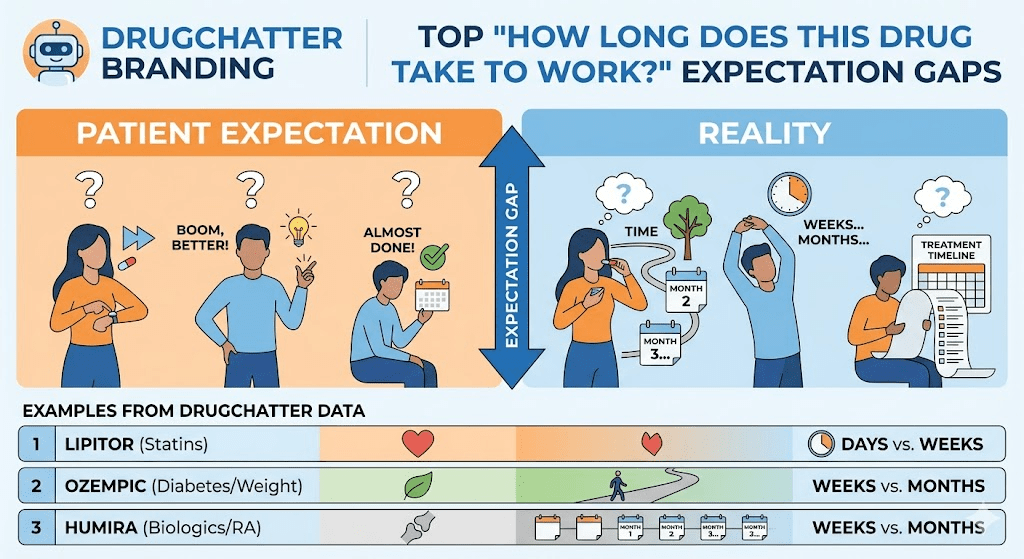
There’s a particular kind of disappointment that shows up in clinics and pharmacies: the patient (or caregiver) expects a drug to feel like a switch—on, off, done. But biology rarely cooperates. The result is a set of recurring expectation gaps: “How long does this drug take to work?” turns into “Why isn’t it working yet?”—even when the drug is doing exactly what it’s supposed to do.
Below are the biggest timing-related misunderstandings, stitched together from real-world questions about everything from cholesterol drugs to pain relievers to cancer therapies. The theme is consistent: onset is not the same thing as effect, and effect is not the same thing as outcome.
1) “If it’s prescribed, it should work immediately.” (It often won’t.)
Some medications are designed for rapid symptom relief; others are designed to change a slow-moving system. When people ask about timelines—especially for cholesterol lowering—the answer is usually measured in weeks, not minutes.
Expectation gap: waiting for a “feeling” that doesn’t exist, then concluding the prescription failed.
2) “I started it—so why am I still dealing with the problem?” (Because the target moves slowly.)
Even when a drug begins working right away at the biochemical level, the clinical endpoint can lag. Cholesterol is a classic example: the body’s lipid pools and downstream risk processes don’t update on the same schedule as a pill dissolving in your stomach.
- How does diet impact lipitor’s cholesterol lowering ability?
- Is low fat diet necessary for lipitor’s optimal effectiveness?
- Is lipitor’s potency affected by high fiber intake?
Expectation gap: assuming the drug’s timeline is fixed and universal, when diet and absorption can shift the pace.
3) “Food and drinks should be neutral.” (They’re not always.)
Sometimes the question isn’t about how long it takes—it’s about whether the drug’s effect is delayed, blunted, or altered by what you consume.
- Can grapefruit consumption affect lipitor’s efficacy?
- Does lemonade affect lipitor’s effectiveness or side effects?
- Does lemonade affect lipitor’s effectiveness or side effects?
- Any side effects when mixing lipitor and orange juice?
- Does lipitor’s effectiveness get affected by aspirin?
Expectation gap: treating “take it with food” as a single instruction, when the details can matter.
4) “If I take it, it should kick in right away.” (Pain meds are a different category.)
For symptom relief, people often want a predictable onset. But even here, “maximum relief” and “first relief” are different points on the curve.
- What’s the typical onset time for advil’s maximum relief?
- Can alcohol reduce advil’s effectiveness as a painkiller?
- Is there a link between alcohol and advil induced ulcers?
- How long should i wait after taking advil to take my prescription medication?
Expectation gap: assuming the drug will behave like a fast-acting “rescue” every time, regardless of timing, interactions, and individual factors.
5) “Combining things won’t change the clock.” (Interactions can shift timing and intensity.)
Sometimes the drug works, but the interaction changes how much effect you get—or how quickly you notice it.
- Does concurrent ibuprofen use reduce lipitor’s efficacy?
- Can lipitor’s side effects worsen with supplement combination?
- Do i need a doctor’s approval to combine lipitor and depression pills?
Expectation gap: treating “no obvious immediate reaction” as proof that nothing changed.
6) “Cancer drugs should show results on the same schedule as everything else.” (They don’t.)
Oncology is where timing expectations can become especially hazardous. Tumors don’t shrink on command, and response can be delayed or measured differently than symptom relief.
- How does disease progression affect lurbinectedin’s efficacy?
- How do these monitors differentiate lurbinectedin’s effects from other drugs?
- How often are lurbinectedin’s adverse effects monitored?
- What’s the recommended frequency for lurbinectedin’s side effect surveillance?
Expectation gap: confusing “not yet obvious” with “not working,” when the evaluation framework is different.
7) “If it’s working, I should feel it.” (Sometimes you won’t.)
Many effective therapies don’t produce a noticeable “working” sensation. Cholesterol lowering, for example, is largely invisible day to day. That invisibility is exactly what fuels the expectation gap.
- Does lipitor’s effect on endurance stem only from cholesterol reduction?
- How does lipitor’s effectiveness on platelet aggregation change over the long term?
Expectation gap: using feelings as a proxy for pharmacology.
8) “Lifestyle changes are either irrelevant or instantly helpful.” (They’re neither.)
Lifestyle can help, but it can also change the drug’s effect size and timeline. Exercise and diet questions show up repeatedly—because people want to do something while waiting.
- Can exercise alleviate lipitor’s impact on muscles?
- Is it true intense workouts affect lipitor’s potency?
- How much can stress reduction improve ozempic’s impact?
Expectation gap: expecting lifestyle to “speed up” a drug in a way that overrides pharmacokinetics and disease biology.
So what should you do with the timing question?
The practical answer is to ask a better question than “How long until it works?” Ask instead:
- What outcome are we timing? Symptom relief? Lab change? Imaging response?
- What’s the expected window? Days, weeks, or months?
- What could delay or blunt the effect? Food, interactions, absorption, disease progression.
- When do we reassess? And what would “not working” look like?
Because the real problem isn’t that drugs take time. It’s that we often measure them against the wrong clock.